
Hey everyone. Today you will learn how a suitable batting scrap can become decent stuffing, and why just tearing it up usually does not work.
Here is the short answer first. Batting and stuffing are not the same thing, and teasing does not make them equal. Batting is made to lie flat in even layers. Loose stuffing fills a shape in soft, separate clouds. A torn strip keeps its flat nature, so a strip-stuffed pincushion gets lumps and empty corners. Some scraps tease apart well into soft clouds that fill much more evenly. Others resist, and no amount of pulling fixes them. A quick test tells you which kind you have.
This is part of our Be the Best at Batting series, where we use up what we already have, on purpose.
Why torn strips go lumpy
Batting fibres are bonded, needled, or layered to hold together as a sheet. That is its job in a quilt. Tear a strip and push it into a small project, and it still wants to fold, roll, and mat. One spot gets a dense wad. The next spot gets almost nothing.
Loose polyfill starts the other way around. Its fibres are already separated and springy, so they settle into corners. You are not changing the fibre when you tease batting. You are changing how separated it is.
What to do about it, step by step
- Test one small scrap first. Tease a little piece before you commit a whole pile. If it pulls into a soft cloud, you have a good candidate. If it resists, tears into flat shards, or stays papery and stiff, stop. That scrap belongs in a different job, not in stuffing.
- Start with clean, dry scraps you know. Keeping one fibre per project is simplest. Mixing can work, but fibres may shrink, settle, and wash differently, so only mix scraps with compatible care needs.
- Pull the batting apart in layers first. Many battings split into thinner sheets if you ease them apart at an edge. Work gently. Thin layers are much easier to tease than one thick slab.
- Tease, do not tear. Take a small handful. Pull it apart with your fingertips, turn it, and pull again. Keep going until it looks like a soft cloud with no flat pieces left. If a piece keeps its sheet shape no matter how you work it, set it aside — that is your stop sign.
- Fill in small clouds. Add the teased fill a little at a time. Push it into corners and edges first, then fill the middle. Pack pincushions firmly and evenly.
- Check by hand before you close. Squeeze and roll the piece. Feel for flat spots, hard knots, and empty pockets. Add or redistribute fill now. After the seam is closed, your options get much smaller.
- Wash-test if it will be washed. Care guidance for batting was written for batting inside a quilt, not for loose teased fill. If your finished piece will be washed, wash a small filled test piece first and let it dry fully before you trust the fill in the real project.
The crumb-scrap hierarchy
Not every scrap belongs in stuffing. Here is how I sort mine, and it saves real money.
Save the biggest clean pieces first, for small quilts, test sandwiches, and joining into bigger pieces. Save long, even strips next, for rugs, baskets, and quilt-as-you-go joins. Medium pieces make good practice sandwiches.
Teased stuffing sits near the bottom of that list, on purpose. It suits small, clean pieces too little for the jobs above. Tiny lint, dusty trimmings, and floor scraps do not belong in stuffing at all. Toss those. Label your bins by fibre. Future you will be grateful.
When loose polyfill still wins
Well-teased batting is a good fill for pincushions, draft stoppers, and small decorative pieces. It is honest, thrifty fill, and it keeps good fibre out of the trash.
Loose polyfill still wins for big projects. A large cushion needs a lot of fill, and teasing that much by hand takes a long time. Loose fill is also easier when you want light, springy fill that starts out even. Match the fill to the job.
It does not have to be perfect. You are your own worst critic. If I can do this, y'all can do it. Test a scrap, tease what clouds, and feel your work before you close that seam.
Thanks for spending a little time with me. We'll see you next time. Bye.
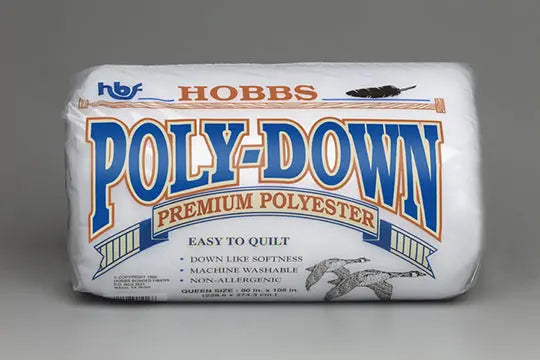
One last note: the product below is sheet batting for quilting — the starting material for scraps like these, not loose stuffing.
Shop Hobbs Polydown Batting Package — Crib 45" × 60" at Linda's Electric Quilters.


