
Hey everyone! Today you're going to learn how to make a whole-cloth quilt that lets one pretty fabric do all the talking.
Here we go.
Meet the fabric first
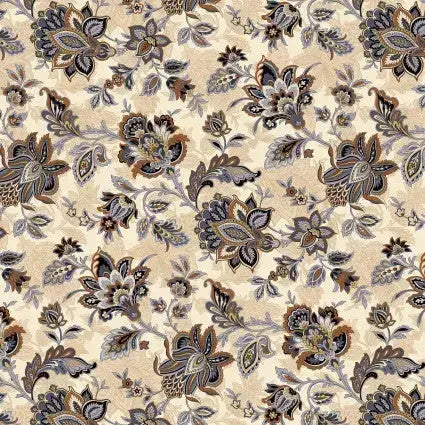
This is the Beige Footstool Cotton Wideback Fabric Per Yard from Benartex.
It is a cotton wideback.
That means it measures 108 inches wide.
Y'all, that width is the whole story here.
Most quilting cotton needs piecing.
This one does not.
The color is a soft beige.
The pattern is floral, with flowers worked across the surface.
It was designed by Pat Sloan for Benartex.
On a regular quilt top, a floral like this might get chopped up.
On a whole-cloth quilt, you get to see it.
Every flower stays whole.
Every repeat stays smooth.
Just like that, the fabric becomes the design.
Why this fabric suits a whole-cloth quilt
A whole-cloth quilt uses one single piece of fabric for the top.
No blocks.
No seams across the front.
Your quilting stitches become the pattern.
That is why width matters so much.
At 108 inches wide, one length can cover most quilt sizes without a center seam.
No seam means no bump under your quilting.
Your ruler work travels clean.
Your meander flows without stopping.
And that soft beige is really forgiving.
It shows texture beautifully in good light.
But it does not shout for attention.
Completely up to you how bold your quilting gets.
Materials list
- Beige Footstool Cotton Wideback Fabric — 2 1/2 yards for a throw about 60 by 72 inches, or 3 yards for a larger lap quilt about 72 by 90 inches
- Batting cut 4 inches bigger than your top on every side
- Backing fabric, also cut 4 inches bigger on every side — a second length of wideback works great here
- Thread to match or softly contrast with the beige
- Binding — about 1/2 yard of fabric, cut into 2 1/2 inch strips
- Pins or basting spray, a walking foot or your longarm, and a ruler you trust
If I can do this, y'all can do it.
We're not reinventing the wheel here.
Brief steps
- Press your wideback fabric well. Smooth out every fold line before you layer.
- Layer backing wrong side up, batting in the middle, and your whole-cloth top right side up. Keep that 4 inch overhang all the way around.
- Baste the layers. Pin every 4 to 6 inches, or spray baste in sections.
- Plan your quilting. You can stitch in the ditch around nothing here — there are no seams — so mark a simple grid, gentle waves, or big feathers first.
- Quilt from the center out. Start slow. Travel along your marked lines and echo them about 1/4 inch away for soft texture.
- Check the back every few passes. Smooth as you go.
- Trim the quilt square. Measure both diagonals so they match.
- Attach your binding with 2 1/2 inch strips, join the ends, and hand stitch or machine stitch it down.
Practical tips from my table
Take your time.
It's not a race.
A whole-cloth quilt lives or dies on the quilting, and quilting shows every rush.
Slow down on direction changes or the needle can snap on a thick, basted layer.
That is my honest warning, right at the moment of risk.
I have rushed a feather before.
Oh my goodness, I picked it out for an hour.
We fixed it the simple way.
We slowed down, we breathed, and we quilted one section at a time.
Try a sample sandwich first.
Use a 12 by 12 inch offcut, the same batting, and the same thread.
Check your tension there, not on the quilt.
You want balanced stitches, no loops on the back.
Another tip: let the floral guide you.
You can echo around a flower here and there.
You do not have to outline every single one.
A little echo quilting is super duper fun and it makes the flowers puff up just a bit.
And here is the permission part, folks.
It does not have to be perfect.
You are your own worst critic, I promise.
From six feet away, this quilt is going to look warm, soft, and really really good.
Step back and enjoy that view.
Alrighty, thank y'all so much for quilting along with me today.
We'll see you next time. Bye.
Shop the Beige Footstool Cotton Wideback Fabric Per Yard at Linda's Electric Quilters.


