
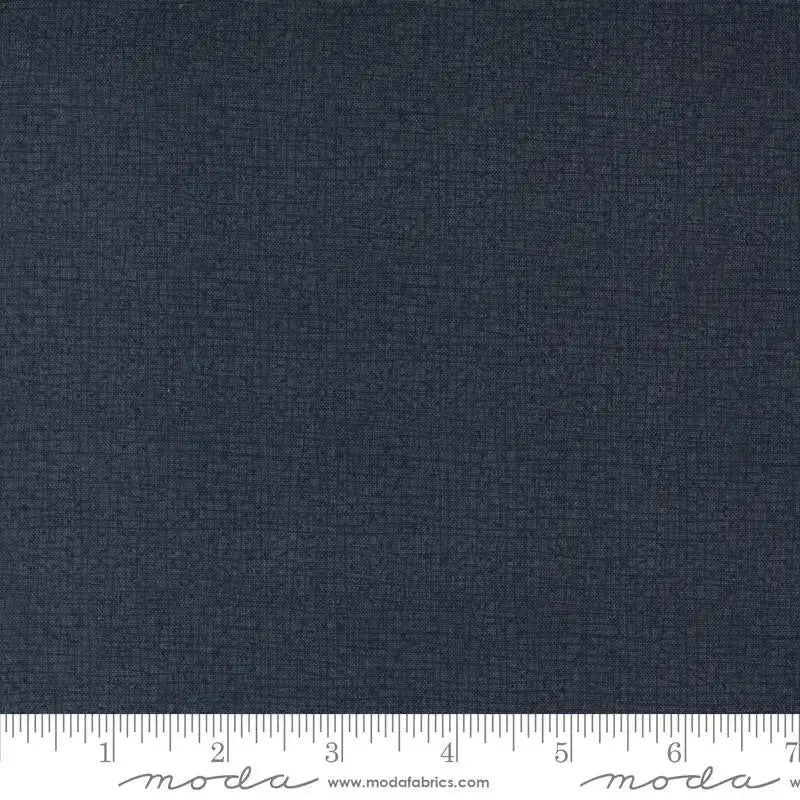
Thatched in Soft Black: A Textured 108-Inch Wideback for Seam-Free Quilt Backs
Most quilt backs are chosen in a hurry, but the back is half the quilt — it shows when the quilt is folded over a sofa or draped at the foot of a bed. A wideback gives a cleaner, easier finish, and a textured near-solid like Thatched in Soft Black gives that finish real character. Instead of a flat black that can look stark, Soft Black reads as a deep, softened black with a subtle woven-look texture, so the back feels designed rather than defaulted.
What This Fabric Is
Black Thatched Soft Black Cotton Wideback is a 100% cotton fabric from Moda Fabrics, sold by the yard, and it measures a full 108 inches wide. Thatched — the collection tagged here with designer Robin Pickens — is a textured basic: from a distance it reads as a solid, while up close a fine crosshatched texture adds depth and movement to the surface. The product listing classes it as a solid with texture, which is exactly how it behaves in a quilt. The Soft Black colorway keeps the drama of black but softens the edges, so it pairs more gracefully with prints than a harsh jet black would.
The headline number is the width. Standard quilting cotton runs about 44 inches wide, so backing even a throw quilt usually means seaming two or three lengths together. At 108 inches, a single width of Thatched covers most quilts edge to edge with no seam at all — and no seam means no bulky ridge down the middle of the back, no pattern matching, and a smoother surface for quilting.
What It Is Best For
Its first job is quilt backing, especially for modern and high-contrast quilts where a black back makes the quilting stitches show. It is an equally good choice behind quilts with dark bindings or black sashing on the front, because the back then echoes the front's palette instead of fighting it. Halloween, masculine, and minimalist quilts all sit naturally on a Soft Black back.
Do not reserve it only for backs, though. As a textured near-solid, Thatched also works on quilt fronts as a background for bright, saturated blocks — think jewel tones, neon accents, or bold white piecing that needs maximum contrast to pop. Cut it for binding and a strip of that fine texture finishes an edge with more interest than a flat solid. Because it is yardage rather than a precut, you can also take the wide width into home décor: whole-cloth throws, duvet backs, and large cushion covers all benefit from fewer seams.
How to Use It
Measure your finished quilt top, then add the overage your quilter requires — typically a few extra inches on every side, especially for longarm quilting — and order that length in one continuous piece where possible. Before loading or layering, press the wideback well and check for the fold lines that come from storage on the bolt; a thorough pressing with steam makes a wide piece far easier to keep flat and square. If you are quilting it yourself, the texture is forgiving: small shifts and minor imperfections in stitching are much less visible on a crosshatched surface than on a plain solid.
For color pairing, Soft Black is a team player. It grounds scrappy quilts with dark elements, cools down warm autumn palettes, and sharpens pastels by contrast. If black feels too strong across a whole back, piece a wideback panel alongside a leftover print strip from the front — the texture bridges the two gracefully.
Care
As a 100% cotton fabric, it cares for like the rest of your quilting cottons. Pre-washing is a sensible choice for a dark fabric like this, both to pre-shrink and to check colorfastness before it sits against a light quilt front. Wash finished quilts in cool water on a gentle cycle and dry on low heat to keep the black looking rich rather than faded.
Shop the Black Thatched Soft Black Cotton Wideback Fabric Per Yard at Linda's Electric Quilters.


