
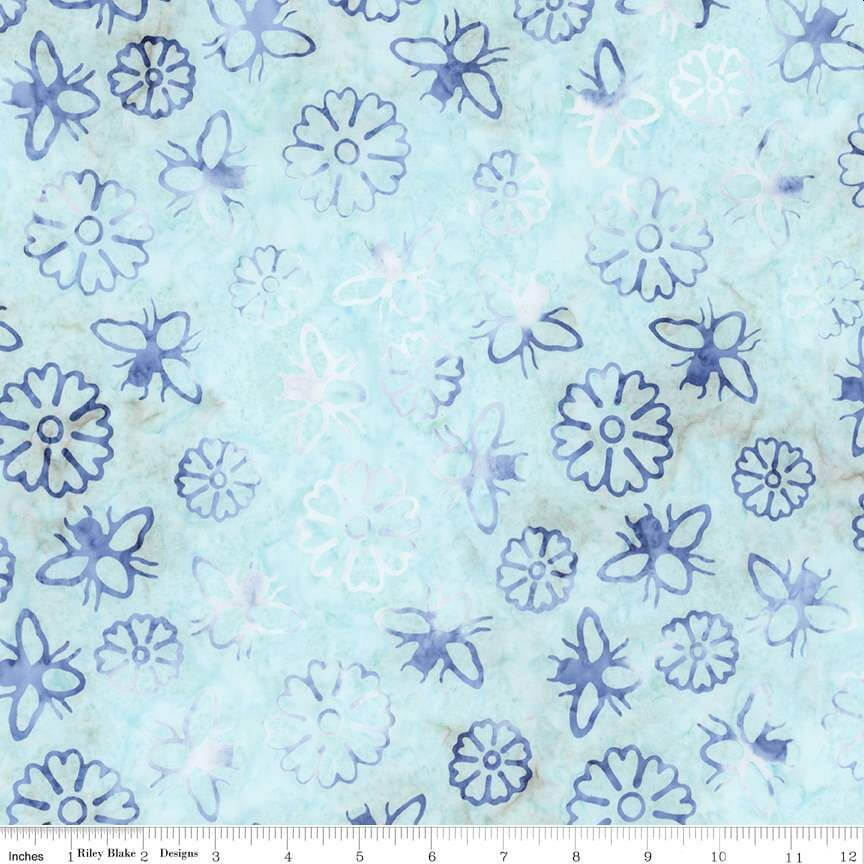
Painting with Fabric: How to Use Watercolor Daisies Batik in Caribbean Shale
Some fabrics behave like a print, and some behave like a painting. Expressions Batiks - Watercolor Daisies - Caribbean Shale, by Riley Blake Designs, falls in the second group. Its floral motif has the soft, blended look suggested by the name Watercolor Daisies, while the batik process gives the colour depth you do not get from a flat print.
What This Fabric Is
This is a handcrafted batik quilting cotton from the Expressions Batiks collection by Riley Blake Designs. It is 100 percent cotton, 45 inches wide, and sold by the yard in a continuous cut. It is made using traditional Tjap stamping, handcrafted in Indonesia, with rich colour saturation on cotton poplin.
Tjap stamping is part of what makes a batik a batik. A design is applied by hand, so small variations in colour and motif are a normal part of the cloth rather than a flaw. No two sections will be absolutely identical. That hand-made character gives a finished quilt movement — the surface shifts subtly as your eye moves across the blocks.
What It Is Best For
This fabric suits batik quilts and Expressions coordinates. Use it anywhere you want colour and floral interest without a hard, repeated pattern: large blocks, borders, backgrounds for appliqué, or a table topper or wall quilt.
Because the daisies are watercolor in feel, it also works as a blending fabric. From a distance it reads as rich, saturated colour. Up close, the floral detail rewards a second look. That makes it a strong choice for the largest pieces in a quilt, where a small, busy print might get lost and a solid might look flat.
How to Cut and Piece It
Start with larger cuts when you can. Chopping a watercolor floral into very small pieces can break up the motif so you lose the effect you bought it for. Try squares and rectangles that let part of a daisy show, half-square triangles with generous finished sizes, or strip sets that keep long runs of colour intact.
If you want to feature a particular cluster of flowers, fussy cut it. Lay a clear ruler over the yardage, move it until a pleasing group sits inside the frame, and cut one feature piece for a block centre or the middle of a table runner. Use the remaining yardage for supporting blocks — the colour ties the project together even when the motif is cropped differently in each piece.
Press and sew as you would for other quilting cottons, using a consistent seam allowance. Before you sew, lay pieces next to other Expressions coordinates and view them from a few steps back. Batiks can shift in apparent value depending on what sits beside them, and a quick audition saves unpicking later.
Pairing Colours and Care
The safest pairings come from the collection itself. Expressions coordinates are designed to work with prints like this one, so start there. Add one quieter fabric to give the eye a place to rest, and one deeper or lighter value for contrast. Pick up two or three tones you can see in your cut, and repeat each in at least two places in the quilt.
Rich colour saturation is a reason to pause before the first wash. Test a small offcut, especially if the quilt will combine this fabric with very light fabrics, and follow the care approach you use for other quilting cottons. Store leftovers out of strong direct light, and press before cutting so measurements stay accurate.
Project Ideas to Try
Make a throw from large squares alternating this fabric with quieter coordinates. Cut a wide strip as a border around a plain centre panel. Fussy cut feature squares for a table runner, or use a yard for a wall quilt where the fabric itself is the artwork and the quilting is kept simple.
Let the handcrafted surface lead — clear shapes and cuts big enough to show the daisies will do the work.
Shop the Expressions Batiks - Watercolor Daisies - Caribbean Shale 44" / 45" Fabric Per Yard at Linda's Electric Quilters.


