
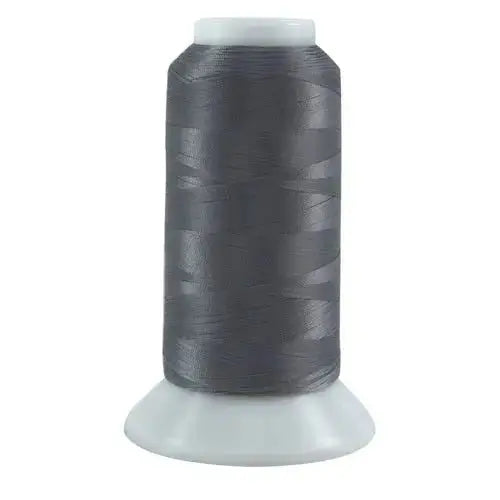
Some threads are meant to be seen. Others earn their keep by disappearing. Gray Bottom Line is firmly in the second camp: a fine, lightweight polyester thread whose job is to hold your work together without calling attention to itself — in the bobbin, under appliqué edges, and through dense, tiny quilting stitches.
What This Thread Is
Bottom Line is a 60-weight, 2-ply polyester thread, and this cone holds 3,000 yards. That 60-weight designation is the key fact: it is noticeably finer than the 40-weight threads most quilters reach for as top thread, and finer than a standard 50-weight piecing thread as well. The product description emphasizes that it is lint-free, and that its lightweight, blending colors are easily matched with any top thread. Gray is an especially useful blending color — a mid-tone neutral that sits quietly under a wide range of light, medium, and cool-toned fabrics instead of forcing a stark white or black line underneath them.
Because it is so fine, you will also wind more yardage onto each bobbin than with a heavier thread, which means fewer bobbin changes mid-project.
What It Is Best For
The description names this thread's strengths directly: it is designed for appliqué, bobbin thread, and quilting. In practice, that breaks down into a few jobs where a fine, lint-free thread has a real advantage:
- Bobbin thread — its standout role. Bottom Line makes a fantastic bobbin thread for any type of sewing, pairing under heavier or decorative top threads without adding bulk in the seam.
- Invisible appliqué and binding — the fine strand stitches through layers of fabric and sinks in at the edge, so the appliqué shape, not the stitching, is what you see.
- Micro-stippling — dense, tiny quilting needs a thread that will not build up into a heavy ridge where stitches crowd together. A 60-weight keeps that texture soft and close.
- English Paper Piecing — fine stitches through layers are exactly what hand-sewn EPP seams need to lie flat and stay discreet.
- Quilting where the thread should recede — background quilting and ditch work where texture matters more than a visible thread line.
How It Compares to Alternatives
Against a 40-weight polyester such as Glide or OMNI, Bottom Line is the quieter choice in every sense: finer, flatter, and without the sheen-forward presence those threads bring to a quilting line. Use the 40-weights when you want the stitching to show; use Bottom Line when you do not. Against a 50-weight blending thread like So Fine!, Bottom Line is a step finer still, which is why it is so often chosen for the bobbin even when a 50-weight is on top. And compared with cotton bobbin threads, its lint-free polyester construction keeps your bobbin area cleaner over a long project — less lint packed around the case means more consistent tension from the first bobbin to the last.
Tension and Needle Tips
Fine thread rewards a gentle setup. If you use Bottom Line in the bobbin under a heavier top thread, the finer bobbin thread usually needs the top tension loosened slightly so it is not pulled up through the fabric. Stitch a test sandwich and check both sides before starting. When Bottom Line is used on top — for appliqué or micro-stippling — choose a needle with a small, smooth eye appropriate for a fine thread, and reduce top tension a little so the lightweight strand is not strained. If stitches skip or the thread shreds, change the needle first; a worn eye is the most common culprit with fine threads.
Care and Storage
Store the cone upright, away from direct sunlight and dust, in a closed cabinet or box, and keep the loose end secured so the fine strand does not unwind and tangle — a 60-weight thread is harder to untangle than a heavier one. Finished quilts can be washed as their fabrics require; the fine polyester stitches hold through layers without adding weight or stiffness.
If you need a bobbin thread that blends under almost anything, this gray earns a permanent spot by your machine.
Shop the 622 Gray Bottom Line Polyester Thread at Linda's Electric Quilters.


