
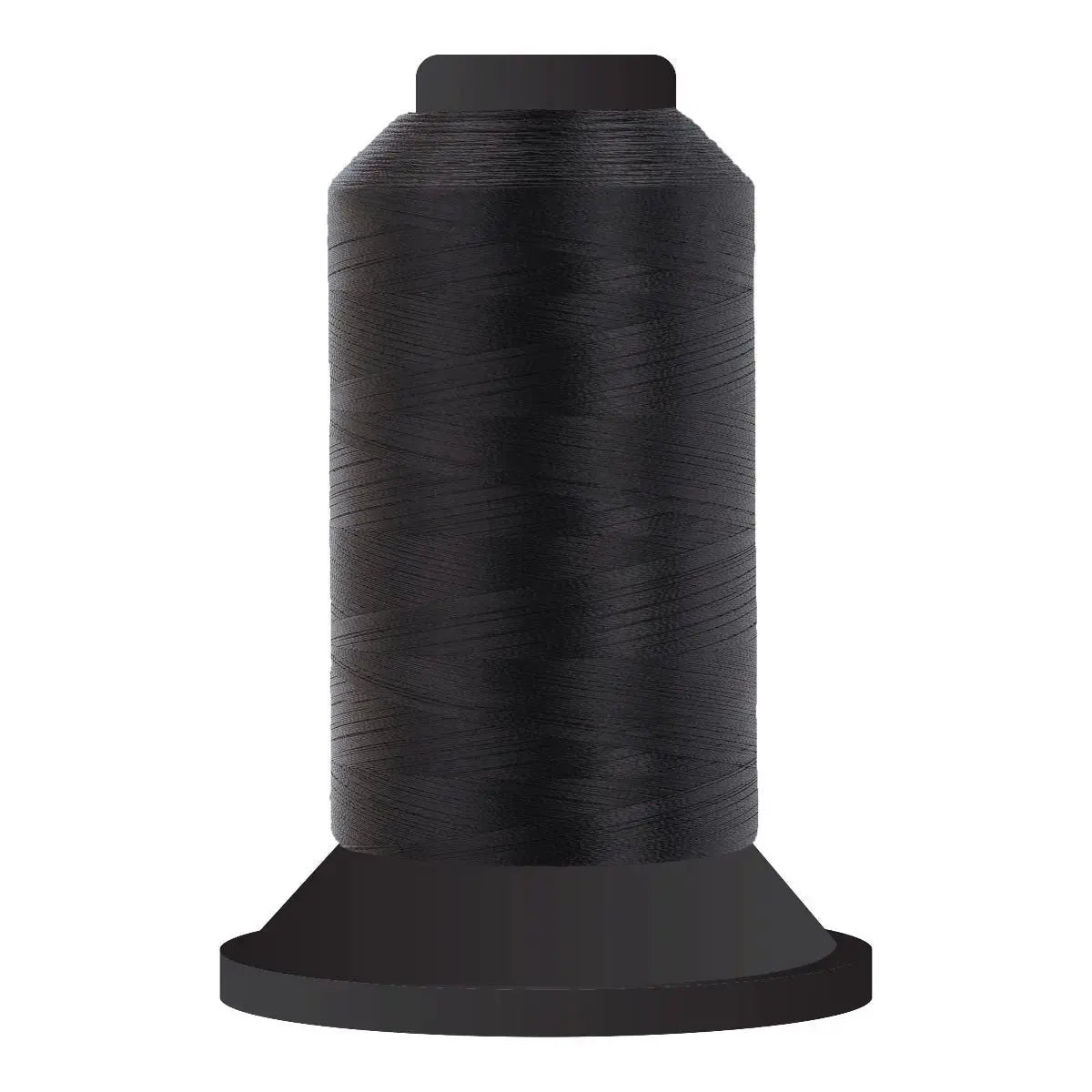
Most Glide threads in a quilting studio are 40 weight — bold enough to show, strong enough for production work. Glide 60 is the finer sibling, and this 11001 Black cone is where that fineness matters most: tiny lettering that stays legible, micro-stippling that adds texture without bulk, and fine-detail quilting where a heavier thread would overwhelm the design.
What Glide 60 Black Is
Glide 60 is a high-tenacity filament polyester thread in a 2-ply, 60-weight construction. That weight number is the key fact: the higher the number, the finer the thread, so 60 weight is noticeably thinner than a standard 40-weight quilting or embroidery thread. The product description highlights its very fine diameter and its tremendous bend-ability — the thread flexes around tight curves and sharp points instead of fighting them. It is also lint-free through the needle and tensioners, which keeps the thread path clean on long runs. This cone carries a generous 5,500 yards in color 11001 Black, a true, versatile black that anchors embroidery outlines, dark quilting, and bobbin work alike.
What It's Best For
The maker names three specialties: small letter embroidery, micro-stippling, and fine-detail quilting. Small letters are the classic fine-thread test — a heavy thread fills in the counters of letters like e, a, and s until they become blobs, while a 60-weight thread keeps those openings clear so words stay readable even at small sizes. In micro-stippling, the fine diameter lets you pack dense background quilting close to appliqué or feature motifs without building up stiffness or thread bulk. Glide 60 also works as both a top thread and a bobbin thread. Used in the bobbin, it lets you wind more yardage onto each bobbin and reduces how often you stop to change it — and in black, it is an unobtrusive bobbin choice under dark top threads.
How It Compares to Alternatives
Against standard 40-weight Glide, Glide 60 trades visible sheen and bold stitch definition for subtlety and detail: choose the 40 weight when you want quilting or embroidery to stand up and catch light across a surface, and choose Glide 60 when the stitching should refine a design rather than dominate it. Against a 50-weight blending thread such as So Fine!, Glide 60 is still finer, making it the better pick for the smallest lettering and the densest stippling. Against cotton threads, this filament polyester offers strength and a virtually lint-free run, which matters on detailed work where lint building up in the tension discs can change your stitch quality mid-design. The rule of thumb is simple: as the detail gets smaller, the thread should get finer.
Tension and Needle Tips
Fine thread rewards a lighter touch. Start with a smaller needle than you would use for 40 weight — many embroiderers and quilters pair 60-weight thread with a 75/11 or 80/12 embroidery or microtex needle, changing to a fresh needle if you see skipped stitches or fraying. Because the thread is thinner, you may need to loosen top tension slightly so stitches lock evenly rather than pulling tight and puckering delicate work; always test on a sample of the same fabric and stabilizer or batting first. Slow down a touch on the tightest curves and smallest letters, keep the cone feeding smoothly from a stand so the fine filament unwinds without snagging, and check that there are no rough spots in the thread path — fine thread finds burrs that heavier thread ignores.
Care and Storage
Polyester is colorfast and durable in the wash, so work stitched with Glide 60 Black can be laundered as the fabric itself allows — important for quilts that will be used, not just displayed. Store the cone upright, out of direct sunlight and away from dust and heat; a covered stand or closed cabinet protects the outer wraps over the months a 5,500-yard cone will last. Black shows dust more than most colors, so that cover matters doubly here. Slip a thread net over the cone if the filament tends to pool, and keep the color number, 11001, with the cone so matching it later is effortless.
Shop the 11001 Black Glide 60 Polyester Thread at Linda's Electric Quilters.


