
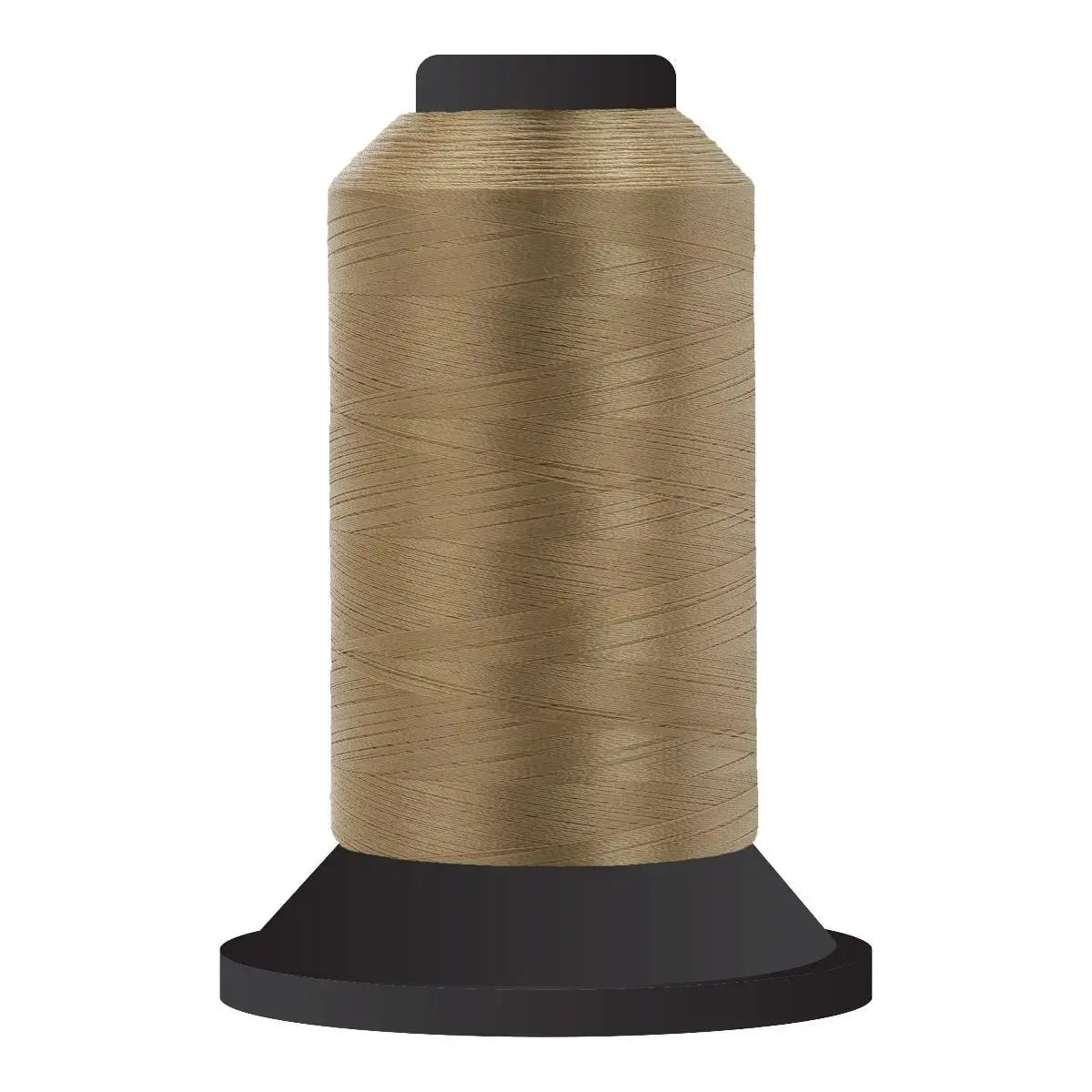
When the quilting gets tiny or the lettering gets small, a standard 40 weight thread can start to look crowded. Stitches bunch, curves lose their smoothness, and fine details fill in. Glide 60 was made for that work — and in Mocha, a warm tan neutral, it blends quietly into earth-toned fabrics.
What Mocha Glide 60 Is
Glide 60 is a polyester thread from the Glide family, built as a high tenacity filament thread. It is a 2-ply, 60 weight thread — noticeably finer in diameter than a 40 weight quilting or embroidery thread — and it comes on a generous 5,500-yard cone, so one cone carries you through a lot of detailed stitching.
Two qualities in the product description define how it behaves. First, it has tremendous bend-ability, which helps a very fine thread follow tight curves and sharp direction changes without fighting the machine. Second, it runs lint-free through your machine needle and tensioners.
Mocha is a soft, warm neutral in the beige-to-tan family, blending across creams, sands, browns, and muted earth tones without the stark contrast of white or the heaviness of black.
What It Is Best For
The description names three standout uses: small letter embroidery, micro-stippling, and fine-detail quilting. In small lettering, a finer thread keeps letter shapes open and legible instead of filling in counters and crowding serifs. In micro-stippling, its fine diameter lets dense background quilting recede, pushing the main motifs forward — exactly what background fill is supposed to do. For fine-detail quilting, it follows intricate designs cleanly while adding texture rather than a heavy thread line.
Glide 60 also makes a great top thread as well as a bobbin thread. Using it in the bobbin can help keep dense, detailed stitching balanced without building up bulk on the back of the work.
How It Compares to Alternatives
Compared with Glide 40, the original Glide line, Glide 60 is the finer, more delicate option. Glide 40 is the choice when you want coverage, sheen, and a stitch that shows with presence in embroidery and quilting. Glide 60 trades some of that presence for precision: less fill, cleaner tiny shapes, and quilting that reads as texture up close rather than bold lines from across the room.
Compared with a 50 weight blending thread, Glide 60 is finer still, which suits even smaller detail. Compared with cotton threads for micro-quilting, its lint-free polyester filament construction means less lint building up around the needle and tension discs during long, dense runs, and its bend-ability helps it handle the constant direction changes micro-work demands.
Tension and Needle Tips
A fine thread needs a lighter touch. Start with a test sample in the same fabrics and batting or stabilizer as your project, and check stitch balance on both sides before beginning the real piece. Because Glide 60 is so fine, small tension changes show up quickly in dense stippling, so adjust in small steps and re-test.
Use a fresh needle sized for fine thread and detailed work, and make sure the thread feeds smoothly and evenly from the cone. If you see breaks, first re-thread completely, check the thread path for snags, and slow down through tight curves — high tenacity helps, but sharp turns at speed are still hard on any fine thread. In the bobbin, wind evenly and avoid overfilling, which can upset tension in dense designs.
Care and Storage
Store the cone upright, away from direct sunlight and dust, ideally in a closed cabinet or box, and secure the loose end so this fine thread does not unwind or tangle between projects. Keep it away from rough edges that could nick the filament. Finished pieces benefit from your usual gentle quilt and embroidery care: wash according to the fabric's needs, and the polyester thread will hold its colour through normal use.
Shop the 20727 Mocha Glide 60 Polyester Thread at Linda's Electric Quilters.


