
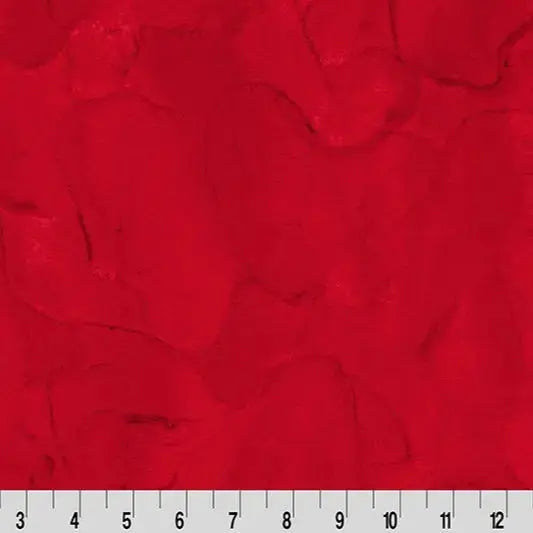
Some quilt backs are chosen to disappear quietly behind the top. A textured plush in a rich red does the opposite: it invites touch, and turns the back into part of the comfort — not just the finish.
What this fabric is
The Luxe Cuddle Hide Red Fabric, from Shannon Fabrics, is a 100% polyester Luxe Cuddle minky sold by the yard. Despite the name, no animal hide is involved — the “hide” is an embossed design worked into the plush surface, giving it a chic, textured, animal-hide look with a soft hand. Its pile height is 10mm, noticeably deeper and plusher than a smooth, short-pile minky, and that depth is what makes it feel so cosy in a finished quilt, blanket, or piece of home decor.
Be clear about the width, because it shapes your plan: this fabric measures 58/60 inches wide. It appears in this wideback series because quilters use it as a backing, but it is not a seamless 108-inch cotton wideback. Treat it as a generous standard-width fabric — ideal in a single width for baby quilts and throws, and straightforward to piece for larger quilts.
How much backing do you really need?
Start with the standard rule: your backing should measure your quilt top plus 8 inches in both directions — 4 extra inches on each side. That overhang lets a longarm quilter load and tension the layers securely, and gives a home quilter a margin if the sandwich shifts while quilting.
Now apply the 58/60-inch width. A 36 x 48 inch baby quilt needs a back about 44 x 56 inches, which fits in one width, so you simply buy the length — order 1 3/4 yards to allow for squaring the ends. A 50 x 60 inch throw needs a 58 x 68 inch back, right at the limit once selvedges are trimmed, so check usable width first or plan a narrow piecing strip. Anything wider needs two lengths joined: buy double the length, sew a generous seam, and keep the pile direction the same on both pieces so the red reads evenly.
Backing types feel different, too. A 108-inch cotton wideback is seamless, stable, and flat under quilting. Flannel adds warmth and a little grip that helps layers stay put. A plush minky like this one adds the most softness and drape, but its 10mm pile and slight give mean it rewards slower, gentler handling.
Working tips: folds, washing, and loading
Pressing the fold. Do not reach for a hot iron — heat can crush or damage polyester pile, and on a 10mm embossed surface the texture is the point. Hang the fabric so fold lines relax on their own, smooth them by hand in the direction of the pile, and use a seam roller for stubborn creases. If you must press, work only from the back on the lowest setting with a press cloth, lifting rather than sliding.
Prewashing. Polyester minky does not shrink the way cotton does, so prewashing is optional. If you do wash it before layering — for example, alongside a prewashed cotton top — wash it separately following the care directions below and let it dry completely before you build the sandwich.
Longarm loading. Pin the backing to the leaders evenly without stretching it — stretched plush relaxes after quilting and can pucker the top. Keep tension gentle and consistent, keep the pile direction consistent across any pieced seam, and baste the edges. Expect the deep pile to soften the look of quilting stitches, so an all-over design suits this backing well.
Care
Follow the manufacturer's directions exactly, because they protect the pile: machine wash cold with like colors, use no fabric softener, tumble dry with no heat, and use no dryer sheet. Softener and heat coat and flatten plush fibres, so skipping both is what keeps that 10mm texture soft and lofty.
Choose this backing when the quilt is meant to be held as much as it is looked at — a baby quilt to snuggle into, or a throw that lives on the sofa.
Shop the Luxe Cuddle Hide Red Fabric per yard at Linda's Electric Quilters.


