
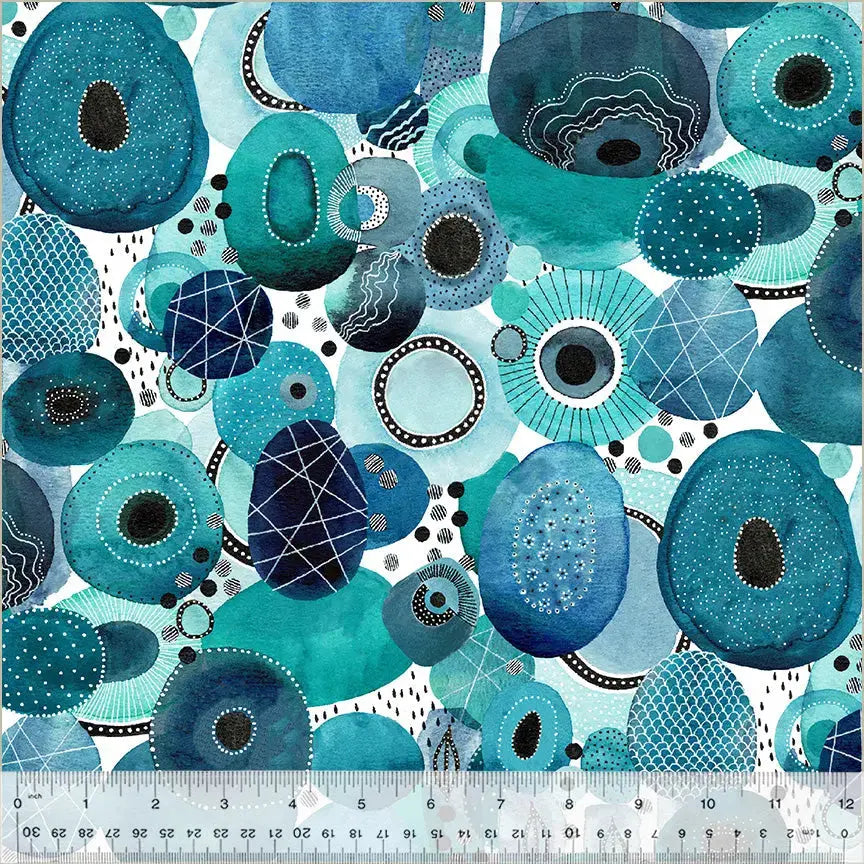
The back of a quilt is half the quilt — the side that wraps around shoulders and shows every time the quilt is lifted. For a blue, watery, or modern top, an aqua backing with soft abstract movement can finish the quilt as thoughtfully as the front, without fighting it for attention.
What this fabric is
The Blue Ebb & Flow Genesis Aqua Wideback Cotton Fabric, made by Windham Fabrics, is a 108-inch-wide, 100% cotton backing fabric sold by the yard. Its Ebb & Flow design is abstract, with bubble- and circle-like shapes in blue and aqua tones — gentle and flowing, reading as texture from a distance and as pattern up close. That kind of print is forgiving: it softens the look of a plain back and does not demand perfect pattern matching.
The width is the practical headline. At 108 inches, one width covers most throw, twin, double, and many queen quilt tops in a single piece — no centre seam, no piecing session, and no seam ridge running down the middle of the finished quilt.
How much backing do you really need?
Use the standard rule: your backing should measure your quilt top plus 8 inches in both directions — 4 extra inches on each side. That overhang gives a longarm quilter room to load, pin, and tension the layers, and it gives a home quilter a margin if the sandwich shifts slightly while quilting.
Work the numbers before you order. A 60 x 72 inch throw needs a back about 68 x 80 inches. The 108-inch width covers the 68-inch side with room to spare, so you only need the 80-inch length — just over 2 1/4 yards, rounded up to 2 1/2 yards so you can square the ends. An 80 x 90 inch quilt needs an 88 x 98 inch back, still inside one width, at about 2 3/4 to 3 yards. Only king-size tops wider than about 100 inches finished will outgrow a single width, and even then one seam in a wideback beats juggling several lengths of standard fabric.
Cotton, minky, or flannel?
Cotton wideback is the stable, familiar choice: it presses crisply, feeds evenly, and behaves like the quilting cotton on the front. Minky adds plush warmth, but it is a polyester plush with stretch and pile — wonderful for a cosy throw, less predictable for crisp, flat quilting. Flannel sits in between: brushed and warm, but it can shrink more and adds bulk. For most pieced tops, and especially for longarm quilting, a cotton wideback like this one is the lowest-surprise option.
Working tips
Press the fold out first. Wide cotton arrives folded, and a centre crease can survive quilting if you skip this step. Press the whole piece with steam before layering, working the fold line from both sides.
Decide on prewashing. Cotton can shrink slightly. If your quilt top is already washed, or you plan to wash the finished quilt often, a gentle prewash keeps everything shrinking together. If you prewash, trim the frayed edges and press again before measuring — always take your final measurements after washing, not before.
Square before you load. Check that the cut ends are on grain and trim them square. On a longarm frame, load the backing with the selvages running side to side, keep the tension even rather than tight, and let the extra 4 inches on each side do their job. On a home machine, roll the excess rather than bunching it, and support the weight so the quilt does not drag.
Care
As a 100% cotton fabric, this wideback cares for like other quilting cottons: wash the finished quilt in cool to warm water on a gentle cycle, and tumble dry low or line dry. The aqua and blue tones will stay truest if the quilt is washed with similar colours, especially for the first few washes. Press with a warm iron if you like a crisp finish.
Shop the Blue Ebb & Flow Genesis Aqua Wideback Cotton Fabric Per Yard at Linda's Electric Quilters.


