
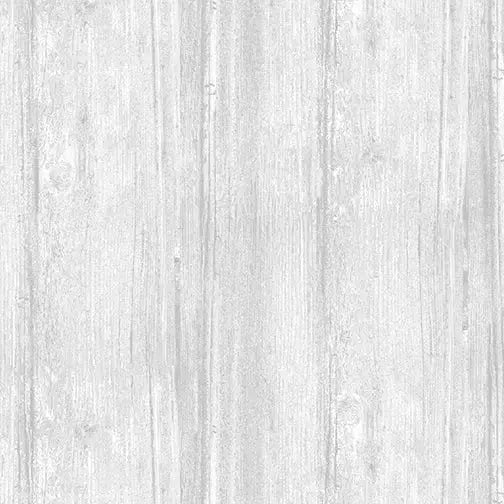
If you want a quilt that feels warm the moment you pull it up, the backing matters as much as the batting. A flannel wideback brings a soft, brushed surface to the underside, and when it comes 108 inches wide with a washed-wood look in soft grey, you get that coziness in one seamless piece — no piecing, no centre seam.
What this fabric is
The Grey Nickel Washed Wood Flannel Wideback Fabric, made by Contempo Studio for Benartex, is a 108-inch-wide cotton flannel backing fabric sold by the yard. Its fibre is cotton, finished as flannel, so it has the brushed, slightly fuzzy hand that distinguishes flannel from a smooth quilting cotton. The colour is Grey Nickel — a light, neutral grey — printed with a washed-wood effect, which gives the back visual texture without a busy, high-contrast pattern.
That texture is practical: it does not demand pattern matching, and it suits rustic, farmhouse, cabin, and modern neutral quilts alike. At 108 inches wide, most tops can be backed from a single width.
How much backing do you really need?
Use the standard rule first: your backing should measure your quilt top plus 8 inches in both directions — 4 extra inches on each side. That overhang lets a longarm quilter load and tension the layers, and gives a home quilter a safety margin if the sandwich shifts while quilting.
Then let the width do the math. A 60 x 72 inch throw needs a back about 68 x 80 inches. The 108-inch width covers the 68-inch side easily, so you only buy the length: 80 inches is just over 2 1/4 yards, so order 2 1/2 yards to allow for squaring the ends and any shrinkage if you prewash. An 80 x 90 inch quilt needs an 88 x 98 inch back — still inside one width, at roughly 2 3/4 to 3 yards. Only tops wider than about 100 inches finished will outgrow a single width of this fabric.
Cotton, minky, or flannel?
Smooth cotton wideback is the all-purpose choice: crisp to press, light, and predictable. Minky adds plush pile and drape, but its polyester surface can stretch and shift under the needle. Flannel sits in a different place altogether. Its brushed cotton grips the batting, which helps the layers stay put while you quilt, and it feels warmer and softer against the skin than smooth cotton. The trade-offs are weight and shrinkage: a flannel-backed quilt is noticeably heavier and cosier, and flannel can shrink more than quilting cotton — which is why how you prepare it matters.
Working tips
Prewash flannel. This is the one backing type where prewashing is close to essential. Washing and drying it before layering lets most shrinkage happen up front, removes loose surface fibres, and means the finished quilt is less likely to pucker unevenly in its first wash. Shake out lint and clean your lint trap after drying — new flannel sheds.
Press out the fold. Widebacks arrive folded, and a centre crease can set into flannel. Press the whole piece before layering, using steam and working along the fold line, and let it cool flat. Do not stretch the fabric as you press; flannel can distort if pulled while warm and damp.
Loading on a longarm. Keep the 4-inch overhang even on all sides and avoid over-tensioning. Flannel's grip is helpful here — it clings to the batting rather than sliding — but the same grip means you should smooth the layers carefully as you advance, rather than tugging the back tight to fix a wrinkle.
Care
Care for a flannel-backed quilt gently: wash cool on a gentle cycle and tumble dry low or line dry. Expect a little lint in the first few washes as the brushed surface settles. Mid-tone greys are forgiving in everyday use, showing less fading and lint than very dark or pale backings.
Shop the Grey Nickel Washed Wood Flannel Wideback Fabric Per Yard at Linda's Electric Quilters.


