
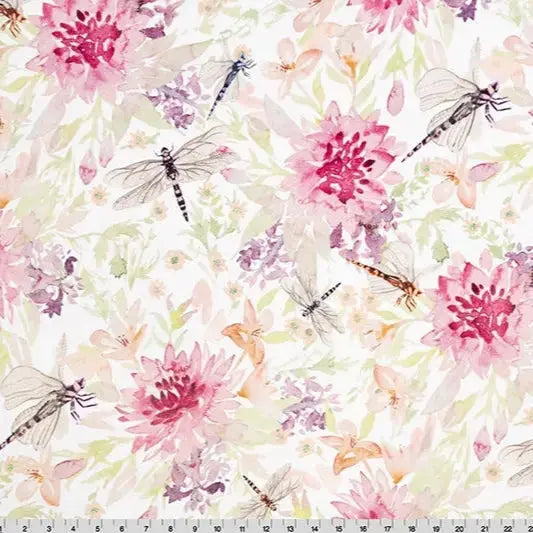
Why a Dragonfly Print Belongs on the Back of a Quilt
A quilt back does not have to be an afterthought. The Multi Wild Dragonfly Digital Cuddle Elderberrry Fabric from Shannon Fabrics is a Digital Cuddle minky plush, sold per yard, with beautiful dragonflies peacefully flying amongst pastel tones. Turn a quilt over to that, and the back becomes part of the gift — especially for a throw or a child's quilt that will be handled and snuggled as much as it is looked at.
Digital Cuddle is Shannon Fabrics' printed minky line, so you get two things at once: a detailed print and the short, velvety plush surface minky is known for. As a wideback-category backing, its job is to cover a top in as few pieces as possible — ideally one seamless piece, with no center seam to line up.
How Much Backing Fabric Do You Really Need?
Start with the standard size math: your backing should measure your quilt top plus 8 inches in both width and length — 4 extra inches on each side for longarm loading, shifting, and quilting take-up. A 60 x 72 inch throw needs a backing of at least 68 x 80 inches. A 72 x 84 inch quilt needs an 80 x 92 inch backing.
Lay that required size against the width of the fabric on the product page before you order. If one width covers the shorter side, you only need yardage for the longer side: divide that length in inches by 36 and round up — 80 inches is about 2 1/4 yards. If your top plus 8 inches is wider than a single width, you will need to piece the backing. Measure first, and confirm your longarmer's requirements.
Cotton vs. Minky vs. Flannel: Choosing Your Backing
A 108-inch cotton wideback is crisp, stable, and breathable. It feeds smoothly, holds a press, and gives quilting stitches clean definition. Minky like this Digital Cuddle is the comfort choice: plush, warm, and soft against the skin, but with stretch and slip that cotton does not have, so it asks for slower handling and moderate tension. Flannel sits in between: warmer than quilting cotton, with a brushed surface that grips batting, but it can shrink noticeably and adds bulk.
Choose minky when the quilt's job is comfort — a baby quilt, a reading throw, or a bed quilt for someone who runs cold. The gentle dragonfly-and-pastel print suits that brief: soft in color as well as in hand, and pretty whether the quilt is spread out or folded over a chair.
Working Tips: Pressing the Fold, Prewashing, and Longarm Loading
Backings arrive with a fold line from the bolt. With minky, do not attack that fold the way you would with cotton — high heat and direct pressure can crush the plush pile. Let the fabric relax flat first; if a crease remains, use low heat on the wrong side with a press cloth.
Prewashing is usually a skip for minky, which shrinks very little compared with cotton. If you normally prewash your cotton top, do so before pairing it with a minky back, so the two layers behave more alike in the finished quilt's first wash. When you cut, lay minky flat, smooth it gently without stretching it taut, and use a fresh rotary blade — minky shifts as you handle it.
For longarm loading, load minky with its stretch running across the frame and keep tension moderate. Over-tensioning can leave puckers once the quilt comes off the frame and relaxes. Moderate, even quilting — an allover meander or a larger-scale motif — shows off a printed minky best; very dense quilting flattens the pile and stiffens the drape.
Care
Wash a minky-backed quilt cold on a gentle cycle and tumble dry low, following the care guidance on the product page. Skip fabric softener and dryer sheets, which coat plush fibers and dull their softness over time, and never iron the plush side.
Shop the Multi Wild Dragonfly Digital Cuddle Elderberrry Fabric per yard at Linda's Electric Quilters.


