
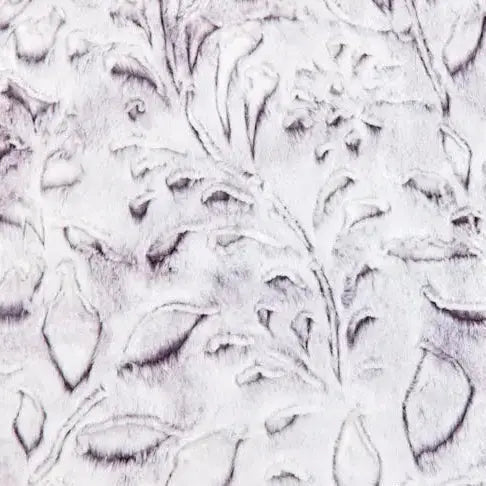
A Garden Print You Can Sink Your Hand Into
Some quilt backs are chosen for color, and some are chosen for touch. The Luxe Cuddle Prism Poppy Berrylicious Fabric per yard, made by Shannon Fabrics, is chosen for both. It is a Luxe Cuddle minky plush — 100% polyester with a generous 10mm pile and a substantial 530 grams per linear yard — printed with a pattern of leaves and stems that the product description calls nature's refined beauty meeting renowned comfort. Its two-tone Berrylicious palette gives the garden motif depth and dimension, so the back of your quilt reads like a blooming garden rather than a flat afterthought.
One honest note before the math: unlike the 108-inch cotton widebacks in this series, this fabric is 58/60 inches wide. That is still far wider than standard quilting cotton, and it changes how you plan — it does not change whether the finished quilt is worth it.
How Much Backing Do You Really Need?
The rule is the same for every backing: start with your finished quilt top and add 8 inches to both dimensions, giving you at least 4 extra inches on every side for longarm clamping, loading, and the slight take-up that happens as quilting draws the layers together. Your backing should measure top width + 8 inches by top length + 8 inches, at minimum.
Now apply the width. With 58/60 inches to work with, one seamless width backs a top up to about 50 inches wide. A 42-by-54-inch baby quilt needs a 50-by-62-inch backing: one width covers it, and 62 inches is about 1.73 yards, so order 2 yards for trimming room. A 60-by-72-inch throw needs 68 by 80 inches — wider than one width — so plan on piecing: buy two lengths and sew them together with the seam running down the center of the back, or use this plush as the feature panel of a pieced backing. Measure first, and let the numbers, not habit, decide the yardage.
Cotton vs. Minky vs. Flannel
Cotton wideback is the stable classic: crisp, low-stretch, and seamless at 108 inches, but cool and smooth rather than cuddly. Flannel is brushed cotton — cozy and grippy, with more shrinkage and a thinner, flatter hand.
Minky like this Luxe Cuddle is a different experience entirely. The 10mm pile and heavier weight make the finished quilt warmer, softer, and noticeably more substantial draped over a lap. The trade-offs are real: it has some stretch, the pile has a direction, and at 58/60 inches wide it is not a one-width answer for a queen top. Choose it when comfort is the point of the quilt — baby quilts, throws, and gifts meant to be grabbed daily — and choose cotton when you need maximum width and stability.
Working Tips for a Smooth Finish
Mind the nap. Run your hand across the fabric before cutting: the pile lies smoother in one direction, and you want that direction running head-to-foot on the finished quilt. Mark the top edge with a pin so the direction survives loading. Do not press the pile with a hot iron — instead, shake out fold lines, smooth the fabric flat by hand, and let it relax before layering. Prewashing is optional with polyester minky, since it does not shrink the way cotton does; if you wash, follow the care directions below and re-measure before you cut.
On the longarm, load minky gently. It stretches more across its width than along its length, so pin evenly, avoid pulling it drum-tight, and keep tension even rather than tight — over-tension is what makes plush backs pucker. A center seam on a pieced backing should be pressed open and loaded so it lies flat under the quilting.
Care
Follow the manufacturer's directions exactly: machine wash cold with like colors, use no fabric softener, tumble dry with no heat, and use no dryer sheet. Softener and heat coat and flatten minky pile, so skipping both is what keeps that 10mm plush lofty wash after wash.
Shop the Luxe Cuddle Prism Poppy Berrylicious Fabric per yard at Linda's Electric Quilters.


