
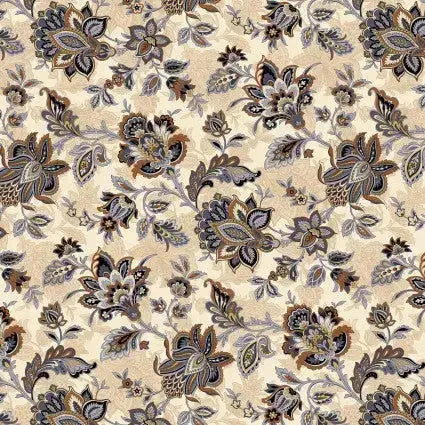
Backing a Quilt Without Piecing: What a 108-Inch Beige Cotton Wideback Does Best
Every quilt top needs a back bigger than the top on every side. Piecing one from standard-width fabric means measuring, seaming, and pressing long joins — then hoping they sit flat under the quilting. A wideback removes that step. The Beige Footstool Cotton Wideback Fabric from Benartex, designed by Pat Sloan, is a 108-inch cotton sold by the yard, so most tops are covered by a single, seamless piece cut to length.
What This Fabric Is
This is a quilting cotton at a true wideback width: 108 inches from selvage to selvage. The color is a warm beige — a quiet, neutral ground that sits comfortably behind scrappy tops, warm palettes, traditional blocks, and low-volume quilts alike. Because the back is one continuous piece, there is no center seam to align, no seam ridge for a longarm roller to catch on, and no pattern matching. A neutral back also shows quilting texture beautifully: stitch definition, rather than print, becomes the feature on the reverse side.
Size Math: Top Plus Eight Inches
The working rule for backing is simple: your backing should measure your quilt top plus 8 inches in both directions — 4 extra inches on each side. That overhang gives a longarm quilter room to pin and clamp, and it gives you margin at home if the top shifts slightly while basting.
So a 70 by 84 inch quilt needs a back at least 78 by 92 inches. With a 108-inch width, the width is already covered, and you need 92 inches of length — just under 2.75 yards, so order 3 yards to be safe. A 90 by 96 inch bed quilt needs a 98 by 104 inch back: the 108-inch width still covers it, and 3 yards gives you 108 inches of length. Only very large or extra-wide tops outgrow a 108-inch backing, which is why this width has become the practical standard.
Choosing Cotton Over Minky or Flannel
Cotton, minky, and flannel all make good backs — for different quilts. Cotton is the versatile default: it feeds evenly, presses crisply, adds no bulk or stretch, and suits quilts washed and used year-round. Minky adds warmth and softness but brings stretch and nap that need careful handling. Flannel sits between the two, cozy and forgiving, but thicker and warmer in use. For a beige, goes-with-everything backing, cotton is the calm, predictable choice.
Working Tips
Press the fold. Yardage arrives folded, and a 108-inch cotton can hold a sharp center crease. Press the whole piece before loading, working the crease out with steady heat rather than stretching the fabric.
Consider prewashing. Cotton can shrink slightly. If your top is unwashed and you prefer both layers to behave the same way after the first wash, prewash the backing; if you like the soft crinkle a first wash creates across the whole quilt, skip it — just be consistent.
Loading on a longarm. Check that the edges are cut reasonably straight, load the backing with the selvages at the sides, and confirm the extra 4 inches extend beyond the top on every side before you begin. A seamless back loads faster and rolls more evenly than a pieced one.
Care
Once quilted, care follows the quilt itself: wash gently in cool to warm water, dry on a low to medium setting, and remove promptly. A cotton back softens with use while keeping its shape, so the quilt drapes the same way in year five as it did on day one.
A good backing rarely gets the compliments — the top takes those. But a wide, neutral cotton back is what lets the quilting finish cleanly, and that is exactly the job this one is built for.
Shop the Beige Footstool Cotton Wideback Fabric Per Yard at Linda's Electric Quilters.


