
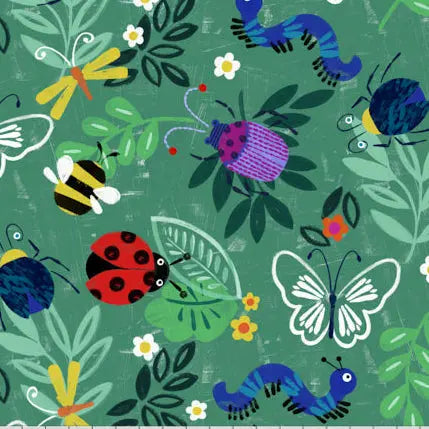
Some quilt backs are meant to be quiet. This one is meant to be discovered. Flip a child's quilt over and there they are — colourful garden bugs wandering through leafy greenery, soft enough to trace with a fingertip. A playful back like this turns the reverse side of a quilt into part of the fun.
What This Fabric Is
The Multi Doodle Bugs Digital Cuddle Fabric, by Shannon Fabrics, is a digitally printed Cuddle minky plush. Its description highlights a lively collection of colourful garden bugs and delightful greenery, printed digitally on a 2.5mm pile fabric with the ultra-soft, smooth texture Cuddle minky is known for. The product tags list it as 100% polyester, and it is sold by the yard at 58/60 inches wide.
That width matters, and it is worth being clear about it: this is not a 108-inch cotton wideback. At 58/60 inches it is generously wide for baby quilts, children's throws, pillows, play mats and bags — the very projects its description suggests — but a large bed quilt back will need a seamed panel or a different, wider backing.
How Much Backing Do You Really Need?
Start with the standard rule: your backing should measure your quilt top plus 8 inches in both dimensions — about 4 inches of overhang on every side. That extra room lets a longarm quilter load and clamp the quilt without running short, and it helps on a domestic machine too.
Now check it against the 58/60-inch width. A baby quilt top up to about 50 inches wide can be backed in a single width once you add the 8 inches. For length, divide the required backing length by 36 to get yards: a 40 by 50 inch baby quilt needs a backing about 48 by 58 inches, so 1.75 yards is comfortable. A 50 by 60 inch throw needs about 58 by 68 inches — right at the limit of the width, so order 2 yards and check your usable width after squaring up. Anything wider than about 52 inches means piecing two lengths together, turning the fabric, or choosing a 108-inch cotton wideback instead.
Cotton, Minky, or Flannel?
Cotton wideback is the all-purpose choice: stable, breathable, 108 inches wide, and easy to press and quilt. Minky like this Digital Cuddle is the cosy choice — plush, smooth and warm, and wonderful against skin, which is why it suits baby quilts and play mats so well — but it is stretchier and thicker to handle than cotton. Flannel sits between them: brushed and warm, but prone to more shrinkage and bulk. For a child's quilt that will be dragged, snuggled and washed often, minky's softness usually wins the argument.
Working Tips
Check the pile direction before you cut: the bugs and greenery should all run the same way, and the smooth pile should feel consistent across the piece. Smooth out the fold line gently rather than pressing hard on the pile — a hot iron pressed flat can crush minky's texture, so use low heat, work from the back, or let the crease relax under the quilt's own layers.
Prewashing is your choice with polyester minky: it does not shrink the way cotton or flannel can, so many makers skip it, but a first wash removes any surface finish. When loading on a longarm, pin the minky without stretching it, keep tension even, and let the 4 inches of overhang do its job — pulled tight on the frame, minky can relax and shift once the quilt comes off. Cut with a rotary cutter on a mat to keep the plush edges clean.
Care
Finished quilts and play mats backed in minky are made to be used and washed. Wash cold on a gentle cycle and tumble dry low, which helps the pile stay soft and smooth. Avoid high heat, which is minky's main enemy over time. Follow any specific care instructions on the product page for this fabric.
Shop the Multi Doodle Bugs Digital Cuddle 58/60" Fabric Per Yard at Linda's Electric Quilters.


