
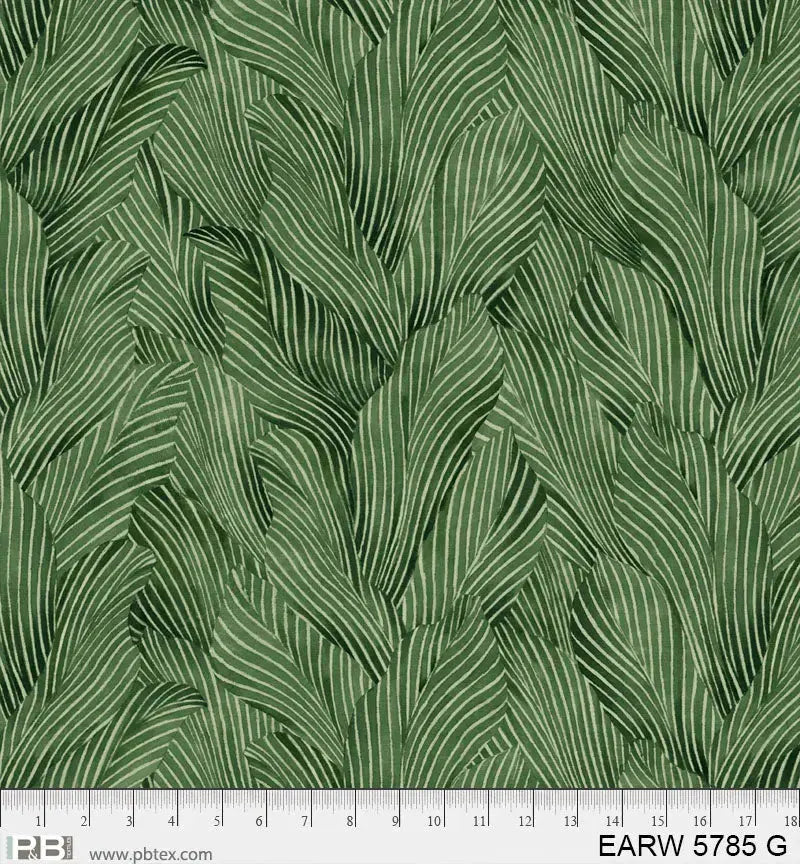
Some quilt backs disappear quietly behind the top. Others bring their own character. A leafy, textural print in rich earth tones does the second job beautifully — it finishes the back with warmth and movement, and coordinates with many tops without needing an exact match.
What this fabric is
The 108" Earth Tones Green Leaf Cotton Wideback Fabric, made by P&B Textiles, is a 108-inch cotton wideback sold by the yard. Its design is a leaf-like, textural print, and the product description notes that its 15 rich, earthy colors provide many options for your next project. That multi-color, nature-inspired surface is the key to its versatility: greens and earth tones pick up the foliage, landscape, and warm neutral tones found in so many quilt tops.
As a cotton wideback, it behaves like the quilting cotton in most quilt tops — stable, smooth, and easy to press — but at 108 inches wide it covers most quilts in a single width, with no pieced seam down the middle of the back. The description also suggests using it beyond quilt backs, for curtains or a duvet cover, where that same generous width and leafy print work just as well.
How much backing do you really need?
Use the standard rule: your backing should measure your quilt top plus 8 inches in both directions — 4 extra inches on each side. That overhang gives a longarm quilter room to load, clamp, and tension the layers, and gives a home quilter a safety margin if the sandwich shifts slightly while quilting.
With 108 inches of width, a quilt top up to about 100 inches wide can usually be backed in one width. For example, a 72 x 84 inch quilt needs a back about 80 x 92 inches. One width covers the 80-inch side easily, and the 92-inch length is just over 2 1/2 yards — round up to 2 3/4 or 3 yards so you can square the ends and allow for any shrinkage. Measure the finished top first, add 8 inches both ways, divide the length by 36, and round up to a practical cut.
Because this print is textural rather than a strict directional stripe, it is forgiving if you need to rotate it, but check the leaf direction before cutting if you want the foliage running a particular way on the finished quilt.
Cotton vs. minky vs. flannel
Choose a cotton wideback like this one when you want structure, crisp quilting definition, and predictable handling. Cotton is the natural partner for a cotton top, loads evenly on a longarm frame, and lets quilting stitches show cleanly — an advantage with a textural print, where the stitching adds a second layer of pattern.
Choose minky when softness and drape matter most; it is a plush polyester with some stretch, so it needs careful pinning and lighter tension. Choose flannel for extra warmth and a brushed surface, allowing extra yardage because flannel can shrink more. For nature-themed and everyday quilts alike, cotton remains the simplest choice.
Working tips
Widebacks arrive folded, and the center fold can be stubborn. Press the whole piece before loading, working the fold with steam and letting the fabric cool flat; a light mist of water and a second press usually relaxes a resisting crease. Square the cut ends before measuring so your yardage math stays honest.
Prewashing is a personal choice, but be consistent: if the top fabrics were prewashed, prewash the back; if not, most quilters load it unwashed so everything shrinks together in the finished quilt's first wash. Press after washing either way.
For longarm loading, center the backing, keep the selvages even, and roll it on under smooth, consistent tension without stretching. With no center seam, there is no bulky ridge to plan around.
Care
Care for the finished quilt as you would other cotton quilts: wash in cool water on a gentle cycle and tumble dry on low or line dry. Cotton softens with washing while holding its shape, suiting a quilt meant to be used and loved.
Shop the 108" Earth Tones Green Leaf Cotton Wideback Fabric per yard at Linda's Electric Quilters.


