
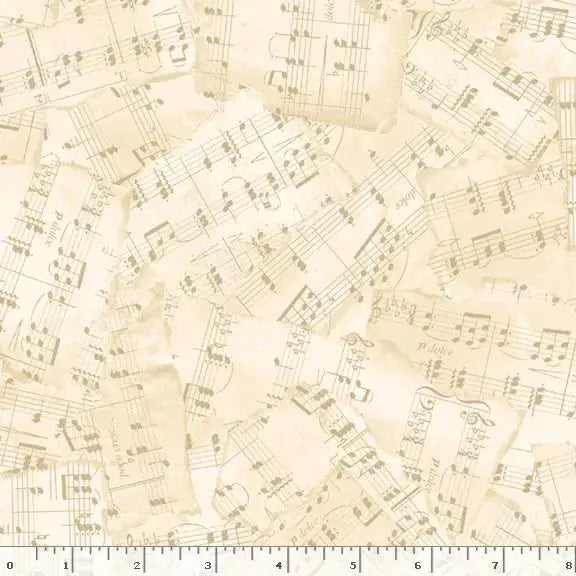
Music Notes on Cream: Backing a Quilt With a Seamless Cotton Wideback
If you have pieced a quilt for a musician, singer, or piano teacher, you know the back deserves a theme too. Cream Music Notes Cotton Wideback Fabric is a cotton wideback sold by the yard, so most quilts can be backed in a single piece — no centre seam to match, no seam line to feel through the quilt, and a print worth looking at when the quilt is folded back.
What This Fabric Is
According to its product listing, this fabric is 108/110 inches wide, made of cotton, and produced by Marcus Fabrics. It belongs to the Scarecrow's Song collection, designed by Lisa Norton and Lora Zmak. The ground is cream, with a music-notes theme — a light, neutral backing that pairs easily with many quilt tops while adding a clear musical character on the reverse. Because it is a true wideback, the print runs across the full width in one panel. That matters for a motif like music notes: you do not have to try to line up notes and staff lines across a pieced seam, and the direction of the print stays consistent from edge to edge.
A cream ground is also practical: it sits quietly behind light and medium tops, supports brighter tops without competing, and shows quilting stitches in a gentle, readable way.
How Much Backing Do You Really Need?
Start with your quilt top and add 8 inches to both dimensions — 4 inches of extra backing on every side. That overhang gives a longarm quilter room to load, clamp, and advance the quilt, and it gives home quilters margin for slight shifting while basting.
For example, a 60 x 72-inch throw needs a backing at least 68 x 80 inches. At 108/110 inches wide, this covers the 68-inch width in one panel. For length, 80 inches is about 2.25 yards, so order 2.5 yards. A 90 x 96-inch queen needs 98 x 104 inches: the width still fits, and you would order about 3 yards. Check the direction of the notes before ordering, so they read upright as planned.
Cotton, Minky, or Flannel?
Choose a cotton wideback like this one when you want the widest single panel, a smooth hand that presses and quilts predictably, and a printed back that becomes part of the design. Choose minky when the back should be the cosy side — it is plush and warm, but typically narrower, heavier, and a little stretchy to handle. Choose flannel when you want cotton-based warmth with a brushed, flatter feel, keeping in mind it will not give you the same crisp, smooth finish as a plain cotton wideback. For a theme quilt where the back should be seen, cotton is usually the clearest choice.
Working Tips: Folds, Prewashing, and Loading
Pressing the fold: Wide cotton arrives folded, with a crease down the centre. Press from the wrong side with a warm iron and steam, working in sections rather than dragging across the full width. Let it cool flat before measuring.
Prewashing: Cotton can shrink slightly, so many quilters prewash a wideback, especially if the top was not prewashed. Wash cool and gentle, dry on medium, and press before loading — squaring is easier on a table than on a frame.
Longarm loading: Check the fabric is square before pinning or floating it, and trim a straight edge if the cut is off-grain. Centre the width so overhang is even, and confirm the notes run the way you want before the first pass.
Care
Care for the finished quilt the way you would other cotton quilts: wash cool and gentle, and tumble dry low or line dry to protect the fibres and the quilting stitches. The cream ground and printed notes will soften gradually with washing, like any well-loved cotton quilt back.
Shop the Cream Music Notes Cotton Wideback Fabric Per Yard at Linda's Electric Quilters.


