
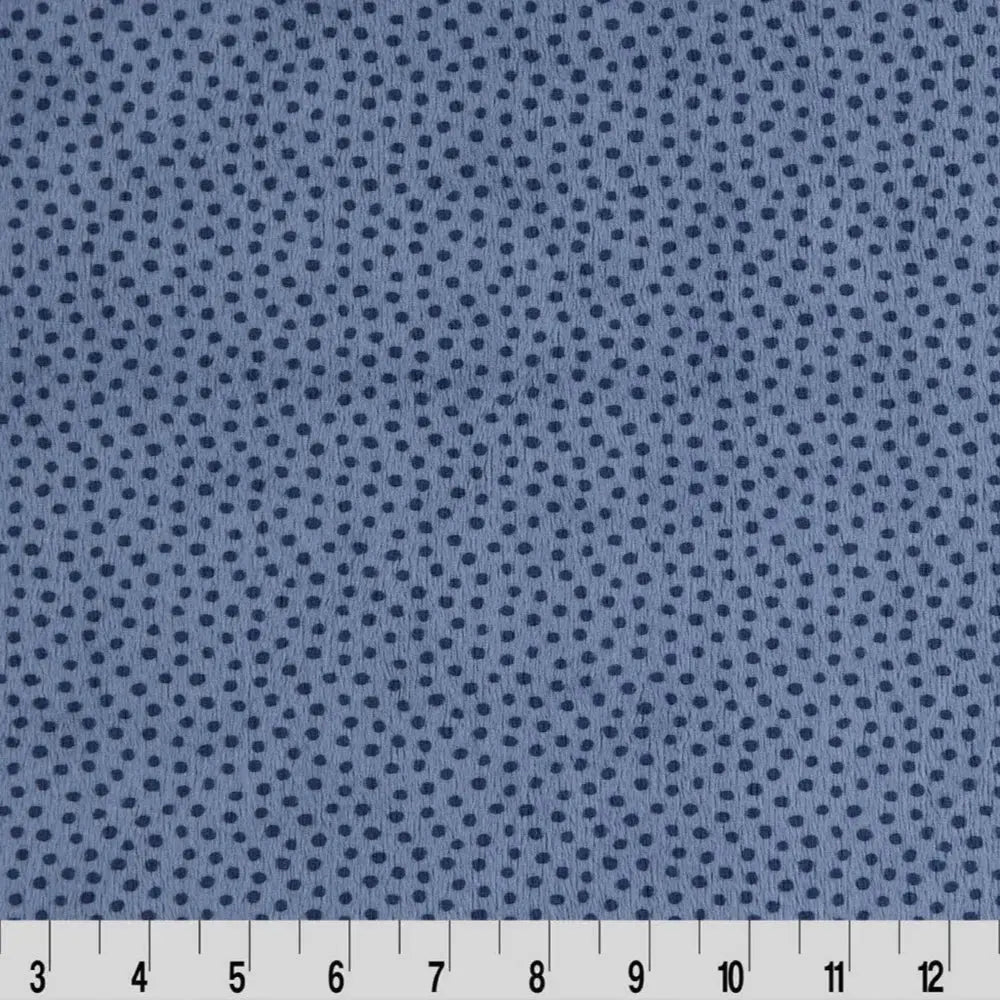
Some quilt backs are chosen for neutrality, and some are chosen for joy. A blue minky covered in playful dots belongs firmly in the second camp — soft enough that people reach for it, cheerful enough that the back gets compliments of its own, and wide enough to cover most quilts in a single, seamless panel.
What This Fabric Is
The Blue Extra Wide Dottie Cuddle Jeans Fabric, from Shannon Fabrics, is an Extra Wide Dottie Cuddle minky plush featuring a playful dot print. The print is digitally printed on a 3mm pile fabric, so the dots sit on that familiar ultra-soft, smooth Cuddle minky texture rather than on a flat quilting cotton. It is 100% polyester, weighs 360 grams per linear yard, and — most importantly for a backing — comes in a wide width of 88 to 90 inches.
That width is the whole point of a wideback. Instead of piecing two or three lengths of standard-width fabric and trying to keep a seam straight and flat, you load one continuous piece. Shannon Fabrics describes this fabric as perfect for quilts, throw blankets, backings, and long-arm quilting, and its blue jeans colorway makes it an easy match for denim-look tops, kids' quilts, and any project where a solid back would feel a little too plain.
How Much Backing Fabric Do You Really Need?
Use the standard size math: your backing should measure your quilt top plus 8 inches in both width and length — roughly 4 extra inches on each side for longarm loading, clamping, and take-up during quilting.
For example, a 60 by 72 inch throw needs a backing of at least 68 by 80 inches. Against an 88- to 90-inch width, that fits comfortably in one panel, so you order for length only: 80 inches is about 2 1/4 yards, rounded up. A larger top at 75 by 90 inches needs a backing of at least 83 by 98 inches — still within this width, at about 2 3/4 yards. If your top plus 8 inches is wider than about 88 inches, measure again before ordering: you may need to piece, turn your plan, or choose a 108-inch cotton wideback instead.
Cotton vs. Minky vs. Flannel: Choosing Your Backing
A 108-inch cotton wideback is the stable, all-purpose choice: breathable, crisp to press, and low-stretch, which makes it forgiving to load. Flannel sits in between — warmer than quilting cotton, with a brushed surface that grips batting, but more prone to shrinkage and a little bulkier in the seam allowances.
Minky like this Dottie Cuddle is the comfort choice. The 3mm plush pile adds warmth and a soft hand that is hard to beat for baby quilts, throws, and quilts meant to be cuddled under rather than displayed. The trade-offs are handling: polyester minky has more give than cotton, the pile can shift under the presser foot, and it adds a little more drape and weight. If the quilt will be loved, dragged around, and washed often, that softness is usually worth the extra care in handling.
Working Tips for a Smooth Finish
Wide minky arrives folded, and the fold deserves respect. Unfold it fully and let it relax before you measure and cut. Avoid pressing the pile flat with a hot iron — heat and pressure can crush minky. Instead, smooth it by hand, let it hang or rest flat, and if a crease lingers, use only gentle, low heat from the back side, keeping the iron moving. Always measure after the fabric has relaxed, not straight off the fold.
Prewashing is optional with this 100% polyester fabric, and many quilters skip it, since polyester does not shrink the way cotton or flannel can. What matters more is consistency: if your quilt top is made of unwashed cotton that may shrink slightly on its first wash, expect the finished quilt to settle as a whole, and quilt it with that in mind.
For longarm loading, pin the minky with the pile running consistently in one direction, keep tension even but not stretched — stretched minky springs back and can pucker — and use plenty of pins or clamps because the smooth surface can creep. On a domestic machine, a walking foot, a slightly longer stitch, and pinning every few inches help keep the layers feeding together.
Care
Follow the care instructions given for this fabric: machine wash cold with like colors, with no fabric softener, and tumble dry low with no dryer sheet. Skipping softener and dryer sheets matters with minky — coatings can build up on the polyester pile and dull the soft, smooth feel that made you choose it in the first place.
Shop the Blue Extra Wide Dottie Cuddle Jeans Fabric per yard at Linda's Electric Quilters.


