
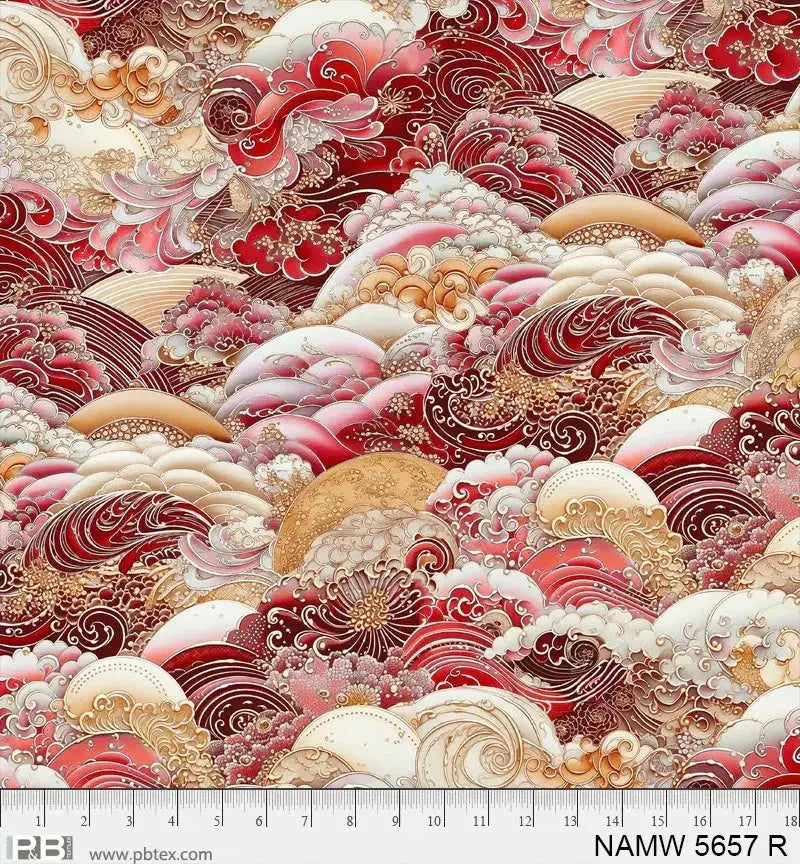
A backing with movement changes a quilt when you turn it over. Instead of a plain reverse, you get surf, foam, and colour — a second design that deserves its own planning.
What This Fabric Is
The Red Multi Waves in Motion Nami Wideback, from P&B Textiles, is a 108-inch cotton wideback sold by the yard. The design, by Clint Eagar, shows pounding waves and sea froth, with details placed so you can nearly feel the power of the ocean in the print. In this Red Multi colourway, that energy is carried by warm red tones worked through the wave pattern, making it a bolder choice than a neutral or blue coastal backing.
Nami comes in six colourways, and the maker notes these prints are strong enough to stand alone — suggested as a duvet cover, a shower curtain, or even framed as artwork. That scale is exactly why it works as a quilt back. At 108 inches wide, the waves can run across most quilt backs in one unbroken piece, with no pieced seam cutting through the surf pattern.
How Much Backing Fabric Do You Really Need?
Start with the standard rule: your backing should measure your quilt top plus 8 inches in both width and length. That gives you 4 inches of overhang on every side for longarm loading, clamping, and the small shift that happens as quilting progresses.
Then check that math against the 108-inch width. A queen top at 90 by 95 inches needs a backing of 98 by 103 inches. That width fits within 108 inches, and 103 inches is just under 3 yards — so order 3 yards for a single seamless piece. A throw at 60 by 72 inches needs 68 by 80 inches, about 2¼ yards. A king top wider than 100 inches will exceed even a wideback once you add the 8 inches. When numbers land close to the edge, round up — squaring up and selvedge take a little usable width.
Cotton, Minky, or Flannel: Choosing the Backing
Cotton wideback like this Nami print is the seamless default for large quilts: stable, breathable, easy to press, and wide enough for most tops in one piece. It also holds a detailed printed design crisply, which matters when the wave artwork itself is the feature you want to show.
Minky adds plush warmth and a soft hand, but many extra-wide minky backings are narrower than 108 inches, so check the width math carefully before you commit. Choose it when softness and warmth matter more than a printed scene.
Flannel sits in between — cosier and softer than quilting cotton, but it can shrink noticeably, so prewash it before pairing it with a top that has not been prewashed. For a directional wave print you want to see in full, cotton is the natural choice.
Working Tips: Folds, Prewashing, and Loading
Wide cotton arrives folded, and that centre fold can be stubborn. Press it out before loading, working from the centre outward, and let the fabric rest flat if you can. A crease left in place will quilt in.
On prewashing, decide before you cut. Prewashing a cotton backing reduces later shrinkage, but it also softens the fabric and can wrinkle it — press carefully afterwards. If you skip prewashing, treat your top fabrics the same way so the finished quilt shrinks evenly.
For longarm loading, centre the wave design deliberately. This is a directional print, so check which way the waves run before you pin, confirm you still have that 4-inch overhang on all sides after centring, and take a quick photo before quilting. That simple check catches an upside-down back while it is still easy to fix.
Care
As a cotton backing, this fabric cares for like the cotton in your top: wash gently in cool to warm water, and dry on low or line-dry to limit fading. Avoid harsh bleach, which will dull the red and froth detail. With ordinary care, a cotton wideback holds its colour through regular use.
Shop the Red Multi Waves in Motion Nami Wideback Fabric Per Yard at Linda's Electric Quilters.


