
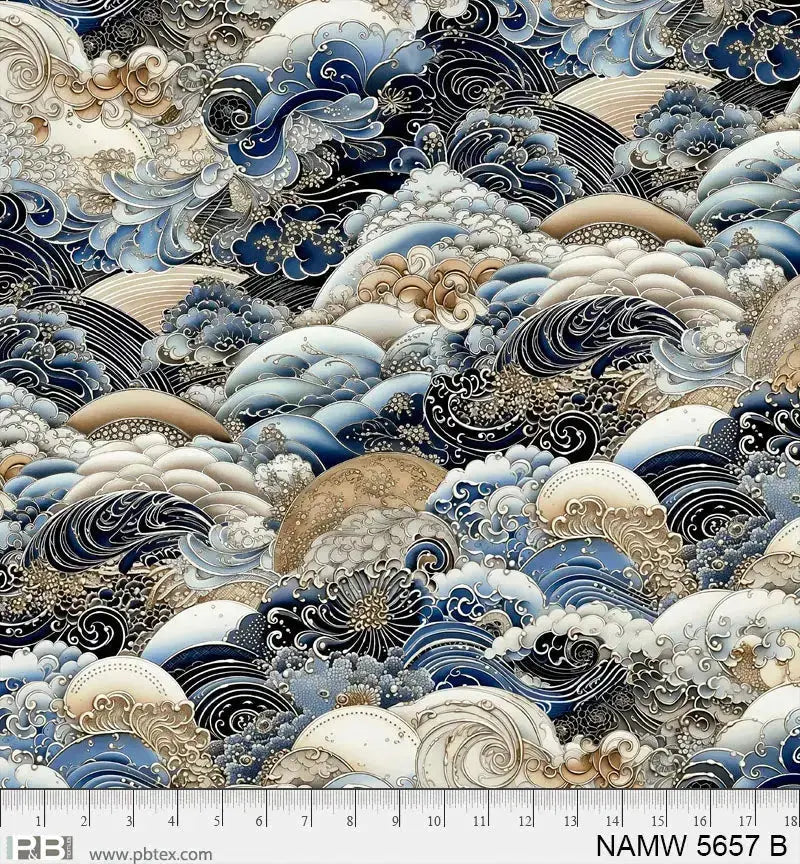
When the Back Deserves Its Own Seascape
Most quilt backs are chosen quietly — a solid or blender that will not compete with the top. The Blue Multi Waves in Motion Nami Wideback invites the opposite decision. This is a 108-inch, 100% cotton wideback from P&B Textiles, printed with a dramatic ocean design by Clint Eagar: pounding waves and sea froth in layered blues, detailed enough that the maker notes it can stand alone as a duvet cover, shower curtain, or framed artwork. As a quilt back, it turns the reverse side into a second finished piece.
What This Fabric Is
Nami is a printed cotton wideback sold by the yard, a full 108 inches wide. That width is its practical heart: standard quilting cotton is only about 44 inches wide, so backing even a throw quilt normally means seaming lengths together. At 108 inches, one unbroken panel covers most quilts edge to edge, with no seam down the back and no pattern-matching headache. The design belongs to a family of six colorways, and this Blue Multi version runs the full range of ocean blues, from deep water to foam white. Because the waves form a directional, large-scale scenic print, treat it like a feature fabric — its direction and scale are part of how it works.
Sizing Your Backing: The Top-Plus-8 Rule
A backing must be bigger than the quilt top on every side, because quilting takes up fabric and layers can shift as they are stitched. The standard allowance is 8 inches in both dimensions — 4 inches of overhang per side. Measure your finished top, add 8 inches to width and length, and check the result against the 108-inch width. A 70 × 90 inch twin needs a back at least 78 × 98 inches: the 98-inch side fits the width, so you order the 78-inch dimension as yardage — a little over 2.1 yards, so 2¼ yards gives breathing room. A 90 × 95 inch queen needs 98 × 103 inches; the 103-inch side still fits, and about 2¾ yards covers the length. Only when both dimensions plus 8 exceed 108 inches — true king territory — would you need to piece, which is why widebacks like this one suit most quilts up to a large queen.
Cotton, Minky, or Flannel?
A cotton wideback like Nami is the versatile default: it quilts cleanly, presses crisply, breathes well, and drapes like the cottons on your top. Minky adds plush warmth for baby quilts and throws, but its stretchy polyester pile needs more pinning and patience. Flannel sits in between — soft and cozy, with a cotton weave, though it shrinks more noticeably. Choose cotton when you want the back to showcase a print and behave predictably; that is exactly the job this ocean print was made for.
Working Tips
Mind the direction. Waves have a right way up. Unroll the fabric, decide which way the surf should run, and mark the top edge with a pin or tape so it cannot get turned around at the frame or machine.
Press out the fold. Widebacks arrive folded, and a hard center crease is common. Press the full length with steam before layering — a crease left in the sandwich can stitch in permanently.
Consider prewashing. Cotton backing can shrink slightly at its first wash. Prewashing means the back and top age together and removes sizing so layers grip evenly. If your longarmer prefers unwashed backing, ask first — but decide before loading.
Loading on a longarm. Center the scenic panel so the wave composition sits balanced behind the top, keep the marked edge at the correct rail, and confirm 4 inches of overhang all around before basting. Directional backs reward two extra minutes of checking.
Care
Care for the finished quilt as you would any cotton quilt: wash gently in cool water with mild detergent — especially for the first wash of a saturated blue print — and dry on low or line dry. The cotton softens with use while the waves keep their movement.
Shop the Blue Multi Waves in Motion Nami Wideback Fabric Per Yard at Linda's Electric Quilters.


