
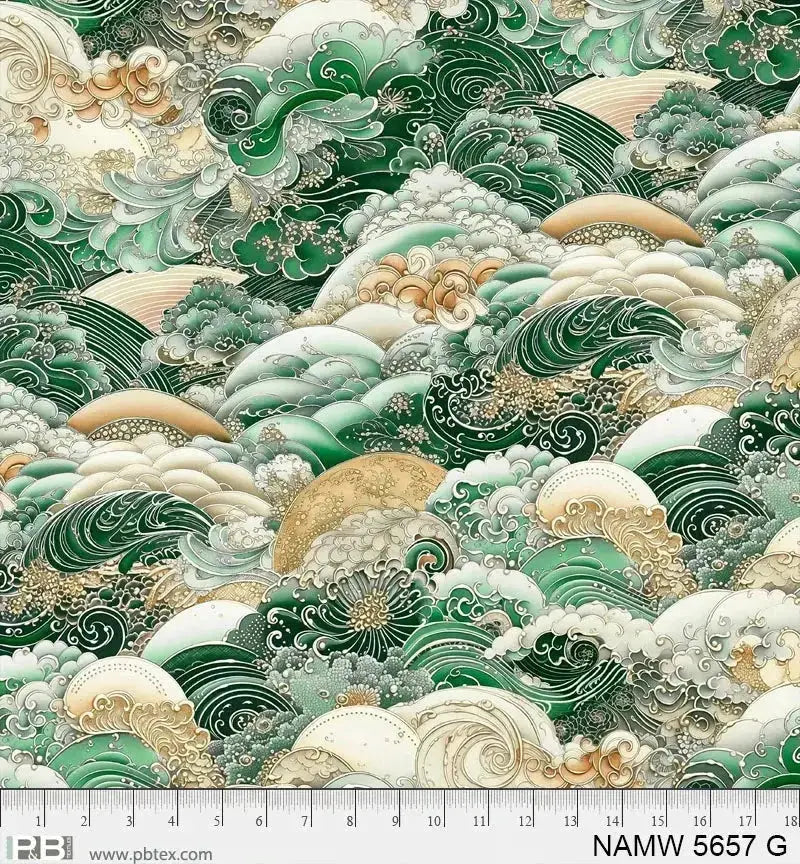
When the Back Feels Like the Ocean: Using Green Waves in Motion as a Seamless Quilt Backing
A quilt back does not have to be plain to be practical. Green Multi Waves in Motion Nami, from P&B Textiles, puts pounding waves and sea froth across a full 108-inch cotton wideback — a dramatic ocean print by Clint Eagar. If you love coastal tops or sea-glass colours, this back becomes a second feature panel.
What This Fabric Is
This is a 108-inch wide, cotton wideback fabric, sold by the yard and made by P&B Textiles. The design evokes pounding waves and sea froth, reading as a scene, not just a repeat. It is one of six colourways, in a green multi palette.
At 108 inches wide, one panel backs most quilts without a centre seam, so the wave scene stays unbroken. The print is also suggested as a stand-alone for a duvet cover, shower curtain, or framed artwork — a large, confident motif. Centre the strongest wave where you want the eye to land.
How Much Backing Do You Really Need?
Use the standard rule first: backing = quilt top plus 8 inches in both directions, giving you 4 inches of extra fabric on every side. That overhang lets a longarm quilter load and clamp without running short, and gives home quilters a margin while basting.
Then check it against the 108-inch width. A 70 x 90-inch throw needs a backing of at least 78 x 98 inches. The 78-inch side fits easily across 108 inches, so you need 98 inches of length — 2.75 yards, so order 3 yards to allow for squaring up and a little shrinkage. A 90 x 90-inch queen top needs 98 x 98 inches: still one panel across the width, and again about 3 yards of length. Only if your top plus 8 inches exceeds 108 inches would you need to piece it — and then match the waves carefully at the seam.
Cotton, Minky, or Flannel?
Choose a cotton wideback like this one when you want the widest seamless panel, a flat and stable back, and a print that quilts cleanly and presses crisply. Choose minky when plush softness is the priority — for a baby quilt or a comfort throw — accepting its stretch and narrower widths, which often mean piecing. Choose flannel when you want cotton-based warmth with a brushed feel, for winter or cabin quilts. For a coastal, modern, or sea-glass-coloured top, a green wave cotton back keeps the quilt light, breathable, and visually striking on both sides.
Working Tips: Pressing, Prewashing, and Loading
Pressing the fold: Wide cotton arrives with a centre fold. Open it fully, press from the wrong side with steam, and work the crease out in sections rather than dragging the iron across the printed waves. Check that the print is straight before you measure — a scenic design makes a skewed cut obvious.
Prewashing: Decide before you cut. If the finished quilt will be washed often, prewash the backing the way you will wash the quilt, then dry, press, and re-measure. Cotton can shrink a little, and re-measuring protects that essential 4-inch margin on every side.
Longarm loading: Load the backing with the waves running in the direction you planned, sighting along the wave lines as you pin and clamp so the scene does not drift. Keep tension even but not stretched tight, and confirm the extra length is distributed top and bottom before quilting begins.
Care
Care for the finished quilt as you would other quality cotton quilts: wash gently in cool water, dry on a low to medium setting, and remove promptly to reduce creasing. Keeping the back smooth and clean helps the wave detail — the froth, shading, and movement that make this print special — stay clear wash after wash.
Shop the Green Multi Waves in Motion Nami Wideback Fabric Per Yard at Linda's Electric Quilters.


