
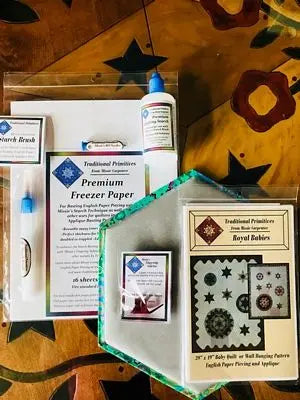
English paper piecing is the slowest, most portable, most soothing corner of quilting: fabric basted around paper shapes, then whip-stitched together entirely by hand. No sewing machine, no rush. Linda's now carries a dedicated EPP department, from loose hexagon papers to complete pattern-and-paper packs.
Start with the Papers
Hexagons are the classic EPP shape, and precision-cut papers are what keep a thousand-piece quilt flat. Linda's stocks 2-1/2″ hexagon paper pieces and 3″ hexagon paper pieces for bold, fast-growing projects, plus 1-1/4″ honeycomb templates for the elongated hexagon look seen in vintage quilts.
Acrylic Templates for Fussy Cutting
An acrylic template like the EZ Hexagon 5″ acrylic shape lets you cut fabric with the seam allowance included and window-cut motifs precisely — the secret behind those kaleidoscope EPP rosettes where every flower lands perfectly centered.
Kits and Complete Piece Packs
New to EPP? The English Paper Piecing Starter Kit bundles the essentials in one box. Ready for a showpiece? Complete packs pair a designed pattern with every paper shape pre-cut: Hex on the Beach is an approachable statement project, while the Alchemy Pattern and Complete Paper Piece Pack is a heirloom-level millefiori-style quilt with every shape included.
Corey's EPP Tips
Glue-basting is faster than thread-basting and the papers still pop out cleanly — use a fine-tip fabric glue pen sparingly along the seam allowance. Reuse your papers: most survive three or four projects. And keep a small tin in your bag; EPP is the project that turns waiting rooms into sewing time.
Frequently Asked Questions
What's the difference between English paper piecing and foundation paper piecing?
EPP wraps fabric around paper shapes and joins them by hand; the paper is removed and often reused. Foundation paper piecing sews fabric onto a printed pattern by machine and the paper tears away. EPP is portable hand work; FPP is machine precision work.
What size hexagons should a beginner start with?
Larger hexagons like 2-1/2″ or 3″ are the fastest way to learn basting and whip-stitching, and projects grow quickly. Move down in size once your stitches are consistent.
Do the papers stay in the quilt?
No. Once a shape is surrounded on all sides by its neighbors, the paper comes out — and most papers can be reused several times before they soften.