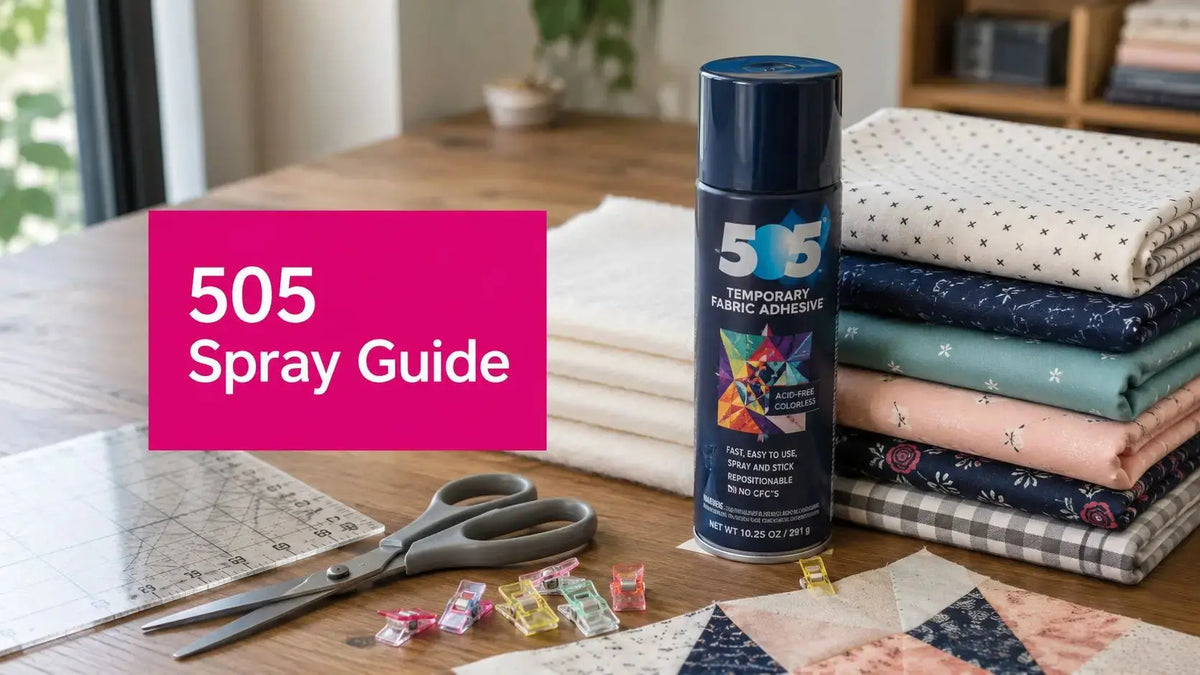
505 adhesive spray gives you a repositionable bond for about 15 to 20 minutes, which is long enough to smooth a quilt sandwich without racing, and on natural cotton fabrics that temporary hold can last up to six months before quilting if the project has to wait. It's the tool many quilters reach for when they're done with pin basting and want a temporary, fabric-safe adhesive that helps build a smooth sandwich fast, washes out completely, and won't gum up needles.
You've got the quilt top pressed, the backing squared up, and the batting ready. Then the least fun part starts. You're on the floor, your borders are trying to drift, the backing wants a crease right where you don't want one, and every pin seems to find your finger before it finds the quilt. That's exactly where 505 adhesive spray earns its place in the sewing room.
At the shop in McKinney, Texas, this is one of those products we keep seeing experienced quilters come back to because it solves a specific problem well. It holds layers in place long enough to quilt cleanly, but it doesn't turn the project stiff or permanent before you're ready. On an Innova longarm or at a domestic machine, that matters. Good basting affects everything that comes after it, from smooth feeding to fewer puckers on the backing.
If you're gathering supplies for your next quilt sandwich, appliqué project, or embroidery setup, keep this guide nearby and pick up the notions you need to finish the job cleanly.
Suggested URL slug: /blog/505-adhesive-spray
Meta description: Learn how to use 505 adhesive spray for quilting, embroidery, and basting. Get pro tips and shop quilting supplies at Linda's today.
The End of Pin Basting Frustration
Pin basting still works. Plenty of beautiful quilts have been made that way. But if you've ever basted a throw or bed quilt on the floor, you already know the trade-off. It's slow, hard on your back, and easy to disturb one section while fixing another.

505 adhesive spray changes that setup step. Instead of depending on pin spacing to control shifting, you create a temporary hold across the batting and fabric so the layers stay where you place them. For longarm quilters, that means less distortion before loading. For domestic machine quilters, it means the quilt sandwich feeds with less bunching and less fighting.
Why quilters switch from pins
The big advantage isn't glamour. It's control.
- Smoother setup: You can pat, smooth, and align wide areas instead of chasing movement between pin points.
- Less handling damage: Delicate tops and soft backings don't get pierced repeatedly during prep.
- Faster transition to quilting: Once the sandwich is secure, you can move to the machine without stopping to add or adjust dozens of pins.
Practical rule: If your main problem shows up before the first quilting line, basting method matters more than thread choice or quilting design.
This is also where project size starts to matter. A small wall quilt can be pinned without much fuss. A larger bed quilt, a lofty batting, or a slick backing fabric is where spray basting starts to feel like a real upgrade. If you're also building out your project kit, it helps to browse quilting notions and prep supplies before you start, so you're not stopping mid-baste to hunt for tools.
What works better in real sewing rooms
The quilters who get the cleanest results with 505 adhesive spray usually do one thing right. They treat basting as part of the quilting process, not as a chore to rush through. Good prep affects drape, feeding, and how evenly the layers behave under the needle.
A smooth sandwich also makes the next decisions easier, especially batting choice. Different loft, hand, and fiber content affect how the quilt settles once it's basted, so it's worth pairing your spray prep with the right batting options for your quilt project.
What Exactly Is 505 Spray and Fix
505 Spray & Fix is a temporary, repositionable fabric adhesive made for textile work. In a quilting room, that means it gives fabric, batting, stabilizer, or appliqué pieces enough tack to stay put during setup without turning the project stiff or sticky.

According to this Odif 505 overview video, 505 Temporary Spray Adhesive provides a repositionable bond for 15 to 20 minutes. That working window is long enough to lift a section, smooth out a ripple, and reset it before you commit. The same source describes it as water-soluble, odorless, colorless, and designed to avoid gumming needles or staining fabric.
What temporary means at the table
Temporary means the hold is meant for assembly and stitching, not for a permanent bond. That is the whole point.
A good spray baste should keep layers from skating around while you load the quilt or move it under the needle, then wash out cleanly later. On cottons, 505 does that well. On slick polyester linings, minky, and some staticky battings, it still works, but technique matters more because static can make a light layer jump or cling before it settles where you want it.
That indoor versus outdoor spraying debate usually gets framed around overspray and fumes. Those are real concerns, but static is the issue I see quilters miss. In dry rooms, especially in winter, synthetic fabric can pull toward your hand, the can, or the wrong section of batting. Outdoors, a breeze helps with ventilation but can make lightweight synthetics shift even more. Indoors, you get better control of placement if you manage the static first and protect the surrounding area.
What repositionable gives you in real use
Repositionable hold matters most on projects that do not forgive drift.
- Pieced backings that need seams to stay straight
- Directional prints where a twist is obvious
- Appliqué layouts that need a trial placement before stitching
- Embroidery and stabilizer setups where you want hold without a permanent fuse
In my shop, this is why 505 stays near both the longarm table and the embroidery machine. It handles quick placement jobs well, but it also gives you a short correction window, which saves a lot of unpicking later.
Why fabric-safe details matter
For textile work, acid-free and fabric-safe features matter because quilts are handled, stitched densely, and often washed. A spray pulled from the garage shelf may hold for a minute, but it can leave residue, affect needle performance, or change the hand of the finished quilt.
505 is made for fabric prep, so the goal is clean hold, clean stitching, and a softer finish after washing. If you like practical household advice beyond the sewing room, you can also explore family shopping tips.
Why 505 Spray Is a Quilter's Best Friend
You feel it before you see it. The batting clings to your sleeve, a polyester backing lifts when you reach across the table, and one light pass of spray lands a little wider than planned because static is pulling fibers and overspray off course. That is the part many quilting guides skip, especially if you work with synthetic blends, fleece backings, or slick embroidery materials.
505 earns its spot because it helps control the sandwich without adding the extra handling that causes shifting in the first place. On quilts, appliqué, and embroidery setups, that matters more than speed alone. A stable layup at the start usually means fewer ripples, fewer resets, and less arguing with the project once it reaches the machine.
Basting method comparison
| Feature | 505 Adhesive Spray | Pin Basting | Thread Basting |
|---|---|---|---|
| Setup speed | Fast once layers are prepped | Slower on larger quilts | Slowest |
| Repositioning | Easy during active tack window | Possible, but requires repinning | Possible, but requires rebasting |
| Risk of finger pokes | None from pins | High | Low |
| Fabric support across broad areas | Even hold across sections | Hold only where pins are placed | Good control along stitched lines |
| Backing puckers from shifting | Reduced when applied evenly | More likely between pins | Low, but labor-intensive |
| Cleanup before quilting | Minimal | Remove pins as you sew or before quilting | Remove basting stitches later |
| Best use case | Quilt sandwiches, appliqué, embroidery prep | Spray-free setups | Heirloom or very controlled prep |
Pin basting still has a place. It is simple, low cost, and some quilters trust it on small cotton projects. But pins only secure the spots where they sit, so fabric can creep between them, especially on larger quilts or slippery backings.
Thread basting gives excellent control and I still respect it for heirloom work. It also takes time, floor space, and patience. If the goal is to prep efficiently and get a quilt loaded while it is still flat and square, 505 usually wins on everyday shop work.
The indoor versus outdoor question matters here. Outdoors gives better airflow, but even a light breeze can shift batting and pull lint onto the adhesive. Indoors gives better placement control, especially on long backing pieces, but dry air can build static fast. In the shop, synthetic materials are where this shows up most. Polyester thread cones, fleece, Minky, and some stabilizers can all add enough static to make spray application less predictable. A quick wipe-down of the table, a little humidity in the room, and lighter section-by-section spraying make 505 behave much better.
At our McKinney shop, that trade-off is easy to see on the longarm. If a quilt starts flat, it tracks better on the frame and needs fewer mid-load corrections. On embroidery projects, the same idea applies. Clean temporary hold helps stabilizer and fabric stay where you put them while you stitch.
Good fit projects for 505
505 adhesive spray tends to work especially well on:
- Throw quilts and bed quilts where broad, even hold saves a lot of crawling and repinning
- Machine appliqué when pieces need to stay put long enough to stitch cleanly
- Embroidery projects where stabilizer placement needs to hold without becoming permanent
- Patterns with large cut pieces, including fan quilts and team-color appliqué layouts like the #1 Fan, which includes multiple size options
It is not magic. It is a practical tool that reduces handling, gives a short reposition window, and behaves well when you match the method to the fabric in front of you. If you're sewing for family spaces and want ideas for practical project planning beyond the quilting room, it's also worth taking a look at explore family shopping tips.
Step-by-Step Guide to Applying 505 Adhesive Spray
Halfway through a large quilt is the worst time to find bubbles, drag, or a top that shifted an inch off center. Good spray basting prevents that. With 505, control matters more than quantity. A light coat in planned sections holds better, stays cleaner, and gives you fewer surprises once the quilt goes on the frame.
Start with a pressed project and a protected work surface.

For quilt basting
The Odif USA product page for 505 Temporary Fabric Adhesive recommends spraying from 10 inches away directly onto the batting. That distance gives a fine, even mist and helps avoid wet spots.
Use this sequence:
-
Prep the backing first
Lay the backing flat and smooth, but do not pull it drum tight. A little relaxation in the fabric helps it stay square. -
Set the batting on top
Smooth it from the center outward with your hands. I always check with my palms because you can feel a ridge before you can see it. -
Fold back part of the batting
Spray a light coat onto the exposed batting area from about 10 inches away. Lower the batting and smooth it back into place. -
Work in sections
Repeat across the quilt, starting near the center and moving outward. That order helps limit creeping and small diagonal shifts. -
Add the quilt top the same way
Fold back one area at a time, spray lightly, then smooth. Pay close attention to borders, corners, and pieced seams, because those spots show distortion first.
Less spray usually gives the better result. If the batting feels damp or slick, the coat is too heavy.
For machine embroidery and stabilizer work
505 has always earned its keep around embroidery machines because it handles awkward fabrics and stabilizers without a lot of fuss.
Use it to:
- Secure backing to garments
- Hold items that are difficult to hoop
- Position appliqué before stitching
- Reduce hoop burn on delicate fabrics
The method stays simple. Spray the stabilizer lightly, let it settle for a moment, then place the fabric instead of dropping it all at once. That gives you a little control if the grain or design placement needs adjusting.
Needle choice matters here too, especially on longarms and multi-directional quilting passes. The #16 MR 3.5 R-Point (Regular Sharp) 134MR is a longarm needle option, not a bobbin case substitute, and its deep scarf can help reduce skipped stitches when the project has dense stitching or frequent direction changes.
Indoor use versus outdoor use
Indoor versus outdoor spraying is usually framed as a ventilation question. In a real sewing room, static is often the bigger variable.
Synthetic batting, polyester thread, fleece, Minky, and some stabilizers can build enough static charge to pull fibers upward, shift light layers, or make one section grab harder than the next. That can look like bad spray performance even when the adhesive was applied correctly. Indoor rooms with dry air tend to show this problem more often. Outdoor spraying can reduce fumes, but a breezy day creates its own trouble by pushing mist off target and dropping lint onto the adhesive.
My shop rule is simple. If the project includes synthetics, test one small area first. If the layers seem to repel, cling unevenly, or shift as you lower them, address the static before you spray the whole quilt.
Pro tip from our McKinney team: For synthetic-heavy projects, wipe the table, add a little humidity to the room, and spray lighter coats in smaller sections. If static is still fighting you, use an anti-static product before basting.
That practical issue comes up in this discussion of indoor use and static buildup with synthetic materials. Experienced quilters run into it most on dry days and on quilts with polyester-heavy layers.
Watch the application in motion
If you like seeing hand placement and spray rhythm before trying it yourself, this video helps:
If you want extra support once the sandwich is basted, a related tutorial on how to load a quilt on a longarm frame is a useful next step before you start stitching.
Safety Cleanup and Storage Best Practices
505 adhesive spray is easy to work with, but it's still an aerosol. That means setup safety matters, especially if you're using it indoors.

The Amazon product listing for Odif 505 states that the adhesive is engineered without CFCs and is an extremely flammable aerosol requiring heat precautions. The same source says it should be applied from 10 inches away to help prevent overspray and secure items without hoop burn.
Safe indoor use
Indoor use is fine when you use common sense and good ventilation. Open windows if possible. Keep air moving. Protect nearby surfaces from overspray. Don't spray near heat sources, flames, or anything that could ignite aerosol vapors.
A few habits make a difference:
- Cover your work area: A sheet, paper, or drop cloth keeps mats and tables from getting tacky.
- Spray in short passes: Long blasts create more overspray and less control.
- Keep the can moving: That helps produce a lighter, more even application.
- Let the area breathe: Give the room a little air exchange before packing everything away.
Cleanup after basting
Cleanup is usually straightforward if the spray was applied lightly.
- On the quilt itself: The adhesive is designed to disappear when washed after stitching is complete, as noted earlier.
- On tools or surfaces: Wipe overspray promptly so it doesn't build up tack on cutting mats or tables.
- On your hands: Soap and water often handle light residue. Gloves can help if you're sensitive to sticky hands.
A clean spray routine matters more than aggressive cleanup later. Most messes come from overspray, not from the product doing something unexpected.
Storage that keeps the can usable
Store the can upright in a cool, dry place. Keep it away from direct heat and sunlight. Don't leave it in a hot car or next to an iron station.
Nozzle care matters too. If the nozzle starts to sputter, your spray pattern gets uneven, and that can lead to wet spots or weak spots on the batting. A quick wipe before storing the can saves frustration later.
Troubleshooting Common 505 Spray Issues
Most 505 adhesive spray problems aren't really product failures. They're application problems, surface prep issues, or static problems that look like bad adhesion.

Why are my fabric layers still shifting
If the layers move after basting, check three things first:
- Coverage: You may have sprayed too lightly at the edges or corners.
- Smoothing: The top may be flat while the batting or backing underneath still has a ripple.
- Static: This is the overlooked one on synthetic materials. The earlier-cited discussion of indoor use notes that static buildup can cause layers to shift, and anti-static prep can help.
Why doesn't it feel sticky enough
Sometimes quilters expect a craft-glue feel. 505 isn't supposed to feel like that. It's a temporary textile adhesive, so a light tack is normal.
If it still seems off:
- Check the spray distance
- Look for a clogged nozzle
- Spray in controlled sections instead of trying to cover the whole project at once
What if I notice residue or needle issues
505 is formulated not to gum needles in normal use, but heavy application can create problems with any adhesive workflow. If you're seeing buildup, use less spray next time and aim for the batting rather than overworking the fabric surface.
For finished quilts that need long-term care after quilting and washing, it helps to review practical storage ideas for keeping projects clean and protected. This guide on safeguarding quilts for home is a useful companion read.
Frequently Asked Questions About 505
How long can a basted quilt sit before quilting
On natural cotton fabrics, the bond can last up to six months, and on polyester fabrics it remains effective for about four months, according to the verified product information in the earlier-cited video source. Real projects vary with handling, folding, and storage conditions, so check edges and corners before quilting if the project has been sitting awhile.
Can I use 505 adhesive spray on delicate fabrics
It's commonly used on quilting cottons and in embroidery applications where fabric handling matters. Because delicate fabrics vary a lot, a small test area is the safest approach before full application.
Is 505 different from general craft spray adhesive
Yes. 505 adhesive spray is formulated for temporary fabric bonding in quilting, appliqué, embroidery, basting, and hemming rather than permanent household bonding. That's why quilters use it for machine work where needle cleanliness, drape, and wash-out matter.
Should I spray indoors or outdoors
Either can work, but indoor use needs ventilation and more attention to overspray and static. Synthetic fabrics and batting are where static can become the hidden variable.
Does it work only for quilts
No. It's also used for machine embroidery, appliqué placement, and holding fabric to stabilizers before stitching.
When you're ready to baste your next quilt, stock up on 505 adhesive spray, batting, needles, and other finishing supplies at Linda's Electric Quilters. It's a practical place to start when you want the right tools on hand before the quilt top reaches the floor.