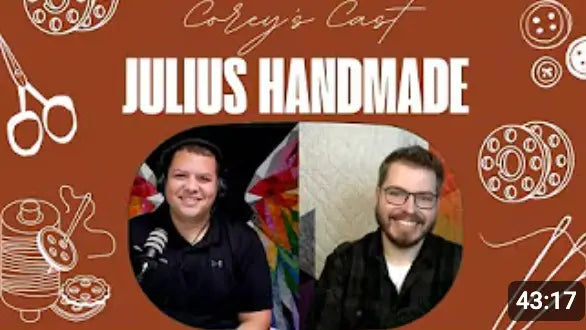
Discover the inspiring journey of a designer who turned a creative breakthrough into a movement, and learn why his approach to foundation paper piecing is changing how quilters think about color, complexity, and community
There's something magical about watching a creative breakthrough unfold in real time. For Julius Rempe-Night of Julius Handmade, that breakthrough came not in a sewing room or design studio, but during a 10-day meditation retreat that sparked what he describes as a "massive creative inspiration." What followed was an explosion of innovative foundation paper piecing patterns that have captivated the quilting world with their bold colors, intricate details, and fearless approach to complex subjects.
In just eight years, Julius has gone from a beginner struggling with his first unicorn pattern to a designer whose work is so compelling that people drive hours just to see it in person. His journey represents more than just personal success—it's a testament to the power of finding your true creative calling and the importance of sharing that gift with others.
But what makes Julius's story particularly fascinating isn't just his rapid rise to recognition. It's his commitment to democratizing the design process, teaching others to create their own foundation paper piecing patterns, and building a community around the shared joy of bringing complex, colorful visions to life through precise piecing.
The Accidental Designer: When a Unicorn Changes Everything
Julius's path to becoming a foundation paper piecing specialist began, like many quilting journeys, with simple half-square triangles. For his first year of quilting, he stuck to basic techniques, creating traditional blocks and learning fundamental skills. But then he discovered a unicorn pattern online, and everything changed.
That unicorn pattern introduced him to foundation paper piecing, a technique that would become his signature and passion. The precision required, the ability to create complex curves and detailed images, and the satisfaction of seeing intricate designs come together piece by piece captured his imagination in a way that traditional piecing never had.
The learning curve was steep. Julius freely admits to making mistakes and struggling with the technique initially. But instead of being discouraged, he was energized by the challenge and the possibilities he saw in the method. The detail and precision possible with foundation paper piecing aligned perfectly with his creative vision and desire to push boundaries.
This early experience highlights an important truth about creative development: sometimes the techniques that challenge us most are the ones that unlock our greatest potential. Julius could have stayed with simpler methods, but his willingness to embrace difficulty led him to discover his true calling.
The Panda That Started It All: First Steps in Design
Julius's first original design was a panda face—a simple but meaningful beginning that he still treasures today. Holding up that original block during his interview, his affection for it is obvious. This wasn't just his first design; it was proof that he could translate his vision into reality using foundation paper piecing techniques.
The panda block represents more than just a cute animal face. It was Julius's declaration of independence as a designer, his first step away from following other people's patterns toward creating his own unique vision. The fact that he later created a rainbow-eyed version of the same panda shows how even his earliest work contained the seeds of the bold color choices that would become his signature.
This progression from following patterns to creating original designs is a journey many quilters dream of but few actually undertake. It requires not just technical skill but also the confidence to trust your own creative instincts and the persistence to work through the inevitable challenges of translating ideas into workable patterns.
Julius's willingness to share this early work, complete with its imperfections and learning moments, demonstrates the humility and authenticity that have made him such a beloved figure in the quilting community. He doesn't present himself as someone who was naturally gifted from the beginning, but as someone who learned through practice, mistakes, and determination.
The Creative Explosion: When Meditation Meets Inspiration
After two years of quilting, Julius took a break from the craft. He had moved to Oklahoma, sold his longarm machine, and stepped away from quilting entirely. But creativity has a way of demanding expression, and for Julius, that expression came during an unexpected moment of stillness.
During a 10-day meditation retreat, Julius experienced what he describes as a massive creative inspiration. The combination of mental clarity, focused attention, and freedom from daily distractions created the perfect conditions for creative breakthrough. Ideas began flowing faster than he could capture them, and he knew he had to return to quilting to bring these visions to life.
The first pattern to emerge from this creative explosion was his Rainbow Lion Head quilt—a bold, complex design that showcased everything Julius had learned about foundation paper piecing while introducing the vibrant color palette that would become his trademark. This wasn't just a return to quilting; it was an announcement that Julius Handmade had arrived as a serious design force.
This story illustrates the unpredictable nature of creative inspiration and the importance of being open to it when it comes. Julius could have dismissed these ideas as impractical or too ambitious. Instead, he embraced them and committed to developing the skills necessary to bring them to life.
The Power of Community: When Strangers Become Champions
One of the most remarkable aspects of Julius's story is how it intersects with the broader quilting community. When Corey Pearson and Brooke Veal from Linda's Electric Quilters discovered Julius's work on Instagram, they were so impressed that they decided to drive from Dallas to Tulsa just to see his exhibit in person—without even knowing Julius personally.
This spontaneous road trip represents something beautiful about the quilting community: the willingness to support and celebrate each other's work, even when there's no personal connection or obvious benefit. For Julius, who had been working primarily in isolation, this unexpected visit was validation that his work was reaching and inspiring others.
The fact that these strangers were willing to drive hours to see his work in person speaks to the power of Julius's designs to create genuine emotional connections. In an age of digital everything, the desire to experience his quilts physically demonstrates their impact and appeal.
This story also highlights the importance of sharing your work, even when you're not sure anyone is paying attention. Julius's Instagram posts reached exactly the right people at exactly the right time, creating connections that have enriched his creative journey and expanded his opportunities.
The Inspiration Everywhere Philosophy: From Mermaids to Buddhas
Julius's design inspiration comes from an remarkably diverse range of sources, reflecting an open and curious approach to creativity that serves him well as a designer. His patterns include everything from spiritual figures like Buddha to mythical creatures like mermaids, from geometric abstractions to realistic animal portraits.
This diversity isn't random—it reflects Julius's belief that inspiration can come from anywhere and that foundation paper piecing is versatile enough to handle any subject matter. When someone suggested he design a merman pattern, he didn't dismiss it as outside his wheelhouse. Instead, he embraced the challenge and created not just one but multiple merman designs, including his stunning "Deep Sea Adonis" and "Rainbow Merman" quilts.
His spiritual side influences designs like his Buddha patterns, while his love of animals shows up in his various lion and panda designs. He's even begun incorporating AI-generated images as starting points for geometric patterns, showing his willingness to embrace new tools and technologies in service of his creative vision.
This openness to diverse inspiration sources is part of what makes Julius's work so fresh and unexpected. While many designers develop a narrow focus or signature style, Julius continues to explore new subjects and approaches, keeping his work dynamic and surprising.
The Rainbow Revolution: Bold Color as Creative Statement
Perhaps the most immediately recognizable aspect of Julius's work is his fearless use of color, particularly his love of rainbows. In a quilting world that often defaults to safe, coordinated color schemes, Julius's bold, saturated palettes stand out like beacons of creative courage.
His rainbow color choices aren't just aesthetic preferences—they're creative statements about joy, inclusivity, and the power of color to transform both quilts and moods. The Rainbow Lion Head, Rainbow Merman, and rainbow-eyed panda all demonstrate how color can elevate a design from merely interesting to truly spectacular.
But Julius is careful to emphasize that his color choices are personal preferences, not requirements. He encourages other quilters to adapt his patterns to their own color palettes, understanding that part of the joy of quilting is making each project uniquely your own. This flexibility makes his patterns accessible to quilters with different aesthetic preferences while still showcasing the power of bold color choices.
The confidence required to use such vibrant colors reflects Julius's overall approach to design: fearless, joyful, and unapologetically bold. In a world that often encourages playing it safe, Julius's work is a reminder that sometimes the most rewarding creative choices are the ones that feel a little scary.
The Technical Mastery: EQ8 and the Art of Precision
Behind Julius's creative vision lies serious technical skill and a deep understanding of the tools required to translate ideas into workable patterns. His use of Electric Quilt 8 (EQ8) software and Quilt Assistant demonstrates his commitment to precision and his willingness to invest in the tools necessary to achieve his vision.
The process Julius describes—manually drawing lines, ensuring connections are perfect, creating curves, and sectioning complex designs—reveals the meticulous work required to create foundation paper piecing patterns. This isn't a matter of inspiration alone; it requires technical skill, patience, and attention to detail that many quilters never develop.
Julius's willingness to test his own patterns before releasing them shows his commitment to quality and his understanding that a pattern is only as good as its ability to help others successfully complete the project. This testing process, while time-consuming, is what separates professional-quality patterns from amateur attempts.
The fact that he's willing to teach these technical skills to others through his workshops demonstrates his commitment to elevating the entire foundation paper piecing community. Rather than hoarding his knowledge, he's actively working to create more skilled designers who can contribute their own unique visions to the craft.
The Teaching Revolution: Democratizing Design Skills
Julius's four-week online workshop represents a significant contribution to the quilting education landscape. By teaching others how to create their own foundation paper piecing patterns using accessible software like Quilt Assistant, he's democratizing skills that were once the exclusive domain of professional designers.
The workshop covers all the essential elements: drawing lines, coloring, creating curves, and sectioning complex designs. But more than just technical instruction, Julius emphasizes the importance of practice and patience in developing these skills. He understands that becoming proficient at pattern design is a journey, not a destination.
This educational approach reflects Julius's broader philosophy about creativity and community. Rather than seeing other designers as competition, he views them as potential collaborators and contributors to a richer, more diverse design landscape. By teaching others to create their own patterns, he's helping to expand the entire foundation paper piecing universe.
The manual nature of the process that Julius emphasizes is important for students to understand. This isn't about finding shortcuts or automated solutions—it's about developing the skills and understanding necessary to create truly original work. This approach builds not just technical competence but also creative confidence.
The Community Builder: Block of the Month and Live Streams
Julius's free Block of the Month club, launched in January, represents a masterful approach to community building. By releasing a new pattern on the first of each month and hosting live streams on the 15th to sew along with participants, he's created a regular rhythm of engagement that keeps his community active and connected.
This approach serves multiple purposes: it provides regular value to his followers, creates opportunities for real-time interaction and instruction, and builds a sense of shared experience around his designs. The live streams allow for immediate feedback, question answering, and the kind of personal connection that's often missing from online interactions.
The decision to make this offering free demonstrates Julius's commitment to accessibility and community building over pure profit. While he certainly benefits from the exposure and connection these events provide, the primary value flows to participants who receive high-quality patterns and instruction at no cost.
This model could serve as a template for other designers looking to build engaged communities around their work. The combination of regular content, live interaction, and free value creates a powerful foundation for long-term relationships with customers and fans.
The Sneak Peek Strategy: Building Anticipation and Engagement
Julius's approach to sharing upcoming projects, like his "Beneath the Northern Lights" polar bear quilt, demonstrates sophisticated understanding of audience engagement and marketing. By offering sneak peeks and promising to live-stream the entire sewing process, he creates anticipation while also providing educational value.
This transparency in his creative process serves multiple purposes: it builds excitement for upcoming releases, provides educational content for his audience, and creates multiple touchpoints for engagement throughout the project development cycle. Rather than disappearing during the design process and emerging only with finished products, Julius invites his audience into the journey.
The promise to live-stream the entire sewing process for the polar bear quilt is particularly bold, as it exposes both successes and potential struggles in real time. This vulnerability and authenticity are part of what makes Julius such a compelling figure in the quilting community.
This approach also demonstrates confidence in his skills and patterns. By showing the complete process, he's essentially providing a master class in foundation paper piecing while also showcasing the quality and workability of his designs.
The Advice for Aspiring Designers: Patience, Grace, and Practice
Julius's advice to aspiring designers reflects the wisdom gained from his own journey: be patient, have grace with yourself, and understand that there's a learning curve. This counsel is particularly valuable in a world that often promises quick results and instant success.
His recommendation to start with simple blocks acknowledges that complex designs like his own require foundational skills that must be developed over time. This isn't about limiting ambition but about building the competence necessary to achieve ambitious goals successfully.
The emphasis on having grace with yourself is particularly important for creative endeavors, where perfectionism can be paralyzing and mistakes are inevitable. Julius's own journey, with its breaks, struggles, and gradual development, demonstrates that creative growth is rarely linear or predictable.
His encouragement for people to join his free offerings shows his commitment to supporting developing designers rather than just talking about it. By providing accessible entry points into his community and instruction, he's creating pathways for others to follow their own creative journeys.
The Future of Foundation Paper Piecing: Bold Visions and Bright Colors
Julius Handmade represents more than just one designer's success story—it's a glimpse into the future of foundation paper piecing as an art form. His bold color choices, complex subjects, and commitment to community building are pushing the boundaries of what's possible with the technique.
The integration of modern tools like AI for inspiration and sophisticated software for pattern creation shows how traditional techniques can evolve and adapt to contemporary possibilities. Julius isn't abandoning the fundamentals of foundation paper piecing; he's expanding what those fundamentals can achieve.
His success also demonstrates the power of authenticity and community in building a sustainable creative practice. Rather than trying to appeal to everyone, Julius has stayed true to his vision while building a community of people who share his enthusiasm for bold, colorful, complex designs.
The educational component of his work suggests a future where the line between designer and teacher becomes increasingly blurred, with successful creators sharing their knowledge and building communities around their expertise rather than hoarding their secrets.
Your Creative Journey: Lessons from Julius's Path
Julius's story offers valuable lessons for anyone on their own creative journey, whether in quilting or other pursuits. His willingness to embrace challenging techniques, his openness to inspiration from diverse sources, and his commitment to sharing his knowledge provide a roadmap for creative development.
The importance of finding your true calling, as Julius did with foundation paper piecing, cannot be overstated. While it's tempting to stick with familiar, comfortable techniques, the greatest creative growth often comes from embracing what challenges us most.
His approach to color—bold, joyful, and unapologetic—reminds us that creative choices don't have to be safe to be successful. Sometimes the most rewarding path is the one that feels a little scary but aligns with your authentic vision.
The community aspect of Julius's work demonstrates that creativity doesn't have to be a solitary pursuit. By sharing his process, teaching his skills, and building connections with others, he's created a richer, more sustainable creative practice than would have been possible in isolation.
Most importantly, Julius's journey shows that creative breakthroughs can come at any time and from unexpected sources. The key is staying open to inspiration, being willing to act on it when it comes, and having the persistence to develop the skills necessary to bring your vision to life.
Whether you're drawn to foundation paper piecing specifically or simply inspired by Julius's approach to creativity and community, his story offers a powerful reminder that the most rewarding creative journeys are often the ones that require us to be brave, patient, and generous with our gifts.
Your Julius Handmade and Foundation Paper Piecing Questions Answered
What makes foundation paper piecing different from traditional piecing? Foundation paper piecing allows for incredible precision and the ability to create complex curves and detailed images that would be difficult or impossible with traditional piecing methods. It's perfect for intricate designs like Julius's animal portraits and geometric patterns.
How can I learn to create my own foundation paper piecing patterns? Julius offers a four-week online workshop teaching pattern creation using Quilt Assistant software. He also provides free patterns through his Block of the Month club and hosts live streams for community learning and support.
What software does Julius use for his designs? Julius primarily uses Electric Quilt 8 (EQ8) and Quilt Assistant (a free program) for creating his foundation paper piecing patterns. He emphasizes that the process is very manual, requiring careful line drawing and connection verification.
Can I adapt Julius's patterns to different color schemes? Absolutely! While Julius is known for his bold, rainbow color palettes, he encourages quilters to adapt his patterns to their own color preferences. The patterns work beautifully in any color scheme that appeals to you.
How do I join Julius's free Block of the Month club? Visit Julius's website at juliushandmade.com or follow him on social media (@JuliusHandmade on Instagram, Julius Handmade Crafts on Facebook) for information about joining his free monthly pattern releases and live stream events.
What advice does Julius have for beginning foundation paper piecing designers? Be patient with yourself, start with simple blocks, understand there's a learning curve, and practice regularly. Julius emphasizes having grace with yourself as you develop these complex skills.
Ready to explore the colorful world of foundation paper piecing? Visit Linda's Electric Quilters for all the supplies you need to start your own Julius-inspired creations, and don't forget to check out Julius Handmade for patterns that will challenge and inspire your creativity!
SEO Keywords: Julius Handmade, foundation paper piecing, quilt pattern design, rainbow quilts, bold quilting colors, paper piecing patterns, quilting community, Electric Quilt 8, quilt design software, foundation piecing tutorial, colorful quilt patterns, modern quilt design