
Hey everyone. Today I want to show you why steam and a bias edge do not belong together, and the dry-press routine that keeps your triangles the size you cut them.
I wouldn't use steam on bias edges.
Not on half-square triangles.
Not on flying geese.
Not on any piece where that long edge was cut on the diagonal.
Now, I get why it tempts you, folks.
Steam feels like help.
You hit that button and the seam lays down fast.
For about ten seconds, it looks perfect.
Here is the problem.
A bias edge is cut at a 45-degree angle across the grain.
That is the stretchiest direction your fabric has.
Lengthwise grain barely stretches. Crosswise gives a little. Bias gives a lot.
Add steam, and you add heat plus moisture. Add sliding, and you add a pull.
Steam plus a bias edge equals stretch.
Triangles grow.
Blocks bow.
And that edge will never sit back down to the size you cut, no matter how nicely you ask it.
The block that taught me
I learned this watching it happen right here on the shop floor in McKinney.
A quilter brought in half-square triangles she was real proud of, and she should have been.
Her cutting was clean. Her quarter-inch seam was honest.
But half her units measured right, and half measured long.
We laid them out on the counter, one by one.
The difference was not her sewing, y'all. It was her pressing.
The units pressed dry sat square. The units steamed hard, sliding corner to corner, had grown along that diagonal seam.
Full confession, here we go. I have done the exact same thing myself.
Steam on, iron moving, feeling efficient.
Then I measured a unit that started at 4-1/2 inches and was suddenly closer to 4-3/4 inches on one side.
Oh my goodness. I did not cut it that way. I pressed it that way.
That was the lesson, and it stuck.
What I do instead
Here is my routine, step by step, with the numbers.
First, I turn the steam off. For bias pieces, I press with a dry iron on the cotton setting. Hot and dry. If your iron holds water, empty it or set it firmly to dry, so one accidental button press does not undo you. Steam has its place in quilting, just not here.
Second, I set the seam before I open anything. I lay the unit down just as it came off the machine, set the iron right on the seam for 3 to 5 seconds, and lift. That little pause sinks the stitches into the fabric and calms the seam down before it gets handled.
Third, I press, I do not iron. There is a real difference, folks. Ironing slides back and forth. Pressing is lift, set down, hold, lift again. I move the iron in the direction of the straight grain when I can, never dragging it corner to corner across the bias. About 5 seconds a spot is plenty.
Fourth, I handle bias units by their centers. Not by their corners. Corners are where your fingers pull without meaning to. I pick a unit up from the middle, lay it flat, and let the iron do the work. If a unit needs support, I slide a ruler or my palm under the whole thing and carry it flat.
Fifth, I measure after I press, not just before. If a half-square triangle is supposed to finish at 4-1/2 inches unfinished, I check it after pressing. One quick check on the first unit, then one every few units after that. If the size starts creeping, I know my pressing is creeping, and I can fix it on unit three instead of unit thirty.
You have options here, and they are all good. Some folks finger-press first and give it one light dry press at the end. Some save steam for the finished top, once every bias edge is sewn in and locked on all sides. My preference is dry from start to finish on the unit itself, and it is completely up to you.
Don't take my word for it — Cuddle Cat Quilt Works walks through working with bias edges in quilt piecing, including starching before you cut and pressing with a dry iron instead of steam, in Working with Bias Edges in Quilt Piecing.
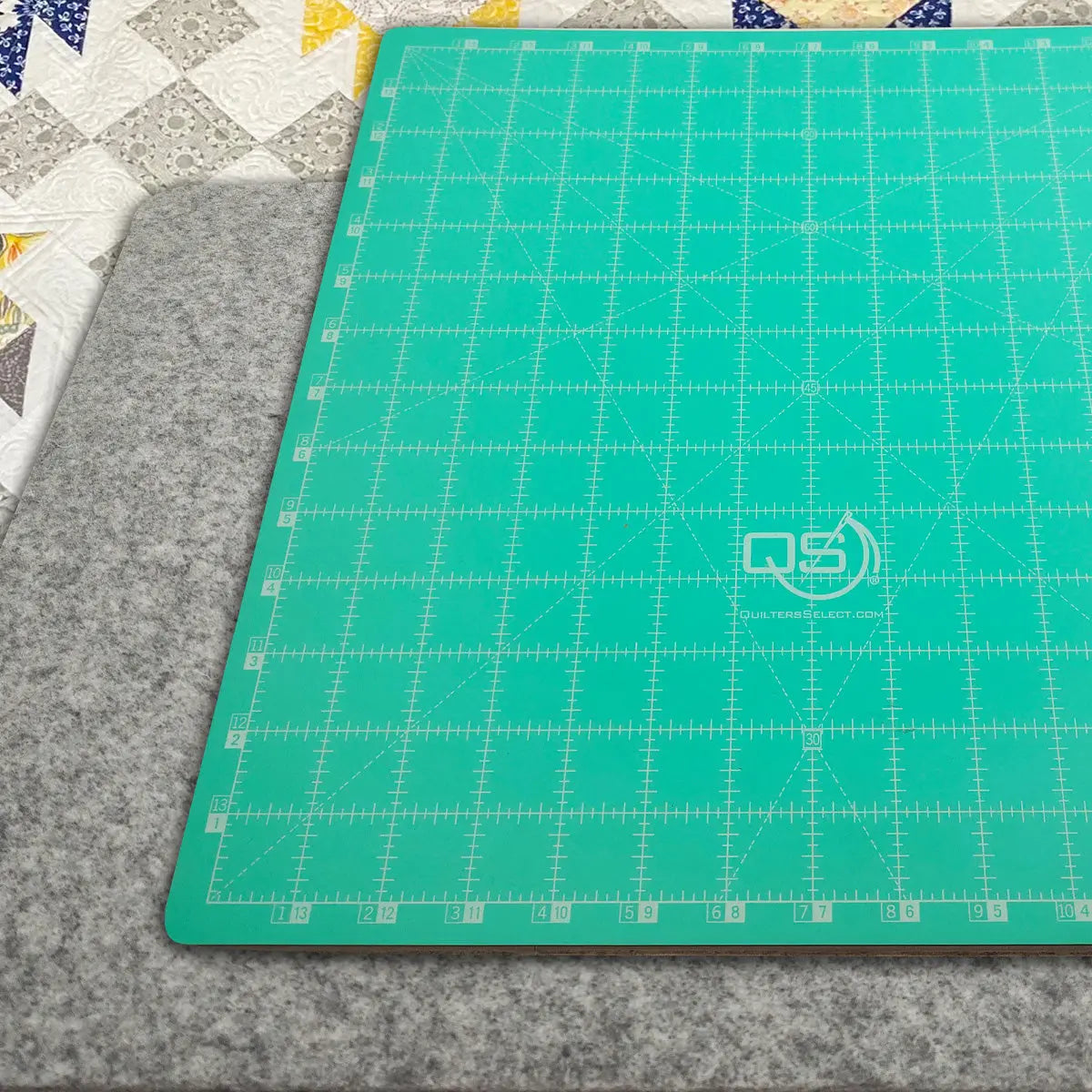
A wool mat helps here, too. It gently grips your fabric, so a bias unit stays put while you lift and set the iron instead of scooting across a slick board.
Shop the Quilters Select Wool Press & Cut Mat 14" x 14" at Linda's Electric Quilters.
And listen, if you have already steamed a few units long, you are not in trouble.
It doesn't have to be perfect.
You're your own worst critic on this, I promise.
Measure what you have, trim what you honestly can trim square, and press the rest dry from here on out.
Take your time.
It's not a race.
If I can learn to lift that iron instead of sliding it, y'all can do it too.
Just like that, your triangles stay the size you cut them.
Thanks so much for spending a little time with me today.
We'll see you next time. Bye.
— Corey, Chief Quilter, Linda's Electric Quilters


