
Hey everyone. Today you will learn how to make a sewing machine vibration mat that quiets your machine and keeps it from walking across the table.
If your machine rattles, hums, or creeps forward while you sew, you are not alone. Slick tables make it worse. Hard tabletops bounce every stitch right back at you.
Here is the fix. A dense pad of batting under the machine absorbs that vibration. It cushions. It grips. It quiets things down fast.
We are spotlighting high-loft batting for this one. That sounds backwards, right? High-loft is puffy. But layered and quilted down tight, it becomes dense and springy. That spring is what eats the vibration. A single fluffy layer will not do it. Two to three layers, stitched down firm, will.
How do you pick the right weight? Squeeze it in your hand. You want loft that bounces back, not loft that collapses flat. Polyester high-loft does this really really well. It holds its shape. It does not pack down after a week. Cotton can work too, but you will need more layers to get the same cushion. Completely up to you. I reach for polyester here because I want that bounce to last.
If I can do this, y'all can do it. This is a one-hour project. And it does not have to be perfect.
Materials
- High-loft polyester batting, enough for 2 to 3 layers cut to size — one crib package will make several mats
- 2 pieces of sturdy cotton fabric, like canvas, denim, or quilting cotton, cut 2 inches larger than your machine base on all sides
- Optional non-slip shelf liner, cut the same size as the mat
- All-purpose thread
- Walking foot if you have one
- Size 90/14 needle
- Pins or clips, ruler, and marking pen
- Double-fold bias binding, or extra fabric to bind the edges
Measure first, folks. Sit your machine down and measure the base. Most domestic machines land around 15 by 7 inches at the foot, but your mat should be bigger than the base. I like 20 by 14 inches finished. That gives your hands room and catches the pedal shake too if you make a second, smaller mat.
How to Make It
- Cut your layers. Cut your fabric to 22 by 16 inches. Cut 2 to 3 layers of high-loft batting to the same size. More layers means more cushion, but go slow — too thick and your machine will feel wobbly.
- Stack it up. Lay one fabric piece right side down. Stack the batting layers on top, nice and even. Lay the second fabric piece right side up on top. That is your sandwich. Just like that.
- Pin well. Pin every 3 to 4 inches. High-loft likes to shift. I learned that the hard way on my first one. It came out lopsided and I had to rip and redo. Pin more than you think you need.
- Quilt it dense. Set your stitch length to 3.0. Use your walking foot. Stitch a grid — lines every 1 1/2 to 2 inches across, then turn and stitch the other way. This is the secret step. The dense quilting compresses the loft into a firm, flat pad. Skip this and you just have a puffy pillow under your machine.
- Check the feel. Set your machine on the pad and give it a little rock. It should feel solid, not tippy. If it feels tippy, add more quilting lines. More stitching means flatter and firmer. Take your time. It is not a race.
- Trim and bind. Trim the mat to 20 by 14 inches, squaring the corners. Bind all four edges with bias binding, stitching in the ditch to catch the back. Slow down at the corners or the needle can snap on the thick layers. Press the binding flat.
- Add grip if you need it. If your table is extra slick, stitch or glue the non-slip liner to the bottom. On wood tables, the quilted cotton alone usually grips just fine.
Tips and Variations
Make a pedal pad to match. Cut a 10 by 12 inch version with the leftover batting. Your foot pedal will stop sliding away mid-seam. Super duper handy.
Tune the density. Want it firmer? Quilt at 1-inch spacing. Want it softer for a lightweight travel machine? Quilt at 2-inch spacing with just 2 layers. Show your machine both ways and pick your favorite. We're not reinventing the wheel here.
Use scraps with purpose. This is a perfect job for batting offcuts. Franken-batting works great here — zigzag scraps edge to edge first, then layer them. Just keep the total thickness even so your machine sits level.
Wash it flat. Toss it in a gentle wash when it gets dusty, then lay it flat to dry. High-loft polyester bounces right back. If it curls, press it under a few heavy books overnight. Alrighty, problem solved.
Your sewing room should be peaceful, y'all. A quieter machine means longer, happier sewing sessions. And your downstairs neighbors will thank you too.
Thanks so much for sewing along with me today. We'll see you next time. Bye.
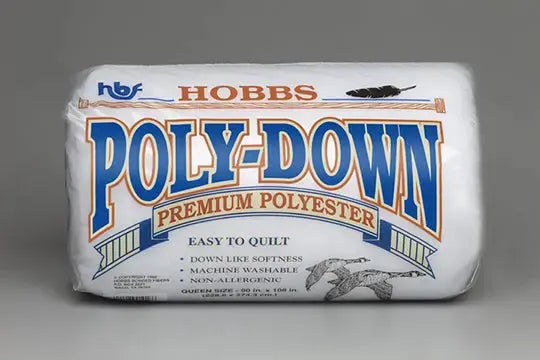
Shop Hobbs Polydown Batting Package — Crib 45" × 60" at Linda's Electric Quilters.


