
Hey everyone. Today you're going to learn why t-shirt quilts really run on tricot fusible, and how that one layer keeps stretchy tees from turning into wavy blocks.
Here we go. A t-shirt wants to stretch. That's the whole job of a t-shirt.
It's comfy on your body. It's not so comfy in a quilt.
Cut a tee into a square, and the edges curl. Sew it to a cotton block, and it grows. Press it a little too hard, and that logo block is suddenly wider than the one next to it.
The fix isn't more pins. It's not pulling it flat. It's tricot fusible on the back, before you ever cut the final block.
Why it happens
Most tees are jersey knit. Knit loops stretch side to side, and they recover. Woven quilting cotton does not do that.
So you have two fabrics that move differently. In a quilt, that means waves, and seams that don't quite line up.
Standard nonwoven fusible will stop the stretch, yes. But it can lock that shirt solid. Board stiff.
Tricot is different. Tricot is a knit fusible. It has a little give in one direction, just like the shirt does.
So it tames the stretch without killing it. The shirt still feels like a shirt. It just behaves like a quilt block now. That's the sweet spot we're after.
I have made the stiff version, y'all. Oh my goodness, I have. The quilt would almost stand up on its own. We don't need that. We want cozy, not cardboard.
What to do about it
This part is super duper easy once you slow down.
First, rough-cut your tee bigger than your final block. Don't cut to finished size yet. Leave yourself room. You'll trim to exact size after fusing, when everything is stable.
Cut your tricot fusible about the same rough size. Lay the shirt flat, wrong side up, smooth but not stretched. Lay the tricot on top, glue side down against the shirt.
Check that twice. Glue side down. Rough and slightly shiny is usually the glue side — feel for it before the iron gets hot.
Now, lift and press. Do not slide the iron. Sliding stretches the shirt while the glue is melting, and that stretch gets locked right in.
Work in sections. Press one spot for about 8 to 10 seconds. Lift. Move. Press the next spot, overlapping a little. Just like that, all the way across.
Use a medium heat and let the iron do the work. You don't have to push hard. If you need to, use a press cloth over a logo or a printed design, so the heat doesn't bother the print.
Here's the part folks rush. Let each section cool before you move the shirt.
Warm fusible is still settling. Move it too soon and it can shift or bubble. Let it cool flat on the table for a minute. Then pick it up.
It's not a race. Take your time here and the rest of the quilt gets so much easier.
Once it's cool, flip it over and trim to your final block size from the front. Now your measurements will actually stay true. A 15-inch block will stay a 15-inch block while you sew.
When it matters — and project notes
It matters on every t-shirt quilt, really. But it matters most on memory quilts.
Graduation tees. Race shirts. Dad's favorites. Those shirts can't be replaced, so a test matters. If you have a spare tee of the same weight, fuse a test square first. See how the hand feels.
It also matters when your shirts are all different weights. A thin concert tee and a heavy sweatshirt will not behave the same. Tricot evens them out, close enough that your seams meet and your sashing lies flat.
A couple of little notes. Don't stretch the shirt while you fuse — smooth is good, stretched is trouble. If a corner lifts later, just lift and press that one spot again and let it cool.
You have options here, too. Some folks like a very light tricot for soft tees, and a slightly firmer knit for heavy shirts. Completely up to you. Try a swatch and pick what you like.
And please don't be hard on yourself if your first block is a little wobbly. You're your own worst critic. We're not reinventing the wheel here. Fuse it flat, let it cool, trim it true — if I can do this, y'all can do it.
Thanks so much for spending a little time with me today. We'll see you next time. Bye.
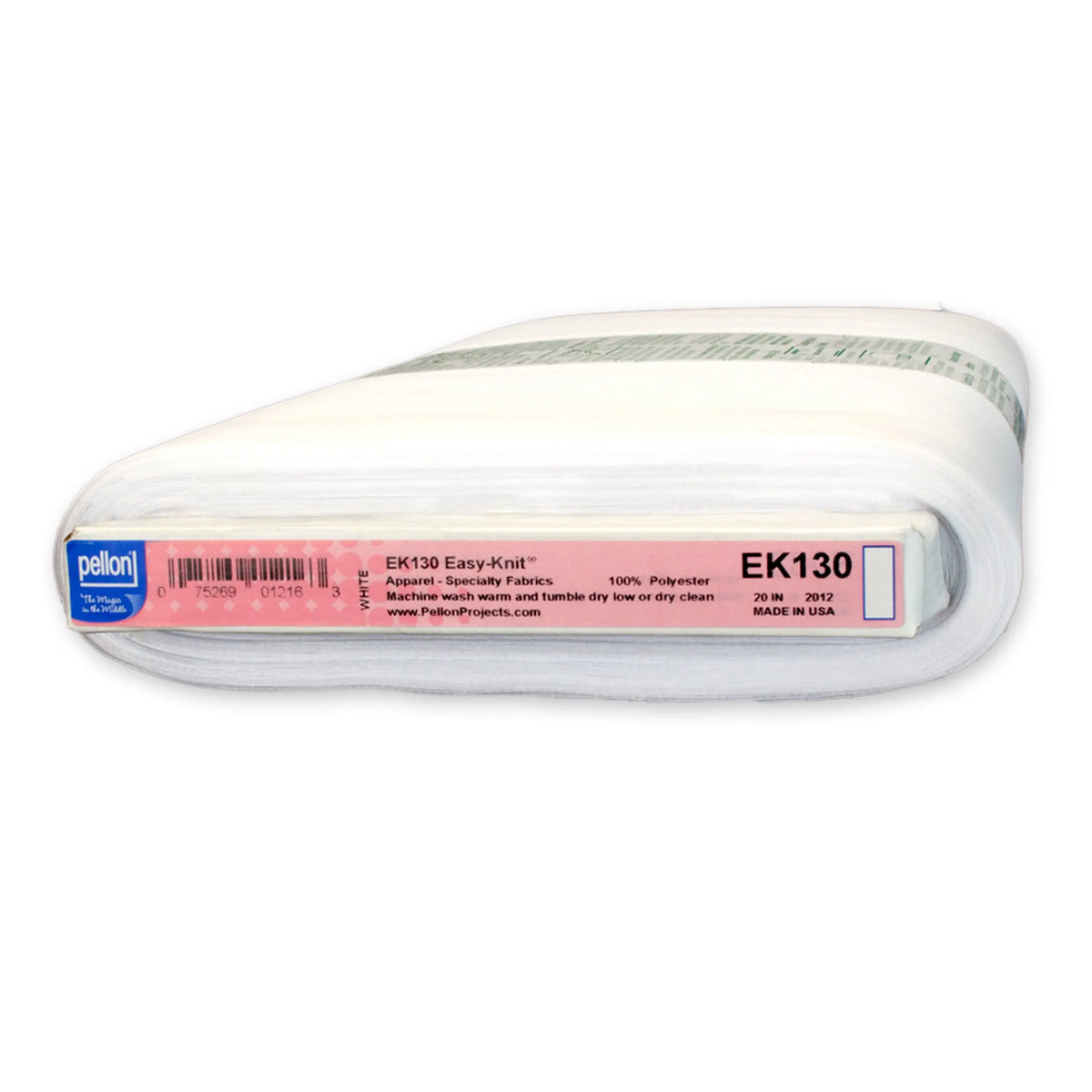
Shop Pellon® EK130 Easy-Knit® Interfacing 20" x 10 yards Bolt. Color: White. at Linda's Electric Quilters.


