
Hey everyone. Today you'll learn why a quilt that looked flat on the table can come out of its first wash wavy — and how to keep that from happening.
Here's the surprising part, y'all.
The wash usually isn't the villain.
The ripple was built in earlier. It just showed up in the water.
I learned this the slow way. I basted a quilt good and snug. I pulled that sandwich nice and taut. Oh my goodness, it looked flat. Then I washed it. Waves. Everywhere.
Why it happens
Batting is soft, springy fiber. It stretches a little when you handle it.
When you tug a sandwich taut, you stretch the batting. The top and backing may stretch a different amount. Nothing complains yet. The pins and stitches hold everything right where you put it.
Then comes the wash. Water relaxes those fibers. Warmth relaxes them more. The batting tries to go back to its natural size.
But it doesn't relax evenly. One area was stretched more. Another area barely stretched at all. So one spot shrinks back further than its neighbor.
That uneven relaxing is the ripple.
Quilting density plays a part, too. A spot quilted every 2 inches is held tight. A spot with lines 6 or 8 inches apart can move. Dense here, loose there? The loose areas have room to wave, and they will.
There's one more quiet culprit. If you quilt in one direction while pushing extra fullness ahead of the foot, that fullness has to go somewhere. It often waits for the wash to announce itself.
What to do about it
Good news, folks. The fix is simple. It just takes a gentle hand.
One: let the batting rest first. Unroll it and let it relax for a few hours, a day if you can. Compressed batting is already a little stretched and wrinkled. Give it time to bloom before you baste.
Two: smooth, don't stretch. Lay the backing down and tape or clamp it just smooth, not drum-tight. Lay the batting over it. Smooth from the center out with flat hands. Just like that. No tugging the edges to make it reach.
Three: check your overage. Keep about 4 inches of batting and backing past the top on every side. If a corner comes up short, don't pull the batting to cover it. Add a piece instead. We talked about joining scraps before — a butt join with a wide zigzag works great.
Four: baste without shifting. Pin or spray baste in a steady pattern. Work from the center out. Lift as little as possible once a section is settled. Every lift and re-lay is a chance to stretch one layer more than the others.
Five: keep quilting density even. You don't need the same design everywhere. You do want similar spacing everywhere. If the border gets lines every 2 inches, don't leave the center at 8 inches. Aim for a similar distance across the whole quilt, within what your batting allows.
Six: ease, don't push. On a domestic machine, use a walking foot and let it feed. Support the quilt's weight so it isn't dragging off the table. That drag stretches the sandwich while you sew. A quilt pulling at 45 degrees will fight you the whole way.
On a longarm, same idea. Load it smooth and even. Don't crank the rollers tighter to fix a wavy edge. That just stores up more stretch for wash day.
When it matters — and project notes
It matters most on quilts that will be washed often. Baby quilts. Couch quilts. Charity quilts. Those quilts meet water early and often, so build them relaxed from the start.
It matters less on a wall hanging that may never be washed. Still, even tension is a good habit. Gravity files its own report over time.
A small note on crinkle. Some ripple is not failure. Cotton batting shrinks a touch in the wash, roughly 3 to 5 percent, and that gives the soft antique crinkle many of us love. Even crinkle is charming. Uneven waves from stretched batting are different. Learn to tell them apart, and you'll stop blaming the washer.
And here is your permission beat.
If your finished quilt has a little wave, it is still a good quilt. You're your own worst critic. Most folks see a warm quilt made by someone who cares. Take your time on the next basting. It's not a race. If I can do this, y'all can do it.
Thanks so much for learning along with me, folks. We'll see you next time. Bye.
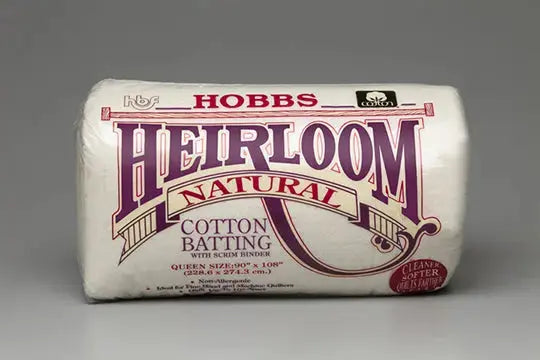
Shop Hobbs Heirloom 100% Cotton Batting Package at Linda's Electric Quilters.


