
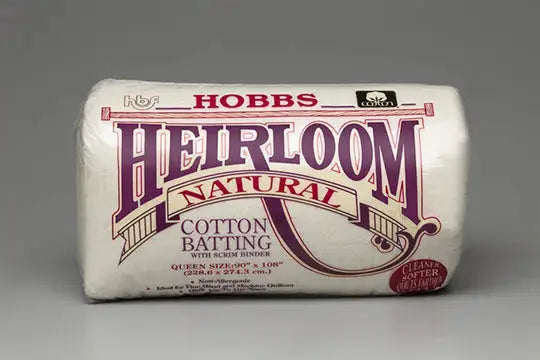
Hey everyone. Today you'll learn why that folded batting package leaves lines in your quilt — and how to relax them before they become permanent.
Here's the surprising part, y'all.
Batting remembers how it was stored.
Open a packaged square of cotton batting. See those deep fold lines? Crossways and lengthways, like a road map. Those are not just wrinkles. The fibers have been pressed flat in one position for weeks. Maybe months.
And cotton holds a grudge.
Quilt right over a deep crease and it can survive quilting. It can survive washing. You finish a beautiful top, and there is that faint ridge, right where nobody wanted it.
I have done it. I was in a hurry. I told myself the quilting would hide it. It did not. Just like that, lesson learned.
Why it happens
Packaged batting is folded to fit a bag.
It gets folded once, twice, sometimes three times. Then it sits. Weight sits on top of it in a warehouse. Weight sits on top of it in the store. Time does the rest.
Cotton fibers bend and then stay bent. Polyester bounces back a little easier. Wool bounces back best of all — that's a story for another day. But cotton, especially 100% cotton, learns the fold.
A roll is different.
Batting on a roll was never folded flat. It curves gently. No sharp corners. No hard press lines. Unroll it and it lays out smooth, or very close to it. That is why frequent quilters graduate to rolls. Not because rolls are fancier. Because they skip the crease fight entirely.
We're not reinventing the wheel here. Folds make lines. Rolls don't.
What to do about it
Here we go. Three good options. Pick what fits your day.
One: give it rest. This is my favorite. Unfold the batting completely. Lay it flat on a bed or a clean floor, or drape it over a shower rod or a longarm frame. Leave it overnight. A full 24 hours is even better. Gravity and air do quiet work. Most shallow creases relax on their own. Completely up to you how long you wait, but do not skip the rest entirely.
Two: use light steam. Hover your steam iron 1 to 2 inches above the crease. Do not press down hard — pressing can flatten the loft you paid for. Let the steam kiss the fibers, then smooth the line gently with your hand. Work one section at a time. Slow down here. Too much direct heat on a fold can set it instead of releasing it. That's the moment of risk.
Three: tumble it warm and gentle. If the care label allows it, put the batting in the dryer on low heat for 10 to 15 minutes. Add a clean, damp hand towel. The gentle warmth and moisture help the fibers let go. Take it out while it is still warm and lay it flat right away. Do not leave it balled up in the dryer. It will just learn a new set of wrinkles.
Still see a line? Place that section where dense quilting will live, if you can. A meander or an echo breaks up a faint crease far better than wide, open quilting does.
When it matters — and project notes
It matters most on smooth, solid tops.
Wholecloth quilts show everything. Light-colored solids show almost everything. A busy print with lots of piecing? Much more forgiving. The busier the top, the less a faint crease can announce itself.
It also matters for gifts on a deadline. If you are quilting tomorrow, open the package today. That overnight rest is not wasted time. It is prep, just like pressing your top. Five minutes of planning saves a whole lot of wishing later.
Should you switch to rolls? If you quilt often, and you have a corner to store one, a roll really really helps. You cut what you need, it starts out smooth, and your scraps stay flat, too. If you quilt now and then, packages are just fine. Just budget the relaxing time.
And here's your permission beat.
If a faint line sneaks into a finished quilt, it does not have to be perfect to be loved. You're your own worst critic. Most folks will see the colors, the pattern, and the person who made it for them. Take your time. It's not a race. If I can do this, y'all can do it.
Thanks so much for learning along with me, folks. We'll see you next time. Bye.
Shop Hobbs Heirloom 100% Cotton Batting Package at Linda's Electric Quilters.


