
Hey everyone. Today you will learn how two thin battings can make your quilting look carved, puffy, and really, really special.
Here we go.
Most quilters pick one batting and go.
One layer. One loft. Done.
But show quilters have a quiet trick.
They use two battings on purpose.
Cotton on the bottom. Wool on top.
No stuffing little motifs by hand.
No trimming tiny bits of batting.
Just two layers working as a team.
Oh my goodness. The stitches just pop.
It looks like trapunto. It is not trapunto.
That is why folks call it faux trapunto.
Why it happens
Real trapunto pads only the design.
You stitch around a motif, stuff it, trim close.
Beautiful work. Also a whole lot of work.
Double batting skips that fussy part.
The bottom layer gives you a stable base.
Cotton is perfect for that bottom job.
It is flat, steady, and easy to control.
It keeps the whole sandwich honest.
The top layer does the showing off.
Wool is springy. Wool wants to bounce back.
Those crimped fibers push up between stitches.
So your quilting lines sink in a little.
And the unquilted areas rise up a little.
That contrast is the whole effect, y'all.
We're not reinventing the wheel here.
Dense quilting pushes down. Loft pushes back.
Put wool on the bottom and it still works.
But cotton on top flattens the magic.
Cotton does not spring like wool does.
So layer order matters more than brand.
Wool up. Cotton down. Remember that order.
Just like that, the dimension shows up.
What to do about it
Start with a small test sandwich first.
Make it about 10 inches square.
Use your actual top fabric.
Use your actual backing fabric too.
Layer backing, cotton batting, wool batting, top.
Yes, in that exact order, folks.
Baste a little more than usual.
Two layers like to shift a tiny bit.
Pin or spray baste every 3 to 4 inches.
Now quilt your test piece fairly densely.
Try stitch in the ditch around a shape.
Then add echo quilting about 1/4 inch away.
Add a little freehand feather or meander too.
Keep background quilting closer than usual.
About 1/2 inch apart is a good test.
That dense background is what sells it.
It compresses the wool everywhere except the motif.
So the motif stays puffy and proud.
Use the needle you trust for thickness.
Many folks like a size 90/14 topstitch.
Go a touch slower through the thick spots.
Slow down or the needle snaps — ask me how I know.
I tried to rush my first double-batt quilt.
Skipped stitches. A bent needle. A big sigh.
Second try, slower speed, longer stitch length.
I used about 2.5 to 3.0 millimeters.
Clean stitches. Happy quilt. Lesson learned.
And here is your permission beat.
It does not have to be perfect.
You are your own worst critic.
Take your time. It is not a race.
If I can do this, y'all can do it.
When it matters / project notes
This stack shines on show and heirloom quilts.
Wholecloth quilts love it too.
So do quilts with big, open motifs.
Feathers, wreaths, and appliqué shapes pop beautifully.
It is less useful on a busy everyday quilt.
Dense piecing already gives you plenty of texture.
Two layers also add weight and warmth.
That is great for a winter bed quilt.
It is a lot for a summer throw.
Completely up to you, as always.
You have options, not just one way.
Option one is cotton plus wool, my favorite.
Option two is cotton plus a high-loft poly.
Poly pops too, but it feels firmer.
Option three is a single wool batting alone.
Softer dimension, lighter quilt, still lovely.
One last note on washing, folks.
Wool and cotton shrink a little differently.
That test sandwich earns its keep here.
Wash the test piece the way you will wash the quilt.
Check that you still like the hand.
Alrighty. Cotton down, wool up, quilt the background close.
That is the faux-trapunto stack, super duper easy.
Thank you so much for learning with me today. We'll see you next time. Bye.
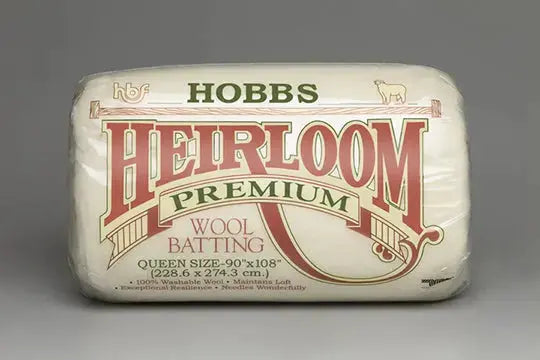
Shop Hobbs Heirloom Wool Batting Package — Queen 90" × 108" at Linda's Electric Quilters.


