
Hey everyone. Today you will learn why your home machine quilts happier with thinner batting.
Here we go. A lot of folks pick batting by warmth first. Or by puff. Then they sit down at a domestic machine. And that big, fluffy sandwich just fights them.
It is not you. It is the loft. Your home machine has batting rules, too. Once you know them, quilting gets a whole lot easier.
Why it happens
Loft is the thickness of the batting. Low loft is thin and flat. Medium loft has a little puff. High loft is thick and cloud-like.
On a longarm, that puff has room. The machine moves. The quilt sits open. On a home machine, you move the quilt. You push it through a small throat space. Every extra bit of thickness adds drag.
That drag is the trouble. A thick sandwich pulls against your walking foot. The top layer wants to creep. The bottom layer wants to lag. Your feed dogs and walking foot try to move all three layers together. With high loft, they struggle to stay in step.
So your stitches change length. Your straight lines wobble. Your quilt shifts a hair sideways. And that throat space fills up fast. A queen-size quilt rolled through a 7- or 8-inch throat is already a tight squeeze. Add high loft, and you are wrestling, not quilting.
I learned this the hard way. I tried to push a puffy quilt through my home machine years ago. My shoulders ached. My meander went sideways. Oh my goodness, it was not cute. The batting choice made that job hard before I took stitch one.
What to do about it
First, match the loft to the machine. For most home-machine quilting, pick low to medium loft. It feeds evenly under a walking foot. It folds and rolls smaller in the throat. You stay in control.
Second, use the right foot and settings. A walking foot is your best friend here. It feeds the top and bottom together. Slow down a touch. Lengthen your stitch a little — try around 3.0 to 3.5 millimeters for walking-foot quilting. Short, fast stitches in a thick sandwich just add puckers.
Third, test with a small sandwich. Make a 10-inch square with your exact top, batting, and backing. Quilt it the way you plan to quilt the big one. If it feeds clean and your stitches stay even, you are good. If it drags and bunches, you caught it on scrap. Not on your quilt.
Fourth, support the weight. Do not let the quilt hang off the table. That pull is drag, too. Pool it gently on the table and in your lap. Lift and guide. Do not shove. Slow down around thick seam crossings, or the needle can deflect and snap. Ask me how I know.
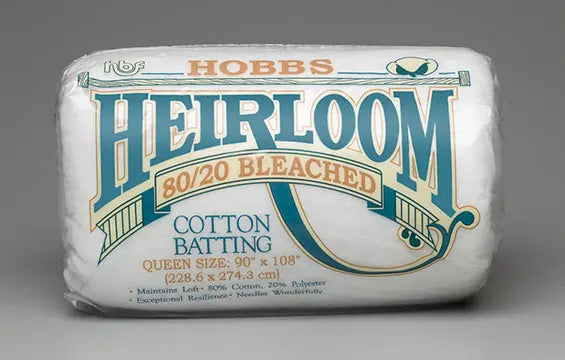
Here is what I use and why. At home, I reach for a low-loft 80/20 cotton-poly batting most of the time. It is thin enough to feed smooth. It still shows my quilting stitches nice and clear. And it drapes like a real quilt when it is done. If I want more puff, I let the quilting do that work — looser quilting, wider spacing, softer patterns. The texture comes from the stitches, not from fighting a thick batt. Completely up to you, though.
When it matters most
This matters most on big quilts. A throw or a queen on a home machine is a lot of bulk. Thin batting keeps that bulk manageable from the first row to the last.
It matters for dense quilting, too. Lots of stitch in the ditch. Lots of echo quilting. Lots of close meander. Dense stitching flattens loft anyway. So starting thin loses you nothing. It just saves the fight.
It matters less on small projects. Wall hangings. Table runners. Baby quilts. Those fit easy in the throat. If you love a puffier batt there, go for it. The machine can handle the small load just fine.
And if your heart is set on high loft? That can still work. Quilt it in sections. Or quilt as you go. Or save that one for a longarm. Options, not verdicts, folks.
It does not have to be perfect. You are your own worst critic. Take your time. It is not a race. Pick the batting your machine can feed well, and the whole project gets kinder. If I can do this, y'all can do it.
Thanks for spending a few minutes with me, folks. We'll see you next time. Bye.
Shop Hobbs Heirloom Bleached 80/20 Batting Package at Linda's Electric Quilters.


