
Hey everyone. Today you will learn why a wet king quilt can be way too heavy for your washer — and your arms.
Here we go. A dry king quilt feels manageable. You fold it. You carry it. No big deal. Then you wash it. And suddenly you are holding a whole different quilt.
I mean that literally, folks. A soaked king can double in weight. Sometimes it triples. Oh my goodness, the first time it happens, you think you did something wrong. You did not. The batting did exactly what cotton does.
Why it happens
Cotton batting drinks water. Cotton fibers are hollow inside. They soak up water and hold it. The top and backing fabrics drink some, too. But the batting in the middle is the big sponge.
Now think about size. A king quilt is about 120 by 120 inches. That is a lot of batting. A lot of sponge. Every square inch takes on water at the same time.
Polyester behaves different. Poly fibers do not absorb much water. Water sits between the fibers instead. It drains and spins out faster. So a poly king gets wet, yes. But it does not gain weight like a cotton king does.
Blends land in the middle. An 80/20 cotton-poly batt will gain a lot. Just not quite as much as 100 percent cotton. The fiber mix you chose months ago decides your laundry day today.
I learned this the hard way. I pulled a wet cotton king out of a home washer years ago. My arms were shaking. The quilt slumped and pulled. I nearly dropped the whole soggy pile on the floor. The quilt was fine. My plan was the problem.
What to do about it
First, check your washer before you start. Many home machines handle around 12 to 20 pounds dry, depending on the model. A big cotton king can pass its comfort zone once it is soaked. If the drum is packed tight with no room to tumble, stop. Do not force it.
Second, support the weight the whole way. Never lift a wet king by one corner. That pull stresses seams and stitches. Slide your arms underneath it. Lift like you are carrying a big, sleepy dog. Move it in a bundle, close to your body.
Third, use the spin cycle well. Let the machine spin as much water out as it safely can. You can run an extra spin on most machines. Every cup of water spun out is weight you do not have to carry.
Fourth, think about the dryer, too. A wet king needs room to tumble there as well. If it fills the drum solid, it will dry slow and uneven. And moving it wet, from washer to dryer, is the heaviest moment of all. Get a second pair of hands if you can. Completely up to you, but I ask for help now.
Here is what I use and why. For a king that will get washed often, I think hard before I choose 100 percent cotton. I love cotton's drape and crinkle. I really really do. But if that quilt is huge and will live on a bed year-round, I weigh the laundry reality, too. Sometimes an 80/20 gives me the hand I want with a kinder wash day.
When it matters most
This matters most with front-loaders and older machines. A front-loader is gentle and uses less water. That is good. But a heavy, soaked quilt can strain the drum and the bearings over time. If the machine sounds like it is struggling, that sound is information.
It matters for your body, too. Wet quilts are awkward, not just heavy. They shift. They slide. They pull at your back and shoulders in funny ways. Slow down here, folks. A dropped wet quilt on a hard floor is a dirty quilt you get to wash again.
And sometimes, the laundromat is just the right call. Those big commercial machines are built for this load. Bring your king there. Use the largest washer. You are not giving up. You are picking the right tool for the job. We're not reinventing the wheel here.
It does not have to be perfect. You are your own worst critic. Take your time. It is not a race. Just plan for the wet weight before the quilt is already soaking. If I can do this, y'all can do it.
Thanks for spending a few minutes with me, folks. We'll see you next time. Bye.
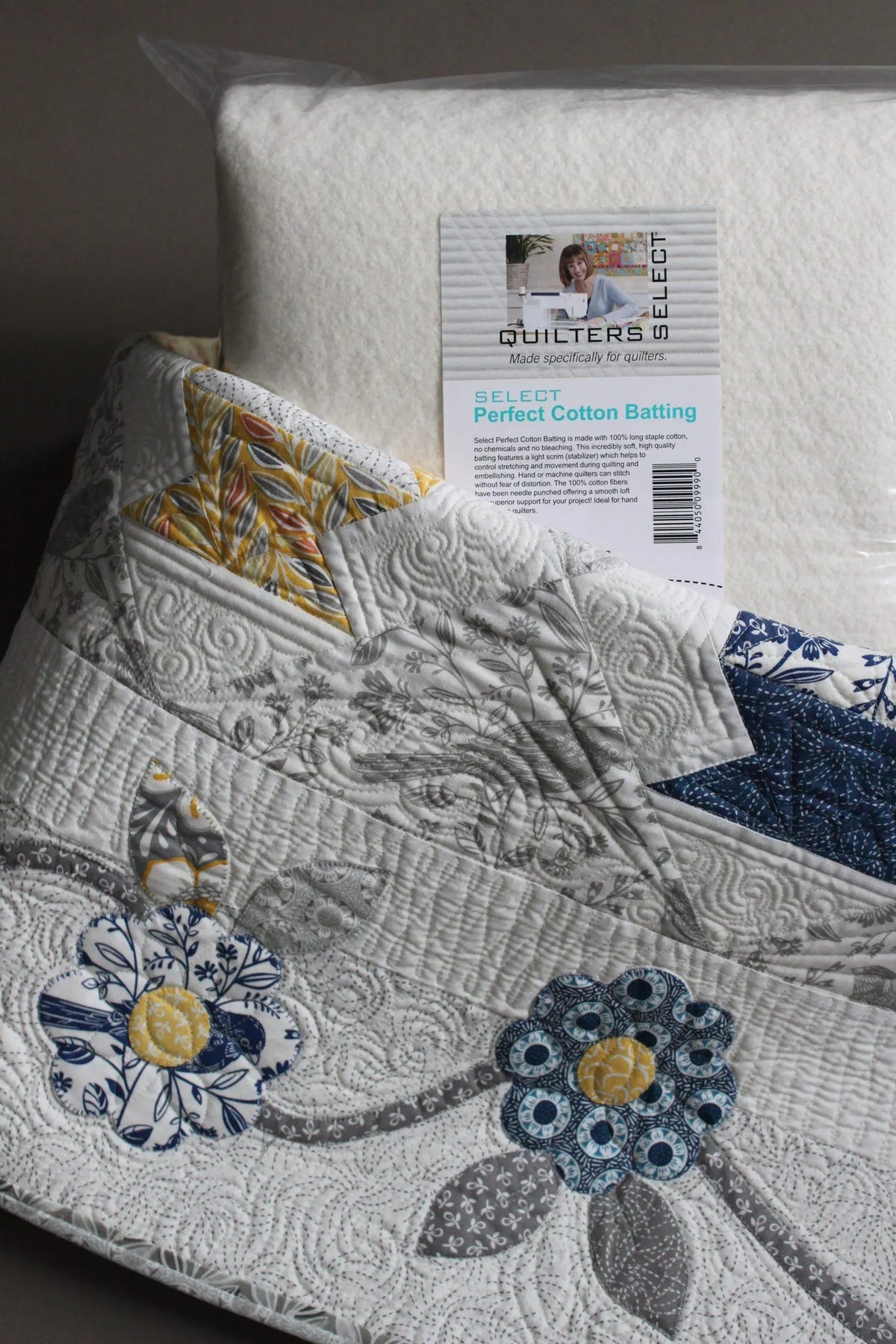
Shop Quilters Select Perfect Cotton Batting 122" x 122" - King Cut at Linda's Electric Quilters.


