
Hey everyone. Today you'll learn why a dark quilt can look washed out before you ever wash it.
Here we go.
You pieced a rich, deep top. Blacks. Navies. Deep purples.
Then you layered it over white batting. And just like that, it looked a little pale.
Oh my goodness. I thought my fabric had faded.
It hadn't, y'all. The batting was showing through.
Why it happens
Batting is not invisible. It sits right behind your top fabric.
Quilting cotton is not a brick wall. Light gets through it. Color gets through it too, just a little.
Put something white behind a dark fabric, and that fabric reads lighter. Put something bright behind seam allowances, and they can glow like little pale stripes.
You will spot this most at the seams. Pressed allowances are thinner. The stitching line has tiny needle holes. And those holes love to show whatever is underneath.
White fibers can peek through those holes, too. One stitch at a time. It can look like tiny white specks scattered across a black block.
That is not dirt. That is not lint. That is your batting saying hello.
Black batting fixes the whole problem from underneath. Dark behind dark stays dark. The top keeps its rich color. The seam allowances stop shouting.
There is a mirror rule, too. White tops want white batting.
Put a natural, creamy batting behind a bright white top, and that white can look dingy. A little yellow. A little tired.
Same lesson, both directions. Match the batting color to the top.
What to do about it
Before you baste, do the window test. It takes ten seconds.
Hold your top fabric up to the light. Slide a piece of white batting behind it. Now slide a piece of black batting behind it.
Look at the color, not just the feel. One of them will make that fabric sing. The other one will change it.
Check your seam allowances in that test, too. Fold the fabric like a real seam. That thin spot tells the truth fast.
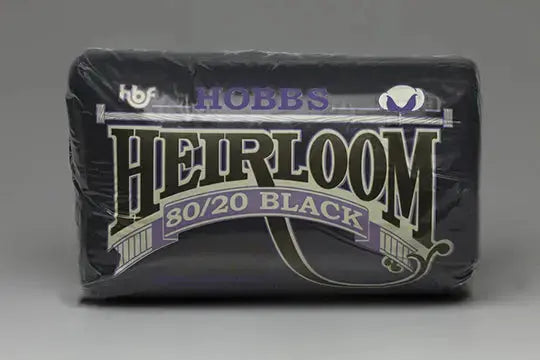
Here is what I use and why. For a mostly dark quilt, I reach for a black 80/20 batting. It is mostly cotton, with a little polyester for strength. It quilts soft, it drapes nice, and it keeps those deep colors deep.
Quilt it the way you normally would. Use your regular needle for your machine. Go at your normal pace. The color change is the only change you need.
If your quilt is half dark and half light, you have options. You can use black batting and check the light blocks carefully. You can use white batting and check the dark blocks. Or you can piece your batting — dark under the dark sections, light under the light ones — joining the pieces edge to edge so there is no ridge.
All three can work. Completely up to you. Just test first, on a small sandwich, before the real quilt commits you.
And here is your permission beat, folks. If you already finished a dark quilt on white batting, it is not ruined. Not even close.
Stand back three feet. If you love it from there, you are done. You're your own worst critic. Take your time. It's not a race.
When it matters most
This matters most on solid dark quilts. Amish-style quilts. Modern quilts with big fields of black. Anything where the color is the whole design.
It matters on dark quilts with light thread, too. Those needle holes stand out more. Dark batting underneath keeps them quiet.
It matters less on busy prints. A wild, multi-color print hides a lot. It matters less on very thick, tightly woven tops, too.
But for a quilt a customer will see under bright shop lights? Or a gift quilt in deep jewel tones? Do the window test. Really really simple. Really really worth it.
If I can do this, y'all can do it. We're not reinventing the wheel here. We're just putting the right color under the color.
Thanks so much for learning along with me, folks. We'll see you next time. Bye.
Shop Hobbs Heirloom Black 80/20 Batting Package at Linda's Electric Quilters.


