
With a directional or nap fabric you cannot rotate pieces, but you can still choose between a lengthwise layout (all rows stacked along the grain) and a mixed layout that pairs long pieces with short pieces in the same row band. Compare both by total length consumed: the mixed layout usually saves fabric when piece lengths differ widely, and it never saves anything when all pieces are near the full usable width.
The constraint, in one paragraph
A nap or one-way print locks every piece to a single orientation: no rotating, no flipping head-to-foot to nest pieces together. What it does not lock is how pieces share rows. Within a row band across the fabric's width, pieces of different lengths can sit side by side as long as each one points the right way — the band's length is set by its longest piece, and shorter pieces in the same band ride free. The full measurement protocol (longest piece, repeat, one-direction row sum) is in the prerequisite guide linked below; this article compares the two ways of exploiting it.
Layout A: pure stacked rows
The beginner-safe method: lay out the pieces piece by piece, one per row, grouped by type — skirts together, bodices together, sleeves together — each row as long as the piece in it. Nothing has to be thought through, nothing can be mis-paired, and the waste is structural: every short piece pays for a full row of its own.
Layout B: banded pairing
Build rows as bands. Start each band with the longest remaining piece; then fill the leftover width in that band with shorter pieces whose lengths are less than or equal to the band's length. The short pieces consume width that Layout A wastes, and add nothing to the total length. The discipline: every piece still points the same direction, and a piece may only join a band if its full width fits the band's remaining width — no squeezing, no tilting.
The worked comparison
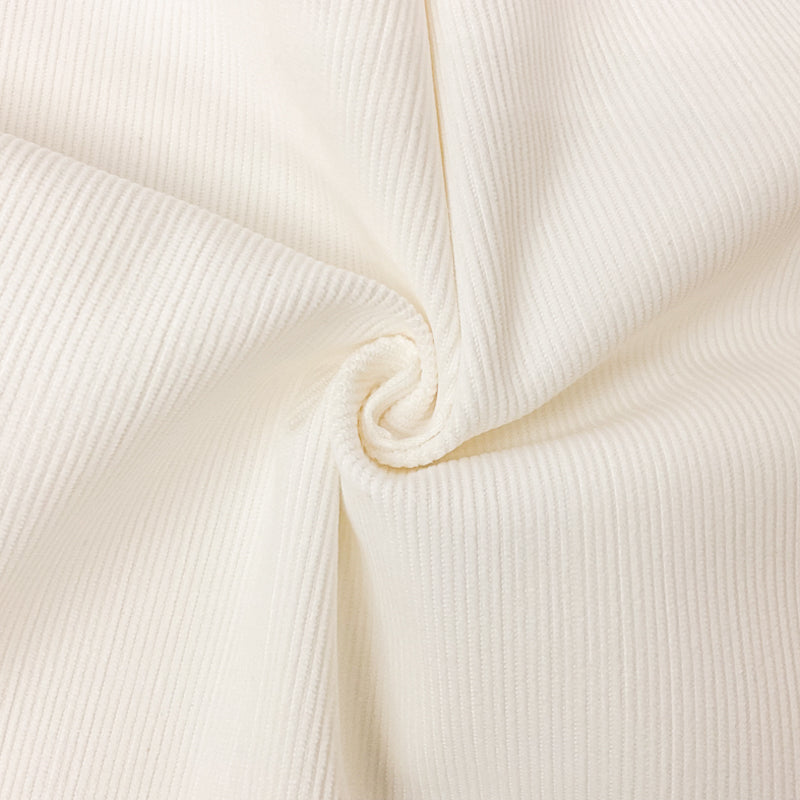
Same garment and fabric as the measurement guide: a dress in the Ivory Cotton Medium Wale Corduroy (100% cotton, 43″ wide; 41″ usable, nap running one way). Pieces: skirt front and back, 20″ wide × 26″ long; bodice front and back, 20″ × 18″; two sleeves, 15″ × 24″; facings, a 10″-long group 12″ wide in total.
Layout A — stacked singly
- Skirt front 26″ · skirt back 26″ · bodice front 18″ · bodice back 18″ · sleeve 24″ · sleeve 24″ · facings 10″
- Total: 146 inches = 4.06 yards → buy 4¼ yards.
Layout B — banded pairing
- Band 1 (26″): skirt front (20″ wide) + one sleeve alongside (15″) = 35″ of the 41″ width; band length set by the skirt, 26″
- Band 2 (26″): skirt back (20″) + the second sleeve (15″) = 35″ across → 26″
- Band 3 (18″): bodice front (20″) + bodice back (20″) = 40″ across → 18″
- Band 4: the facings, tucked beside nothing — they take their own short row of 10″; or, if the 6″ of slack in Bands 1–2 fits a facing piece's width, they ride there and this row disappears
Total with the facings row: 26 + 26 + 18 + 10 = 80 inches = 2.22 yards → buy 2¼ yards.
The measurement guide's straightforward row sum for this garment (sleeves paired with each other, bodices paired, facings in their own row) lands at 104 inches — between the two. Layout B beats it by moving the sleeves out of their own row and into the skirt bands' spare width. Layout B versus Layout A saves 66 inches of length — over 1¾ yards — on this one garment. Apply the cost step from the unconstrained comparison (yardage to buy × price per yard) if you are also weighing this fabric against a narrower or wider directional option.
When Layout B fails
Uniform piece widths. If every piece is near the full usable width — wide skirt panels in a narrow fabric — no band has spare width to fill, and B equals A exactly. Banding is not magic; it only harvests spare width.
Motif placement overrides. A piece whose print motif must sit at a precise place (a centered center-front motif) is placed by the print, not by the banding logic; it takes the row it needs.
Very small garments. When the total is a yard or less, the saving shrinks to inches and the simpler Layout A's lower error rate may be worth more than the cloth.
Cutting accuracy. Banding crowds the table. On a slippery or very bulky nap fabric, a crowded layout raises the chance of a shifted piece; a ruined piece costs more than the saving.
The buying decision
Run both layouts on paper, price the winner by yardage × price per yard, and buy that figure rounded up to the next ¼ yard — plus, for prints, the repeat allowance from the yardage guide, which banding does not replace: bands organize pieces along the width, while the allowance protects motif placement along the length. The fabrics for this module are in the apparel fabric collection; the corduroy of the example and the White Cotton Crinkled Double Gauze (52″) and Light Green Rayon Solid Challis (55″) are the verified examples named across this module.
Limitations
Both layouts are arithmetic demonstrations on the stated piece dimensions, not cut garments. Banding savings depend entirely on the piece set; measure your own pieces rather than borrowing this example's percentages.
Keep reading
More from Fabric Math Made Easy. Prerequisite: directional and nap layouts: the measurements you need before buying. Compare the unconstrained case in fabric-width substitutions: comparing two layouts.


