
Before buying a directional or nap fabric, measure the pattern's longest piece, the print's repeat length (or confirm the nap direction), and the total length of all pieces laid in a single orientation. Because no piece may be rotated or flipped, yardage is driven by the sum of one-direction row lengths — then add the repeat allowance for your repeat size before you buy.
What makes a fabric one-way
Three different properties can lock a layout to a single direction, and they are worth separating because the measurement differs slightly for each:
- Nap. Pile fabrics — corduroy, velvet, velveteen — have a surface direction. Stroke the fabric one way and it feels smooth and looks lighter; stroke it back and it feels rough and looks darker. Pieces cut in mixed directions shade differently and the finished garment looks pieced from two fabrics.
- One-way prints. A print whose motifs have a clear up and down — flowers that grow, figures that stand, text. A rotated piece reads upside down.
- Directional stripes and checks. Less absolute: the pattern may allow some pieces to run crosswise, but the decision is a design decision, made before buying, not discovered at the table.
To identify nap direction, use the two standard checks: the hand-stroke test above, and the light test — hold the fabric up and turn it end for end; the end that reflects lighter is pile-lying-toward-you. Mark the direction with chalk arrows on the wrong side of every piece as you plan. These are layout techniques, not options: on a nap fabric, "with nap" cutting (all pieces running the same direction) is the only version that sews up into one consistent garment.
The three measurements
- The longest piece, measured along the grain. It sets your minimum possible purchase and the scale of every row below it.
- The repeat length (for prints): choose one exact point in a motif — the top of a specific flower, say — and measure along the length to the next identical point. Measure two repeats and halve the figure if the print is large; a mis-measured repeat poisons every subsequent calculation. For nap fabrics there is no repeat; this measurement becomes the nap-direction confirmation above.
- The one-direction row sum. Group pieces into rows across the usable width with every piece pointing the same way. A row's length is its longest piece. Add the row lengths: that sum is the yardage driver.
Worked example: a corduroy dress
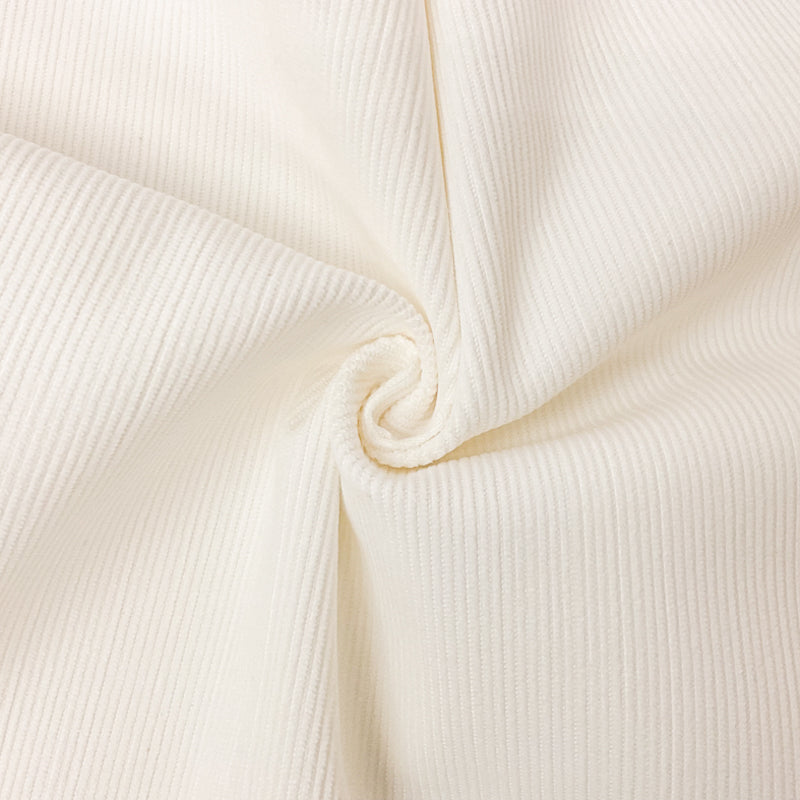
The garment is a simple dress to be cut from the Ivory Cotton Medium Wale Corduroy — 100% cotton, 43 inches wide, 12 wales per inch, a genuine nap fabric — so plan on 41 inches of usable width. Pieces, all running nap-down: skirt front and skirt back, each 20 inches wide × 26 inches long; bodice front and back, each 20 × 18; two sleeves, each 15 × 24; facings totalling a 10-inch row.
- Row 1: skirt front → 26″
- Row 2: skirt back → 26″
- Row 3: bodice front (20″) + bodice back (20″) = 40″ across → 18″
- Row 4: both sleeves side by side (15″ + 15″ = 30″ across) → 24″
- Row 5: facings → 10″
Row sum: 26 + 26 + 18 + 24 + 10 = 104 inches = 2.89 yards → buy 3 yards. Compare the trap: the same pieces in a two-way layout (tops of pieces paired head-to-foot) would consume noticeably less, which is why a yardage figure borrowed from a non-directional version of the pattern under-buys a nap fabric every time.
The repeat allowance for one-way prints
For a one-way print, the row sum is not the end: pieces must also start at the right point in the repeat so motifs sit consistently, and that costs extra length. The store's yardage guide sets the allowances — 10–15% for a small repeat, 15–25% for a medium repeat, and one full additional repeat for a large one. Add the allowance for your measured repeat size to the row sum, then round up to the next ¼ yard. Those percentages are the yardage guide's figures, credited here rather than restated: its fabric yardage guide section on print repeats is the reference of record.
Edge cases
A piece longer than the repeat cycle allows gracefully. If the longest piece spans several repeats, motif placement at its top edge dictates where the cut starts; buy for the placement, not just the sum, and expect the allowance's top end.
Center-front motif placement. If a single motif must sit centered on a bodice front, that piece's position in the repeat is fixed, and neighbouring rows may have to shift to accommodate it — one more reason the allowance exists.
Never mix nap direction across a garment. Not "mostly one way." One reversed sleeve reads as a different fabric under shop light and daylight alike. If the yardage will not cover an all-one-way layout, the answer is a different fabric or a redesigned garment, never a quiet compromise at the cutting table.
Nap also constrains construction. All pieces cut one way means seams join surfaces whose pile lies consistently — a genuine sewing convenience — but pressing and seam direction should follow the nap throughout; the Apparel hub's fabric-handling guides cover the construction side.
Choosing the fabric
The apparel fabric collection is the main collection for this module. The corduroy above is the worked example's fabric; the Light Green Rayon Solid Challis (55″ wide) and White Cotton Crinkled Double Gauze (52″ wide) are the non-directional contrast cases — measure their prints (if any) with the same protocol before assuming they are free to rotate.
Limitations
The worked example is an arithmetic demonstration on stated dimensions, not a cut garment. Print-repeat percentages are planning allowances from the yardage guide, not guarantees for a specific motif layout.
Keep reading
More from Fabric Math Made Easy. Prerequisite: the width-substitution measurement set in the fabric yardage guide. Next: comparing two layouts to reduce waste in directional and nap fabrics.


