
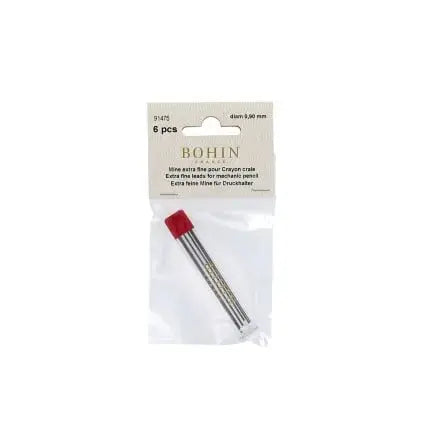
What Is a Mechanical Chalk Pencil Refill?
The Grey Bohin Mechanical Chalk Pencil Refill keeps your Bohin mechanical chalk pencil marking long after the first lead runs out. Made by Bohin France, each pack contains six grey chalk refills in a fine 0.9mm size. Unlike a traditional wooden chalk pencil, a mechanical pencil feeds a consistent, slender lead every time, so your line stays the same width from first mark to last — no sharpening, and no thick, fuzzy lines halfway through a project.
The chalk itself is water soluble, which is the detail that matters most in the sewing room. The marks are meant to be temporary: they guide your cutting, piecing, and quilting, then wash away when the project is finished. The soft grey color is a versatile middle tone — visible on many light and medium fabrics where white chalk disappears.
Why Quilters and Sewists Use It
Accurate marking is the quiet half of accurate sewing. A fine 0.9mm chalk line lets you trace quilting designs, mark seam lines, register appliqué placement, note dart and buttonhole positions, and draw diagonal lines for half-square triangles without a thick line eating into your seam allowance. Because the line is thin, you can sew right on it with confidence instead of guessing which edge of a fat chalk stroke was the true line.
Water solubility brings peace of mind, too. Marks that wash out mean you can label quilt blocks or test a quilting motif on your actual quilt top, knowing a wash will remove the evidence. And because these are refills, one pencil body serves project after project — you simply reload instead of replacing the whole tool.
How to Use It, Step by Step
- Load the refill. Open your Bohin mechanical chalk pencil as directed for the pencil body, insert one 0.9mm grey refill, and close it up. Advance the lead with the pencil's click mechanism until a short length shows.
- Test first. On a scrap of your project fabric, draw a line, then dab or wash the scrap to confirm the mark comes out cleanly. Always test chalk on a new fabric before marking the real thing.
- Mark with a light hand. Draw along your ruler, template, or stencil with gentle, even pressure. Let the fine lead do the work — pressing hard can snap a slender lead and lays down more chalk than you need.
- Sew on the line. Stitch, cut, or fold along your marks as the pattern directs, re-marking lightly if handling fades a line.
- Remove the marks. When the project is complete, wash it to dissolve the water-soluble chalk. Check that marks are gone before drying or pressing with heat.
Practical Tips
Keep the exposed lead short. A 0.9mm chalk lead is precise because it is fine, and a short tip is a strong tip. Use the grey on fabrics where white chalk would vanish, and pair it with a white refill for dark fabrics so you always have a visible option. Mark on a firm, flat surface rather than over soft batting when you can — the line will be crisper and the lead less likely to catch and break. If a line lands in the wrong place, remove it and redraw rather than sewing around a mistake.
Care and Storage
Store the spare refills in their pack so the slender leads stay protected from knocks in a drawer or project bag — they can snap if rattled loose among heavy tools. Keep the pencil and refills dry, since the chalk is designed to react to water. Retract the lead when the pencil goes back in your kit.
Project Ideas
Reach for this pencil when you are transferring a quilting stencil to a finished top, marking the grid for crosshatch quilting, lining up embroidery placement, labeling the rows of a sampler quilt, or marking garment details like darts and hems. Anywhere a project needs a fine, honest line that will not be there in the end, this little refill earns its place.
Shop the Grey - Bohin Mechanical Chalk Pencil Refill at Linda's Electric Quilters.


