
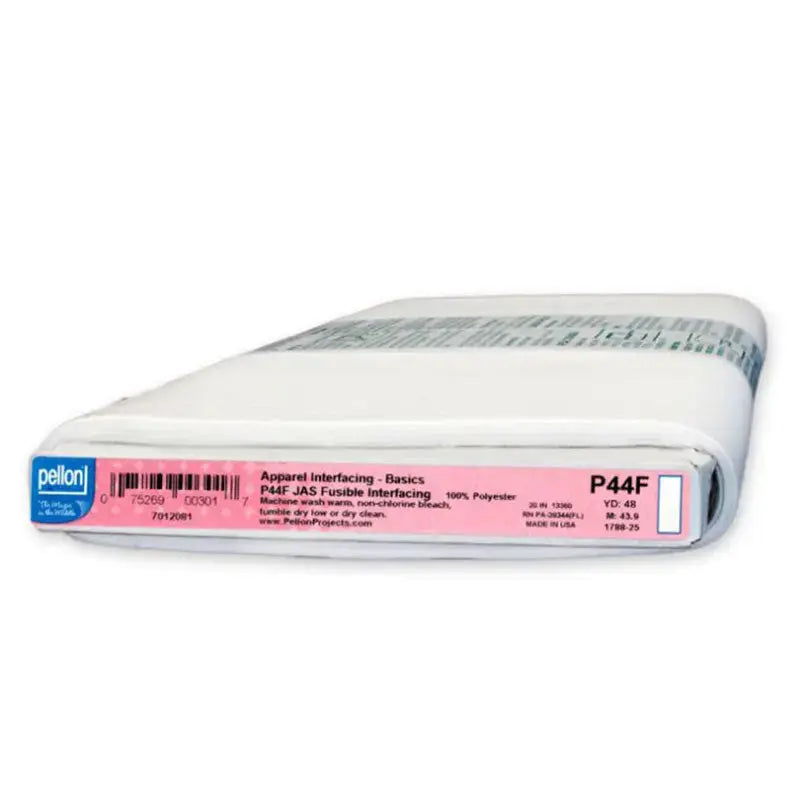
Some fabrics are lovely to wear and sew, but just a little too soft, sheer, or stretchy to behave on their own. That is where interfacing earns its place in the sewing room. The Pellon Lightweight Nonwoven Fusible Interfacing 20" White By The Yard — Pellon P44F — adds lightweight support, shape, and stability to garments, quilting projects, and everyday sewing, reinforcing your fabric without adding unnecessary bulk.
What Is Pellon P44F Lightweight Fusible Interfacing?
P44F is an ultra-lightweight, nonwoven, iron-on interfacing made from 100% polyester. "Nonwoven" means it has no grainline to worry about, so you can cut your pieces in whatever orientation makes the best use of the material. "Fusible" means it bonds to compatible fabrics with heat from your iron, so there is no separate pinning or basting layer to manage — once it is pressed in place, the interfacing and fabric move and sew as one.
It is designed for light- to medium-weight fabrics and works with both woven and knit fabrics. Pellon points to blouses, sheer garments, and lightweight materials such as crepe de chine, voile, and handkerchief linen as natural partners, where a project needs subtle structure and support rather than stiffness. It measures 20 inches wide, is sold by the yard so you can order just the amount your project needs, and comes in white to suit light-colored fabrics.
Why Sewists and Quilters Use It
Interfacing solves quiet problems before they become visible ones. A blouse collar, placket, or cuff made from a soft fabric can droop, stretch, or let buttonholes distort without a little reinforcement behind it. Sheer fabrics can shift at the seams and show every wobble. A lightweight fusible adds body while keeping the drape of a delicate fabric intact, which is exactly the balance P44F is made for.
Quilters reach for it too. Pellon notes that P44F can be used to stabilize quilting projects, adding lightweight support where additional structure is needed — for example behind fabrics that feel too fragile or fluid to piece confidently, or wherever a light layer of stability helps the top layers behave during construction.
How to Use It: Step by Step
- Test first. Cut a small scrap of both your fabric and the interfacing, fuse them together, and let the sample cool. Check that the bond holds, the fabric's drape still suits your project, and nothing has puckered or shown through.
- Cut your pieces. Cut the interfacing to match the pattern piece you are reinforcing. Because it is nonwoven, orientation is flexible; many sewists trim the interfacing slightly inside the seam allowances to keep seams less bulky.
- Position it. Lay your fabric piece wrong side up on the ironing board and place the interfacing on top, fusible side against the wrong side of the fabric, smoothing it flat with no wrinkles or folds trapped underneath.
- Press to fuse. Working in sections, press with your iron to bond the two layers, rather than sliding the iron around, which can shift the interfacing before it grabs. Let each section cool before moving the piece.
- Sew as one layer. Once fused and cooled, handle the fabric and interfacing as a single piece as you construct your garment or project.
Practical Tips
Always test on the actual fashion fabric — sheers and delicate weaves can react differently to heat, and a two-minute test is cheaper than a ruined blouse front. Fuse before you sew the piece into the garment, while it is still flat and easy to press evenly. If an edge lifts after cooling, simply press that spot again. And when in doubt between weights, remember this is the ultra-lightweight option: it is meant to support light- to medium-weight fabrics, not to stiffen heavy ones.
Care and Storage
Store leftover yardage rolled or folded loosely in a cool, dry spot away from direct heat, so the fusible coating stays ready for your next project. Keep cut scraps with the yardage — small pieces are perfect for reinforcing facings, plackets, and other little areas, and for your test samples. Because it is sold by the yard in a 20-inch width, even a single yard gives you a generous supply for garment details.
Project Ideas
Reach for P44F when you are sewing a voile or crepe de chine blouse that needs gentle support at the collar and button band, stabilizing a handkerchief linen top, backing a sheer garment section that needs a little more confidence at the seams, or adding lightweight stability to a quilting project where the main fabrics feel too soft to handle cleanly on their own.
Shop the Pellon Lightweight Nonwoven Fusible Interfacing 20" White By The Yard at Linda's Electric Quilters.


