
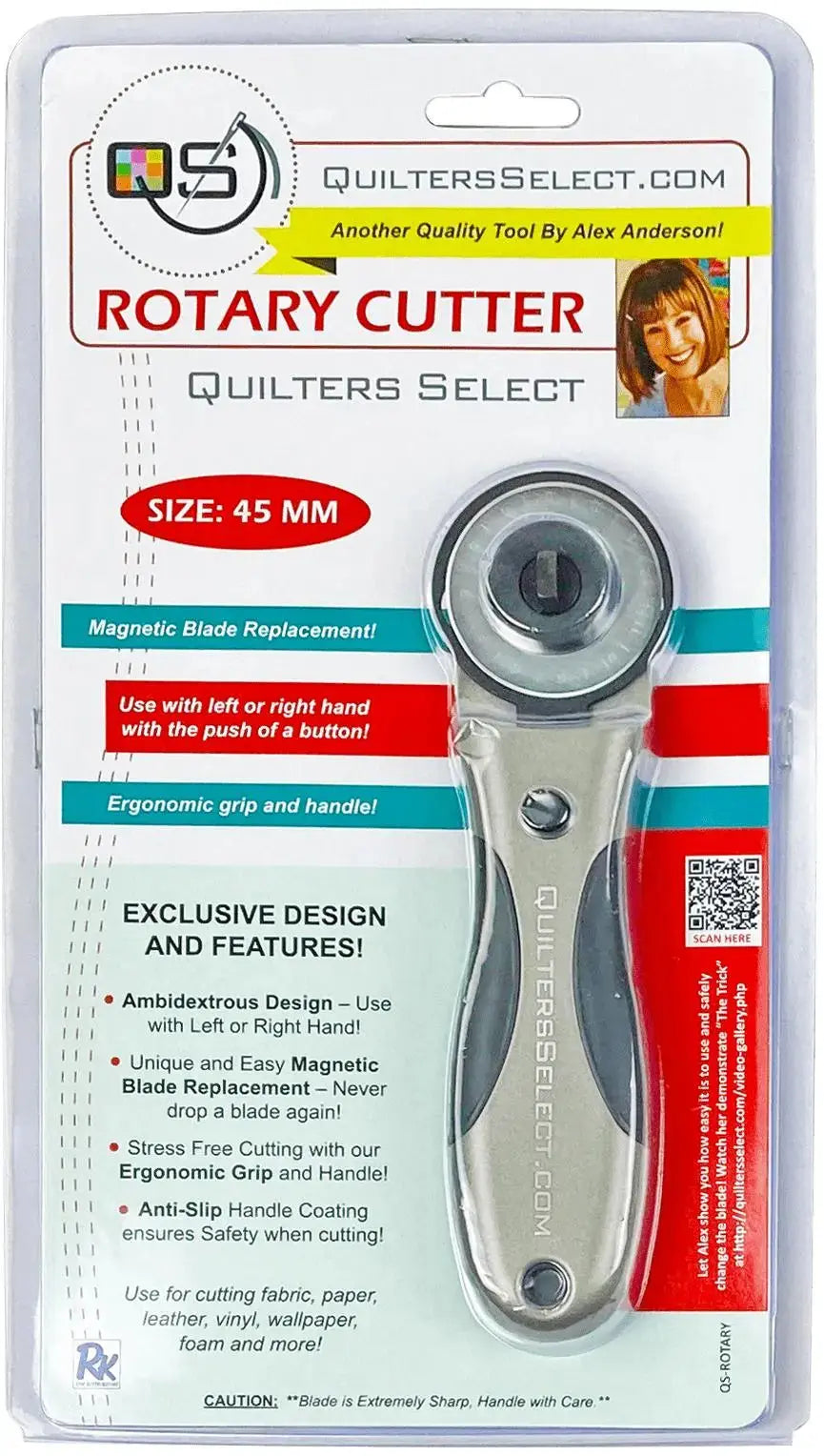
What Is a 45mm Rotary Cutter?
A rotary cutter is a round-bladed tool that rolls through fabric as you guide it along a ruler. Instead of the opening-and-closing motion of scissors, it makes one smooth, continuous cut, which is why quilters rely on it for straight strips, squares, and rectangles. The Quilters Select 45mm Deluxe Rotary Cutter is built around a 45mm blade — the versatile, everyday size most quilters reach for first.
Two features set this cutter apart. First, it has an innovative ambidextrous design that ensures precise cutting along a ruler in either your left or your right hand. Second, its blade replacement is magnetic — a unique and easy system designed so you will never drop a blade again while changing it.
Why Quilters and Sewists Use It
Accuracy in quilting starts at the cutting table. If a strip is cut a fraction too wide, those small errors add up seam after seam, and blocks stop matching. A rotary cutter, used with a ruler on a cutting mat, gives you a clean, repeatable edge that scissors are hard-pressed to match across long cuts.
The ambidextrous design matters more than it might sound. Left-handed cutters often have to mirror right-handed instructions. A cutter designed to track precisely along a ruler in either hand lets you work from whichever side keeps your ruler hand steady and your cutting line in clear view.
How to Use It, Step by Step
- Start on a proper surface. Always cut on a cutting mat on a flat, sturdy table. The mat protects your table and gives the blade a suitable surface to cut against.
- Press and lay out your fabric. Press out wrinkles, align the fold or selvages, and lay the fabric flat on the mat without stretching it.
- Place your ruler. Set the ruler on the fabric, lining its edge up with your measurement. Hold it firmly with your non-cutting hand, fingers curled safely away from the ruler's edge.
- Choose your comfortable hand. Thanks to the ambidextrous design, hold the cutter in whichever hand — left or right — lets you keep the blade tight against the ruler.
- Cut in one smooth pass. Roll the blade along the ruler in a single steady motion with even pressure, keeping it snug against the ruler from start to finish.
- Check the first piece. Measure your first strip or square in two places. If it is consistent, continue cutting the rest the same way.
- Make the blade safe. Cover or retract the blade every time you set the cutter down, even for a moment.
Practical Tips
Let the blade do the work. Pressing harder at an angle tends to push the ruler out of line rather than cut cleaner, so use firm, even pressure and a smooth roll. Never reach across an exposed blade to move fabric.
Change a dull blade promptly. A dull blade skips and drags, which frays edges and ruins accuracy. When it is time, the magnetic blade replacement makes the swap simpler and safer — the magnet helps control the blade so it does not slip from your fingers and drop. Replacement blades are available in packs of 1 or 5, so you can keep a spare on hand or stock up.
If a cut does not go all the way through, do not saw back and forth over the same spot. Realign the ruler on the original line and make one more clean pass.
Care and Storage
Store the cutter with the blade covered, out of reach of children. Keep spare blades in their original packaging, and handle every blade by its edges. Wipe lint from around the blade regularly, since fuzz can affect how smoothly it rolls. Dispose of used blades in a rigid, sealed container rather than loose in the trash.
Project Ideas
Reach for it at the start of almost any patchwork project: cutting strips for nine-patches and log cabin blocks, squaring up half-square triangles, trimming blocks to size, and cutting binding strips. It is equally handy for garment and bag makers cutting pattern pieces from yardage.
Shop the Quilters Select 45mm Deluxe Rotary Cutter at Linda's Electric Quilters.


