
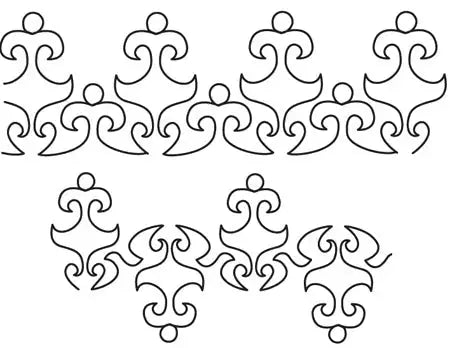
832 Combo Pantograph: One Design in Three Row Heights for Mid-Arm, Short-Arm and Domestic Machines
The 832 Combo Pantograph by Linda V. Taylor is a paper pantograph built for flexibility. It is a beautiful continuous line pattern, measures 121 inches long, and comes on a roll with three sizes of the same pattern: 5 inches, 7 inches, and 8 inches. It was exclusively designed for mid-arm, short-arm and domestic machines, and like other patterns in the 800 series, it is wonderful for borders, too.
What the Design Is
A paper pantograph is a printed, continuous-line pattern worked from behind the quilting machine. You lay the paper on the pantograph table, follow the printed line with a laser light or a stylus, and the needle reproduces that path on the quilt top. Because the line is continuous, you can stitch a full pass without stopping to tie off, and row after row builds into an even, all-over finish.
The "combo" here is about choice on a single roll. Instead of buying separate patterns for a narrow border, a runner, and a full quilt top, you get the same design at 5, 7, and 8 inches. So a quilt and its border can share one design at sizes that suit each area.
What Quilts It Suits
The 832 Combo suits everyday quilts finished on mid-arm, short-arm and domestic setups: lap quilts, throws, bed quilts, table runners, and quilts whose borders you want to quilt as part of the same design plan. Its row heights stay in a range those machines can handle comfortably in a single pass.
It is also smart when one project needs two scales: a larger row for the body and a smaller row in the border reads as one coordinated finish.
Choosing Your Row Height: 5, 7, or 8 Inches
Row height controls both the look of the quilting and how many passes a quilt takes. The 5-inch size keeps the design small and dense, suiting borders, narrow spaces, runners, and smaller quilts where you want closer quilting and a more textured finish. The 7-inch size is the middle path — open enough for a comfortable pace, close enough for even coverage on most lap and bed quilts. The 8-inch size opens the design furthest, covers a large top in fewer passes, and keeps the quilting lighter and softer.
Before you commit, compare each size against your top and border width, and pick the one that looks balanced against your block size.
How to Use It on Your Machine
Unroll the paper smoothly on the pantograph table and secure it so it cannot shift mid-pass. At 121 inches long, the pattern covers most quilts in a single pass. Choose your size, position your laser or stylus at the start of that printed row, and check that the pointer tracks the line accurately. Make a short dry run without stitching to confirm where the row begins and ends.
Stitch at a steady, even pace, watching the pointer and the printed line rather than the needle. When the pass is done, advance the quilt by your chosen row height, re-align the pointer, and check the new row against the stitched row above before starting again. That check keeps rows parallel and evenly spaced.
Extending the Pattern and Practical Tips
Need the pattern to be longer than 121 inches? Find where the pattern repeats, mark that point on your pattern shield, and shift the pattern down to make it meet up. This allows you to extend the pattern to accommodate those larger quilts.
Mark a light reference line for your first row so the design begins square, and check alignment again after the first advance, when a small drift is still easy to correct. Keep the paper flat throughout, and audition your thread on a corner first — a gentle contrast will show the design, while a closer match gives a softer, textured effect.
Shop the 832 Combo Pantograph by Linda V. Taylor at Linda's Electric Quilters.


