
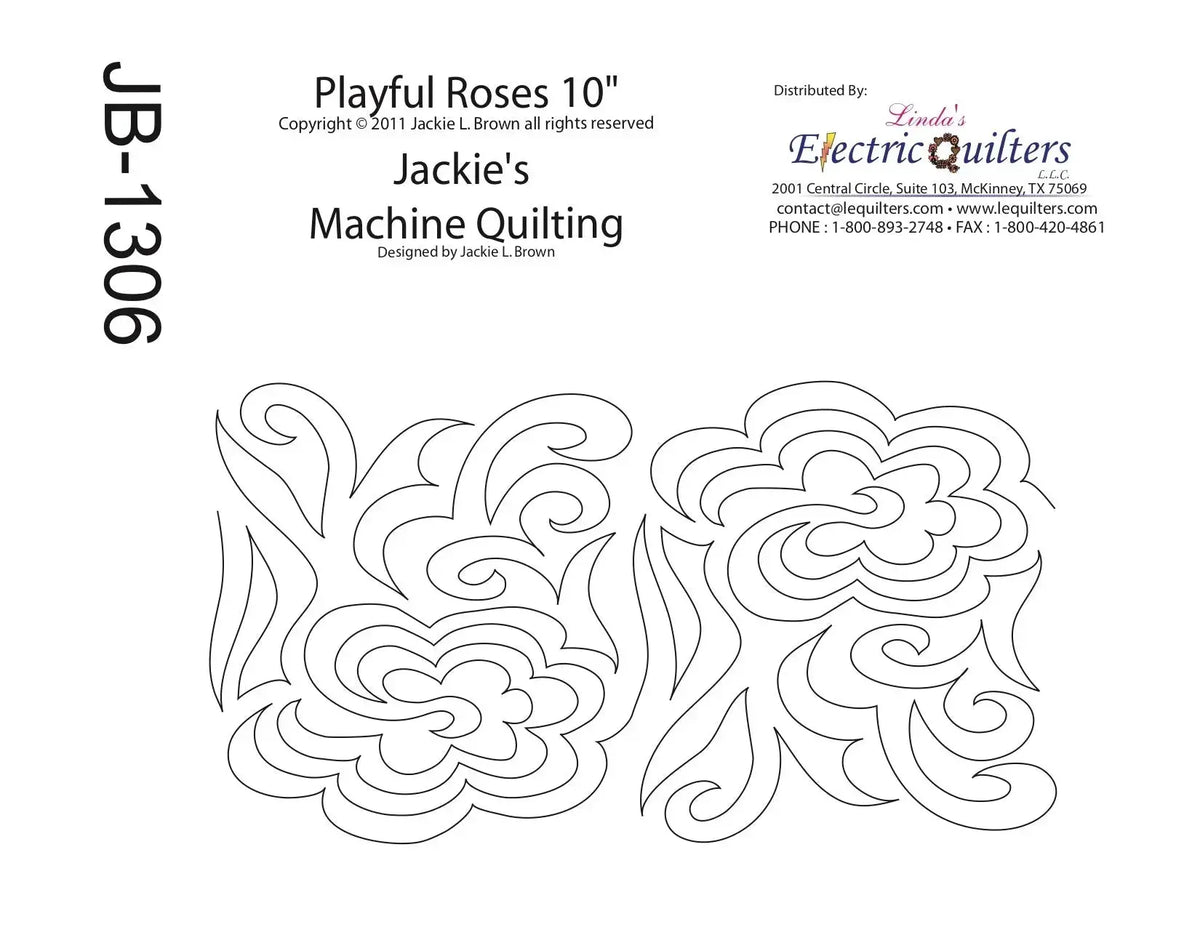
Playful Roses: A Romantic Floral Pantograph in 10-Inch and 12-Inch Rows
The 1306 Playful Roses Pantograph by Jackie Brown is a beautiful continuous line paper pantograph that brings roses into an all-over quilting design. The pattern measures 121 inches long and comes with two row sizes, 10 inches and 12 inches, so you can choose the scale that suits your quilt and your frame.
What the Design Is
A paper pantograph is a printed pattern worked from the back of a longarm frame. You lay the paper flat on the pantograph table, follow the printed line with a laser light or a stylus, and the needle reproduces that path on the quilt above. Because the design is a continuous line, you can stitch a whole pass without stopping at every motif, and each advance adds another band below the last.
Playful Roses uses that structure to carry a floral motif evenly across the surface. Instead of quilting each block differently, you repeat the same rose pattern row after row. The result is consistent, romantic texture that unifies the quilt — the piecing sets the layout, while the roses soften it and tie the top together.
What Quilts It Suits
A floral all-over like this suits quilts with a romantic, garden, or traditional feel: floral prints, soft palettes, wedding and anniversary quilts, and gifts for someone who loves roses. The motif adds a clear theme without custom quilting in every block, making it a practical way to finish a special quilt beautifully.
It also works well on plainer tops. On quilts made from large blocks, broad solids, or simple piecing, a repeated rose gives the surface life and prevents any area from looking unfinished. On busier floral fabrics, choose a thread that blends rather than contrasts, so the texture reads as gentle movement instead of competing with the print.
Choosing Between the 10-Inch and 12-Inch Rows
The choice is mostly about scale and spacing. The 10-inch row gives a tighter repeat: the roses sit closer together, the texture feels denser, and the rows stack more times down the quilt. That suits smaller quilts, quilts where you want the texture close and cosy, and frames where a 12-inch pass would be a squeeze.
The 12-inch row opens the design up. The roses have more room, each pass covers more ground, and you will advance fewer times on a large quilt. That suits bigger tops where you want the motif to read clearly at a glance. Whichever size you choose, measure your usable quilting area first — the throat depth you can reach in one pass — and confirm it fits the full row height before stitching.
How to Use It on a Longarm
Unroll the paper smoothly on the pantograph table and secure it so it cannot shift mid-pass. At 121 inches long, the row covers most quilts in one pass. Position your laser or stylus, check that the pointer tracks the printed line accurately, and make a short dry run without stitching to confirm the row starts and ends where you expect it to.
Stitch at a steady, even speed, keeping your eyes on the pointer and the printed line rather than on the needle. A consistent pace keeps the curves around each rose smooth. When the pass is complete, advance the quilt by one row height, re-align your pointer, and check the spacing against the row above before stitching again — that brief check keeps rows nested evenly instead of drifting.
Need the pattern to be longer than 121 inches? Find where the pattern repeats, mark that point on your pattern shield, and shift the pattern down to make it meet up. That lets you extend the pattern to accommodate larger quilts.
Tips for a Clean Finish
Mark a light reference for your first row so the roses start square, and check alignment after the first advance — small drifts are easy to correct early and hard to hide later. Keep the paper flat and starting points consistent at the edges, and step back after two or three rows: the roses should look evenly spread and relaxed.
Shop the 1306 Playful Roses Pantograph by Jackie Brown at Linda's Electric Quilters.


