
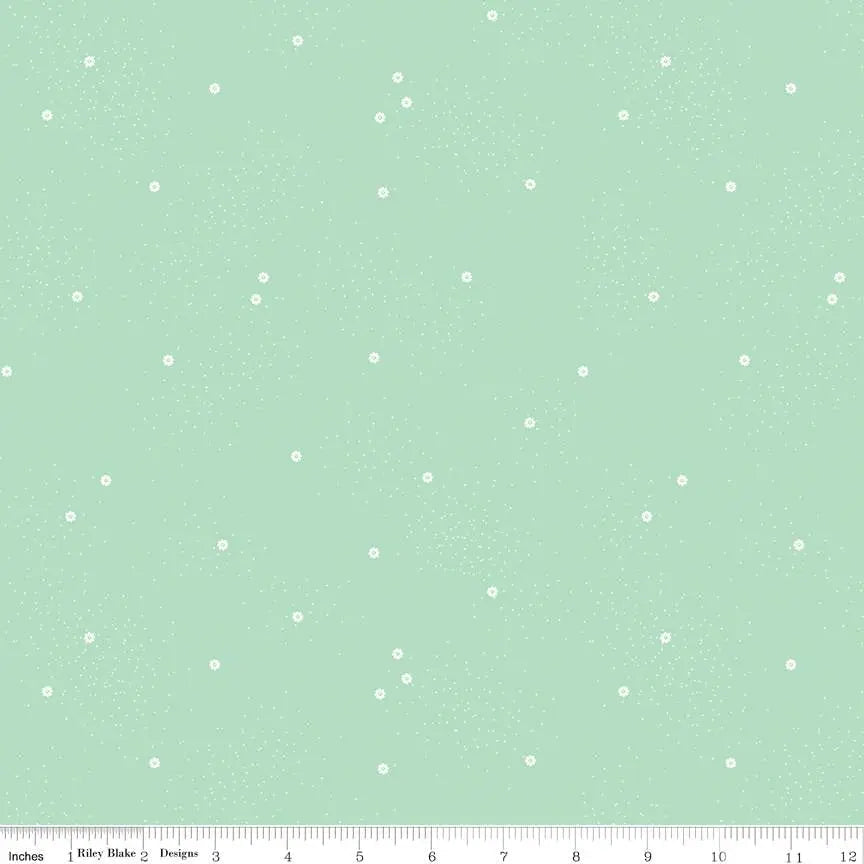
Sweet and Seamless: Backing a Quilt with Dainty Daisy Mint Wideback
The front of a quilt gets all the glory, but the back is half the quilt — and the half that touches skin, drapes over the arm of a chair, and shows every time the quilt is folded back. Dainty Daisy Mint Cotton Wideback makes that back easy and pretty at the same time: small daisies scattered over a background of pin dots, printed on cotton wide enough to back most quilts in a single, seamless piece. Here is what it is, why quilters reach for it, and how to use it well.
What This Fabric Is
Dainty Daisy Mint is a Riley Blake Designs Basic fabric designed by Beverly McCullough for Riley Blake Designs. It is 100 percent cotton and measures 107/108 inches wide — well over twice the width of a standard quilting cotton — and it is sold by the yard. The print is a classic Beverly McCullough look: small daisies sprinkled across a soft mint ground that is itself textured with tiny pin dots, so the background has quiet detail even where no flower falls.
Because it is part of the Riley Blake Basics range and sized at 107/108 inches to accommodate most quilt backs, this is a purpose-built backing fabric. One yard gives you a cut about 36 inches long by the full width, so most throw, twin, and queen-size tops need only two to three yards and no pieced seams at all.
Why a Small Daisy Print Works So Hard
A small, allover floral is one of the most forgiving backing choices you can make. The daisies are tossed rather than arranged in rows, so there is no directional right side up — you cannot accidentally load the backing sideways. The scale hides quilting stitches gracefully while still rewarding a close look, and the pin dot ground adds texture that keeps a large expanse of fabric from reading flat.
Mint is a versatile partner color. It freshens spring and garden quilts, cools down warm palettes, and sits happily behind white, cream, soft yellow, blush, aqua, and navy tops. If your quilt top uses other Beverly McCullough prints, the daisies coordinate naturally; if it does not, the print is quiet enough to support almost any style from traditional patchwork to clean modern blocks.
Measuring, Cutting, and Layering
Measure your finished quilt top first, then add overage on all sides — at least 4 extra inches per side is a common allowance for longarm quilting, and home quilters should add a few inches too so the layers can shift during quilting without exposing the batting. Check whether the shorter dimension of your top fits across the 107/108-inch width; if it does, your yardage is simply the longer dimension plus overage.
Press the wideback thoroughly before layering, since fabric this wide holds bolt creases, and square up the cut ends so it hangs evenly. Smooth it taut and flat, add batting, then center the top. With no center seam, you avoid the ridge a pieced back can telegraph through the quilting, and basting goes faster. Since the daisies look the same from every direction, pin a small marker at what you have chosen as the top edge before loading or basting — the print will not remind you.
Beyond the Quilt Back
Leftover width and offcuts are genuinely useful. Wide remnants make pillow shams, crib sheets, curtain panels, and table runners, and smaller scraps piece into coordinated throw pillows or a matching tote. Because the print is a Basic, it also blends into quilt tops themselves as a gentle floral blender wherever a small-scale mint print is wanted.
Care
Care follows the instructions given for this fabric: machine wash cold and tumble dry low. If you pre-wash your quilt-top fabrics, pre-wash this backing the same way so all layers shrink alike. Finished quilts washed in cold water and dried on low will keep the mint ground fresh and the cotton soft for years.
Shop the Dainty Daisy Mint Cotton Wideback Fabric per yard at Linda's Electric Quilters.


