
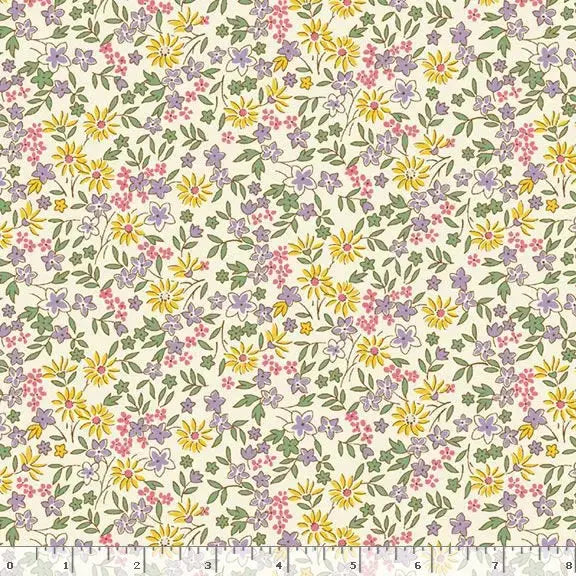
Backing a Vintage-Style Quilt: How a Multi-Colour Calico Wideback Finishes the Story
Some quilt tops look best with a back that belongs to the same era. If you have pieced a 1930s-inspired top — small floral prints, cheerful colours, and traditional blocks — a plain solid can feel a little flat underneath it. The Multi Aunt Grace Calicos Cotton Wideback Fabric, designed by Judie Rothermel for Marcus Fabrics as part of the Aunt Grace Calicos collection, gives you that period calico character across the whole back, with no pieced seam running down the middle.
What This Fabric Actually Is
This is a cotton wideback, listed at 108/110 inches wide and sold by the yard. The product tags describe it as a multi-colour floral on a cream ground, which is exactly the kind of small-scale calico print associated with reproduction quilting. Because the print is distributed across a full wideback width, most quilt tops can be backed in a single seamless piece instead of joining lengths of standard-width fabric.
That matters for more than convenience. Pieced backings need seam allowances pressed, matched, and kept off-centre for longarm quilting. A wideback removes that step entirely, and the small floral calico pattern is forgiving: minor shifts during quilting are far less noticeable on a busy print than on a flat solid.
How to Choose a Backing: Size Math First
Start with measurements, not guesses. Take your finished quilt top and add 8 inches to both width and length. That gives you 4 inches of extra backing on every side — room for longarm loading, and insurance against the layers shifting if you quilt at home.
For example, a 60 by 72 inch throw needs a backing at least 68 by 80 inches. The 68-inch width fits easily across a 108/110-inch wideback, so one width is plenty. For the 80-inch length, divide by 36: about 2.25 yards, so order 2.5 yards to allow for squaring up. A 90 by 96 inch queen top needs 98 by 104 inches; the width still fits in one piece, and the length calls for about 3 yards. If your top plus 8 inches is wider than the usable width, you will need to piece — let the numbers tell you before you order.
Cotton, Minky, or Flannel?
Cotton wideback is the natural partner for a cotton quilt top: similar weight, similar shrinkage behaviour, and a smooth surface that quilts cleanly and shows stitching well. Minky gives a plush, warm back and is wonderful for throws people wrap up in, but its stretch and pile make it a different handling challenge, and it changes the drape completely. Flannel sits in between — soft and cosy, but it can shrink more and add bulk in the seams. For a reproduction-style quilt you want to look and feel consistent front to back, cotton calico is the honest match.
Working Tips: Pressing, Prewashing, and Loading
Widebacks arrive folded, and that centre fold line can be stubborn. Press the whole piece before layering, working the fold from both sides; a light mist of water helps on cotton. If you prewash your quilt tops, prewash the backing too, so both sides shrink at a similar rate — and press again after washing, because wide cotton creases hard in the dryer.
Square the backing before it goes on a longarm frame: check that the cut edges are straight and the corners are true, then load it so the extra 4 inches extend evenly on all sides. On a multi-colour print, also check orientation — calicos are usually non-directional, but a quick look before loading saves surprises.
Care
As a cotton backing, this fabric follows the same care as the rest of the quilt: wash gently in cool water, and dry on a low setting or line dry where possible. A finished quilt with a calico back is meant to be used, washed, and softened over time — that gentle ageing is part of the vintage charm the Aunt Grace Calicos collection was designed to evoke.
Shop the Multi Aunt Grace Calicos Cotton Wideback Fabric Per Yard at Linda's Electric Quilters.


