

Table of Contents
- What Longarm Quilting Actually Means for Your Workflow
- Longarm Quilting Machine Cost: What You'll Actually Spend
- Space Requirements for a Longarm Quilting Machine
- Breaking Down Longarm Quilting Cost Per Quilt
- Can You Build a Profitable Longarm Quilting Business?
- Longarm vs. Domestic Machine Quilting: The Real Trade-Offs
- Is a Longarm Right for You? Making the Decision
- Frequently Asked Questions
Last Updated: October 15, 2026
What Longarm Quilting Actually Means for Your Workflow
Longarm quilting uses a specialized machine that moves the needle while you guide the fabric beneath it, handling the repetitive motion at speeds up to 1,500 stitches per minute.

Unlike domestic machine quilting, where you move the quilt under a stationary needle, a longarm's speed and capacity let you finish projects in hours instead of days.
String & Story notes that buyers should expect a learning curve and cautions that purchasing a longarm will not magically increase productivity. Some quilters see it pay off immediately; others take months to work efficiently.
The real question isn't whether a longarm quilts faster, it does, but whether the speed gain justifies the cost, space, and learning curve.
Longarm Quilting Machine Cost: What You'll Actually Spend
Longarm machines cost considerably more than domestic sewing machines, typically ranging from tens of thousands for entry-level models to well over one hundred thousand for professional-grade machines.
The sticker price is only part of the equation. You'll also need to budget for:
- Thread: Longarm-specific thread like Mako Cotton 3-ply Longarm Thread ($38.00 per spool) or AeroQuilt Longarm Quilting Thread ($11.99) burns through quickly at high speeds
- Needles: Specialized longarm needles wear out faster than domestic needles
- Maintenance and repairs: These machines require regular servicing
- Insurance: Protecting an expensive piece of equipment costs money
Renting time on someone else's longarm at a local studio costs $15 to $40 per hour depending on region and machine, a lower barrier to entry, but with no ownership, flexibility, or guaranteed availability.

For occasional hobbyists, renting makes sense; for regular quilters or businesses, the math shifts. But first you need to understand what you're paying per finished quilt.
Space Requirements for a Longarm Quilting Machine
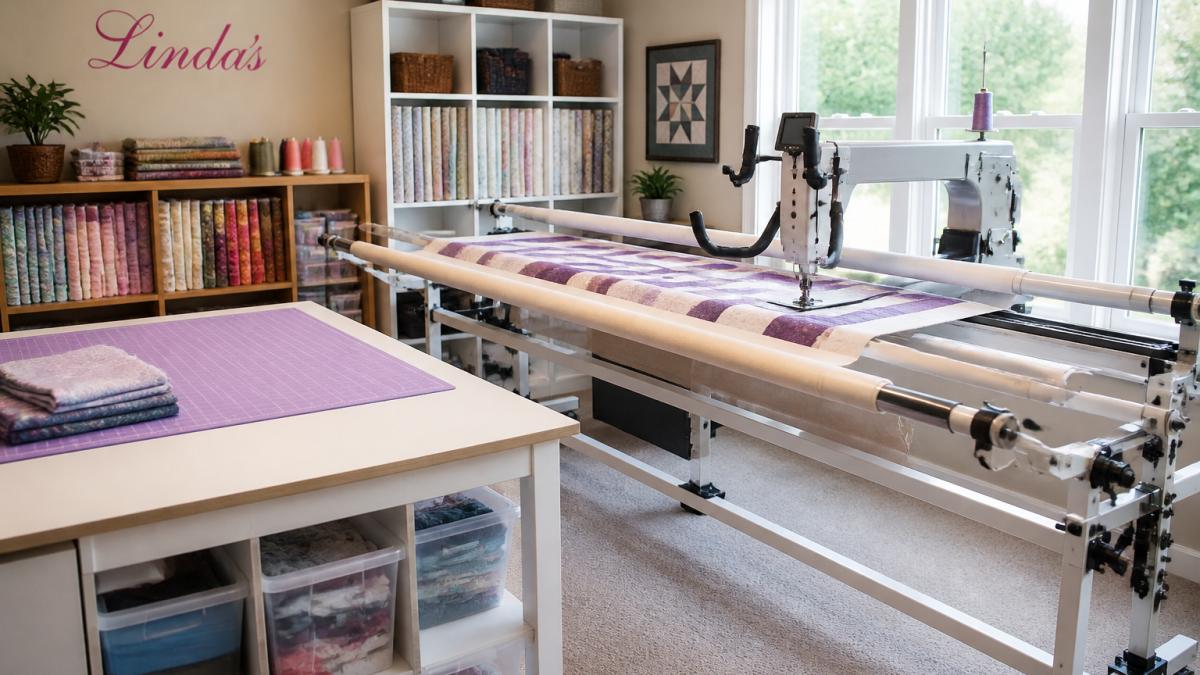
Longarm machines are not compact.
Space is a real constraint: a spare bedroom or basement corner won't work, you need a dedicated room or studio.
Beyond the machine itself, you'll want:
- A large work table for staging quilts before and after quilting
- Storage for fabric, batting, and thread
- Room to walk around the machine on all sides
- Good lighting, you need to see your quilting lines clearly
- Climate control if possible (humidity affects fabric behavior)
Renting studio time solves the space problem entirely. If you're buying, honestly assess your space, cramming a longarm into inadequate space leads to frustration and an unused machine.
Breaking Down Longarm Quilting Cost Per Quilt
Once you own a machine, how much does each quilt actually cost to quilt?
Direct costs are thread and needles. A large quilt might use an entire spool, $38.00 for premium cotton or $11.99 for polyester, plus needle replacement, roughly $50 to $75 in consumables per quilt.
Add the machine cost. A financed longarm might run $500 to $2,000 or more monthly.
At a studio, $15 to $40 per hour for a 4-to-8-hour large quilt is $60 to $320 per quilt, often less than a monthly machine payment if you quilt infrequently.
Break-even arrives when your per-quilt machine cost drops below studio rates.
Can You Build a Profitable Longarm Quilting Business?
Some quilters buy a longarm to offer quilting services, shifting the question from "Is this worth it for me?" to "Can I make money doing this?"
The barrier to entry is high: machine, space, insurance, skill, and customers. Building a client base takes time and marketing.
At the common $0.02 to $0.04 per square inch, a large quilt generates $80 to $200.
Success isn't automatic. You compete with other quilters, studios, and industrial services. Your advantage is personal service and custom designs; your disadvantage is overhead you carry whether or not you have customers.
Longarm vs. Domestic Machine Quilting: The Real Trade-Offs
The choice between a longarm and a domestic machine isn't just about speed. It's about what you're optimizing for, and on a longarm that starts with which stitching mode you run.
Manual mode vs. stitch-regulated mode
On a longarm, the machine can operate in two fundamentally different ways:
Quilt As You-Go Made Vintage →
- Manual mode runs the needle at a fixed speed you set with a dial or foot pedal, independent of how fast you move the fabric. Slow your hands and stitches bunch up; speed up and they stretch out. You are the regulator.
- Stitch-regulated mode uses an encoder on the carriage to sense travel and adjusts needle speed to hold a target stitch length, usually expressed in stitches per inch (SPI). Move slowly and the needle slows; move quickly and it speeds up.
Most longarms also offer submodes within regulation. Cruise keeps the needle at a baseline speed and ramps up as you move, suiting flowing edge-to-edge designs. Precision lets the needle nearly stop when you stop, suiting ruler work, sharp corners, and dense fills. Labels vary by manufacturer, so check your manual.
Matching hand movement to needle speed
In manual mode, the skill is keeping hand speed constant so stitch length stays constant. In regulated mode, the skill is moving smoothly enough that the regulator isn't constantly chasing you. Beginners often do better in regulated mode, then graduate to manual for free-motion work where they want direct control.
How the two compare by task
| Quilting task | Better mode | Why |
|---|---|---|
| Ruler work | Precision regulation | Needle nearly stops at pauses so corners stay crisp |
| Flowing curves | Cruise regulation | Regulator ramps with your movement for even stitches |
| Dense fills (pebbles, stippling) | Precision regulation | Frequent direction changes need stitch control at low speed |
| Edge-to-edge designs | Cruise regulation or manual | Long continuous passes reward steady, higher speed |
| Starts and stops | Precision regulation | Stitch length stays consistent as you accelerate from zero |
Setting SPI and troubleshooting stitch length
Set your target SPI in the machine's regulation menu, then test on a scrap sandwich of the same batting and fabric as your quilt. Long stitches mean your movement is outpacing the needle, slow your hands or raise the regulated speed. Short or bunched stitches mean your hands are too slow. Check tension after any SPI change, because stitch length changes how thread locks into the batting.
Trade-offs beyond stitch consistency
Regulation is not free. At very slow movement, some regulators feel jerky as they hunt for the target speed. At rapid movement, the machine may hit its speed ceiling and stitches lengthen anyway. Manual mode gives a more direct feel and no lag, but punishes inconsistency. Many quilters switch modes mid-project, regulated for the border, manual for rhythm, a legitimate workflow, not a failure.
The longarm vs. domestic trade-off, restated
Domestic machine quilting gives you complete control over stitch length and consistency because you feed the fabric at your own pace.
Longarm quilting is fast, the same quilt takes 4 to 8 hours, and the machine handles the repetitive motion so your hands don't fatigue the same way.
A longarm is superior for edge-to-edge quilting; for intricate designs with sharp corners and tight curves, a domestic machine or a longarm in precision regulation may give better results.
The trade-off is also about style and satisfaction: some love the meditative pace of domestic quilting, others find it tedious. Neither preference is wrong.
Is a Longarm Right for You? Making the Decision
Here's the honest framework: determining whether is longarm quilting worth the investment depends on meeting most of these criteria.
You have dedicated space. A spare bedroom or basement corner won't work.
You're willing to invest time in learning. The first 20 to 50 quilts are a learning curve full of mistakes and tension troubleshooting.
You're quilting for yourself (and value speed and volume) or building a business (and can commit to marketing and client management).
You have the capital. Whether buying outright or financing, you must afford the machine and space.
A mode-based decision guide
Before you commit to ownership, decide which mode you'll actually live in, that answer tells you whether the machine will earn its keep.
- If most of your work is edge-to-edge or allover designs, you'll spend your time in cruise regulation or manual mode. These reward speed and steady movement, and a longarm pays off quickly because you finish quilts in a fraction of the domestic-machine time.
- If most of your work is custom, with ruler work, dense fills, and lots of starts and stops, you'll live in precision regulation. The machine still helps, but the speed advantage shrinks because precision work is slow by nature. Weigh that against the cost.
- If you want to switch modes mid-project, that's normal. A common pattern is cruise regulation for the background, precision regulation for a focal motif, and manual mode for the border. Test SPI and tension on a scrap sandwich every time you change modes, because stitch length changes how thread locks into the batting.
Practice drills that build real skill
Vague advice to "find your rhythm" doesn't help. Concrete drills do.
- Straight-line drill. Quilt parallel lines 1 inch apart across a fat quarter in precision regulation. Goal: every line has the same stitch length, verified by counting stitches per inch on three random spots.
- Speed-ladder drill. In manual mode, quilt the same simple loop at three deliberately different hand speeds. Goal: feel the stitch length change and learn what "too fast" and "too slow" feel like in your hands.
- Stop-and-go drill. In precision regulation, quilt a row of squares, pausing at each corner. Goal: corners stay sharp and stitches don't bunch at the pause.
- Mode-switch drill. Quilt a small piece using cruise regulation for the center and manual mode for the border. Goal: the transition is invisible in the finished stitches.
The rent-first test
If unsure, rent studio time first. At $15 to $40 per hour, a 4-to-8-hour session costs $60 to $320, far less than a monthly machine payment. Try manual, cruise, and precision regulation on the same scrap sandwich.
If you check most ownership boxes and the mode question points to work you'll actually do, ownership makes sense. Check only one or two, and renting is smarter.
For quilters exploring alternatives to ownership, Quilt As You-Go Made Vintage ($20.79) offers a different approach entirely, finishing quilts on your home machine using quilt-as-you-go methods that eliminate the need for a longarm altogether.

The real question of whether is longarm quilting worth the investment isn't really about the machine.
Frequently Asked Questions
How many quilts do you need to quilt to justify buying a longarm quilting machine?
The break-even point depends on your machine cost and whether you quilt for others. If you quilt one or two quilts per year for personal use, the investment rarely makes financial sense. Professional quilters who handle many quilts annually are better positioned to recover their investment through service fees.
Is it cheaper to buy a longarm or pay someone to quilt your quilts?
For occasional quilters, paying a professional is almost always cheaper. Buying a machine costs thousands upfront, plus thread, maintenance, and space. However, if you quilt regularly, ownership can become cost-effective over time. Longarm machines are considerably more expensive than domestic sewing machines, making the purchase accessible mainly to dedicated quilters or those planning to offer services.
What are the main disadvantages of owning a longarm quilting machine?
The biggest challenges are cost, space, and learning curve. Longarm machines require significant floor space for comfortable operation. Purchasing a longarm will not magically increase productivity; new users face a substantial learning period before achieving quality results. Maintenance costs add up, and you'll need quality thread like Aurifil's Mako Cotton 3-ply ($38.00 for 3,280 yards) to avoid thread breaks. Additionally, the initial investment creates pressure to use the machine frequently to justify the expense.
Can you make money with a longarm quilting machine?
Yes, but profitability requires planning. However, you must factor in thread costs, machine maintenance, electricity, insurance, and the time spent on each project. Success depends on your local market demand, your skill level, and how many quilts you can complete per month. Starting with quilt-as-you-go methods on your domestic machine (like the techniques in Jera Brandvig's *Quilt As You-Go Made Vintage*) lets you test demand before making the larger investment.


