
Hey everyone. Today we're sewing a classic grid baby quilt from mini charms, and you'll learn how tiny squares add up to a crib-size top.
The short version: sew 450 mini charm squares into a plain grid, eighteen across, twenty-five down, finishing 36 by 50 inches. It suits a confident beginner with a straight ¼-inch seam.
What is the finished size, and what are the key numbers?
Finished size: 36 by 50 inches, the crib-quilt class in the plan. Each square finishes at 2 inches. Seam allowances are ¼ inch throughout. The unfinished top measures 36½ by 50½ inches. You use 450 of 462 squares in eleven packs; 12 stay spare. Skill level: confident beginner.
Why make this version with mini charms?
The charm-pack version uses big 5-inch squares. This one keeps the same forgiving grid, shrunk, so one collection reads as fine, confetti-like patchwork. No diagonal seams to stretch; the only fuss is pinning crossings. Design work is value: sort light, medium, dark; spread darks evenly. A square a hair off still reads clean. Prefer softer? Completely up to you.
What do you need?
| Material or tool | What you need | Required or optional |
|---|---|---|
| Eleven mini charm packs (42 squares each, 2½ in.) | 450 squares for the top; 12 left over | Required |
| Backing fabric | 1⅔ yd quilting cotton; one piece 42 × 56 in. | Required |
| Batting | Low-loft cotton, one piece 42 × 56 in. | Required |
| Binding fabric | ½ yd; five strips 2½ in. wide | Required |
| Thread | 50-weight cotton piecing; quilting thread | Required |
| Quarter-inch foot, pins, marking pencil, seam ripper | True seams, pinned crossings, marks, fixes | Required |
| Rotary cutter, mat, ruler, iron | Cutting yardage, pressing rows | Required |
| Walking foot | Feeds the quilt layers evenly | Optional |
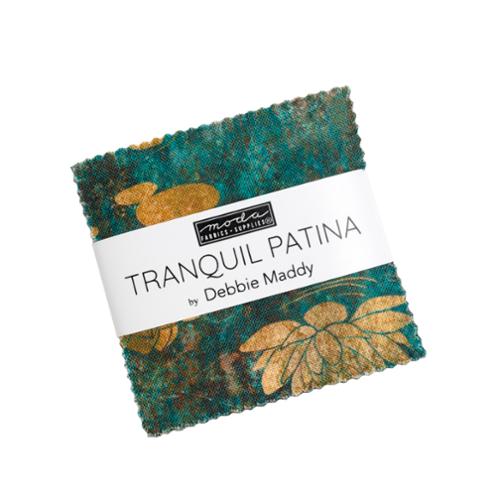
My pack pick is the Tranquil Patina Mini Charm — 42 cotton squares, 2½ inches, by Debbie Maddy for Moda. Value sorting is the main planning you owe.
What gets cut, and from where?
From the packs: count out 450 squares; set 12 aside as spares and testers. Backing: one piece 42 by 56 inches, cut after checking at least 42 usable inches across. Batting: one piece 42 by 56 inches. Binding: five strips, each 2½ inches by the fabric width; joined, roughly 200 inches for a 172-inch perimeter, if usable width is near 42 inches. Cut biggest first.
How do you sew the quilt top?
- Sort all 450 squares into lights, mediums, and darks. Lay out twenty-five rows of eighteen. Scatter the darks so no corner hogs them.
- Step back, squint, or snap a photo. Move squares that clash; the photo shows value clumps your eye misses.
- Test your seam first: sew two spares with the quarter-inch foot. Pressed, the pair should measure 4½ by 2½ inches. Adjust now, not after.
- Sew each row left to right, ¼-inch seam. Chain piece in pairs, then fours, then the full run, threads uncut.
- Check every row: 36½ inches long. Warning: a seam a thread too wide, repeated across seventeen joins, steals real width. Fix short rows now, with the seam ripper, not by stretching.
- Press row one seams right, row two seams left. Alternate down the top. Seams facing opposite ways nest like puzzle pieces.
- Pin two rows right sides together at every crossing — seventeen pins sounds slow, still faster than ripping. Sew slowly over joins.
- Join rows into groups, then join groups. Press once more; the top should measure 36½ by 50½ inches.
- Layer backing (right side down), batting, then top (right side up). Baste well; mark quilting lines with the pencil if you want them.
- Quilt simply: stitch in the ditch, or straight lines ¼ inch beside each seam, at 8 to 10 stitches per inch. Slow down at crossings.
- Trim the sandwich square. Sew binding to the front, miter the corners, fold to the back, and finish by machine or hand.
How does the precut math work?
A mini charm starts at 2½ inches. A ¼-inch seam both sides takes away ½ inch, so each finishes at 2 inches. Eighteen across: 18 times 2 equals 36 inches. Twenty-five down: 25 times 2 equals 50. The whole top, planned on paper before a pack opens.
Yield matters too. Eleven packs hold 462 squares; the top takes 450. The 12 leftovers are testers and replacements, not waste. Pinked edges need no trimming: measure from the body of the square, not the zigzag tips, same reference every time, or rows wander. Sort first, chain piece second, press alternating third.
What can go wrong, and how do you fix it?
| Symptom | Likely cause | Fix |
|---|---|---|
| Rows end at different lengths | Small seam drift, multiplied across seventeen joins | Re-run the two-square test; fix short rows before joining |
| Corners will not nest | Both rows pressed the same direction | Re-press one row the other way |
| Top ripples after quilting | Loose basting or shifting layers | Add pins, use a walking foot, quilt from the center out |
What do people ask before making this quilt?
Does it really take eleven packs?
Yes: 450 squares, and eleven 42-square packs give 462. Count first; if a pack holds a different count, re-run the division before laying out.
Can I make a smaller one with fewer packs?
Yes. Six packs hold 252 squares: fourteen across by eighteen down finishes 28 by 36 inches. Same grid, smaller finish.
Must the tiny squares be trimmed first?
No. Sew them as they come. Measure from the body, not pinked tips; test your seam on spares.
Can I add sashing between the squares?
Yes, but the quilt grows by every strip, so re-run the math before cutting backing. A soft pink solid makes gentle sashing — see our read on Sisters Pink Bella Solids.
How do I back a quilt this size?
Standard-width cotton works if it gives 42 usable inches. For a wider backing option, our guide to Natural Bella Solids Wideback explains its 108-inch width.
How do you care for it, and change it up?
Care follows the components: quilting-cotton prints and cotton batting wash cold, gentle cycle, dry low or laid flat. Follow the makers' labels for fabric and batting where they differ. Press warm, not hot. Adapt by count: each added row adds 2 inches and eighteen squares. Or change the mood: all lights with a few darks reads calm; even thirds reads bold. Hear me: it doesn't have to be perfect. You're your own worst critic. Take your time — it's not a race. If I can do this, y'all can do it.
Shop the Tranquil Patina Mini Charm at Linda's Electric Quilters.
Thanks for sewing along today. We'll see you next time. Bye.


