
Hey everyone. Today we're building a log cabin quilt from layer cake squares: cut two packs into strips, sew thirty blocks finishing at 14 inches, join them five across and six down, add end borders, for a 70-by-90-inch finish. A confident-beginner make.
What is the finished size, and what are the key numbers?
Finished size: 70 by 90 inches. Thirty blocks finish at 14 inches, five across and six down, for a 70-by-84-inch center. A 3-inch finished border at each end brings the length to 90. Seam allowances are ¼ inch throughout.
Why make this version with layer cakes?
Layer cakes suit this quilt: one square cuts into four strips at once, and the collection arrives coordinated. The block grows from one center square, strips added round and round. Lights on two sides, darks on the other two — that split draws the diagonal. Which prints land where? Completely up to you.
What do you need?
| Material or tool | What you need | Required or optional |
|---|---|---|
| Two layer cakes (42 squares each, 10 in.) | 83 of 84 squares; math below | Required |
| Solid for end borders | ½ yd; four strips below | Required |
| Binding fabric | ¾ yd; nine 2½-in. strips below | Required |
| Batting | At least 74 × 94 in. | Required |
| Backing | 5½ yd at 44 in., or 2¾ yd wideback (108 in.) | Required |
| Thread | 50-weight cotton | Required |
| Quarter-inch foot, pins, marking pencil, seam ripper | Seams and fixes | Required |
| Rotary cutter, mat, ruler, iron | Subcutting, pressing | Required |
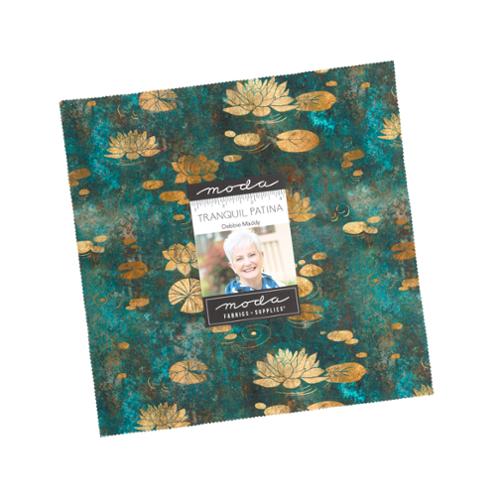
My pack pick is the Tranquil Patina Layer Cake — 42 cotton squares, 10 inches, by Debbie Maddy for Moda. A calm solid rests the prints — see Natural Bella Solids.
What gets cut, and from where?
From the packs: subcut each square into four 2½-by-10-inch strips. Per block: one center, 2½ inches square, plus twelve logs, all 2½ inches wide — one at 2½, two each at 4½, 6½, 8½, 10½, and 12½, and one at 14½. Solid: four strips, 3½ inches wide, joined in pairs, trimmed to 70½ inches. Binding: nine strips, 2½ inches wide — well over the 320-inch perimeter once joined, corners and closing join included. Backing: join two 99-inch lengths along their long edges; wideback needs no join. Batting at 74 by 94 inches leaves 2 inches past each edge here; size up if your setup wants more.
Here is the eleven-strip plan, split by value. Semicolons separate strips; plus signs separate pieces cut from the same strip. Do not join pieces merely because they share a table entry.
| Pile | Strips per block | What each strip gives (in.) |
|---|---|---|
| Light | 5 | 10; 9½; 8½+1½; 6½+3; 4½+2½+2½ center |
| Dark | 6 | 10; 10; 8½+1½; 9½; 6½+3; 5+4½ |
Using a ¼-inch seam, join 9½ + 1½ for each 10½-inch log, and 10 + 3 for each 12½-inch log, keeping each pair within its value pile. Join the remaining dark 10 + 5 for the 14½-inch log.
How do you sew the log cabin quilt?
Build one block, check it, then batch the rest.
- Sort all 84 squares: lights, mediums, darks. Set the most saturated aside for centers.
- Subcut into 2½-by-10-inch strips, lights and darks apart. Measure from the square's body, not the pinked tips.
- Cut pieces to the plan above and join the long logs. Label piles.
- Start a block: sew the 2½-inch log to a center's side. Press away.
- Add logs in the same rotation — lights on two sides, darks on the other two — pressing outward. Chain piece several blocks.
- Check the first block: 14½ inches square. Warning: if it is off, fix your seam guide here — the same error times thirty blocks will not join up.
- Finish all thirty blocks in the same rotation. Warning: one turned block breaks the diagonal — check before sewing rows.
- Sew six rows of five, pinning at every join. Press seams alternating so joins nest.
- Join the six rows. Check: 70½ by 84½ inches.
- Sew one border strip to the top, one to the bottom; sides get none. Width stays 70, length reaches 90.
- Layer top, batting, backing; baste; quilt simply: stitch in the ditch, or straight lines. Choose stitch length for your quilting method. Keep quilting lines within the maximum spacing specified on your batting label.
- Join the binding strips end to end, bind the edges, press flat.
How does the precut math work?
Each log finishes 2 inches wide and extends one side of the block. Three complete rounds — four logs per round — grow the 2½-inch center into a 14½-inch unfinished block, 14 inches finished. Five across give 70; six down, 84; the borders finish the 90.
Yield: 330 strips at eleven per block, from 83 squares; one square and two strips stay spare. Lights take five strips per block, darks six — the dark sides draw the longer logs in each round.
What can go wrong, and how do you fix it?
Four usual troubles.
| Symptom | Likely cause | Fix |
|---|---|---|
| First block is not 14½ in. square | Seam wider or narrower than ¼ in. | Adjust the guide; re-sew that block first |
| Diagonal line breaks in one spot | One block rotated a quarter-turn | Unpick that block's joins, turn it, re-sew |
| Light side reads muddy | Mediums crept into the light pile | Re-sort in daylight; a medium counts as light only if it clearly contrasts with your darks |
| Border strip short of 70½ in. | Pair trimmed before pressing | Press flat, remeasure, or piece in an offcut |
Questions folks ask
Quick answers first.
Do I really need two whole layer cakes?
Yes. This cutting plan uses 83 squares and one pack holds 42, so the second pack is most of the quilt.
What if my packs lean dark?
Sort by contrast, not by label: a medium works as a light only when it contrasts with your darks. Keep that rule and each block keeps its two halves.
Can I skip the end borders?
Yes — it finishes at 70 by 84; the borders only reach the 90-inch length.
Why join strips for the long logs?
A strip is 10 inches long; five logs per block run longer. The joins in the plan above are normal strip piecing; pressed flat, a join can blend into the patchwork.
How do you care for it, and change it up?
Care follows the components: follow the fabric, batting, and backing makers' labels. Change the layout, not the method: rotate every other block for a zigzag, or run all darks to one corner. It doesn't have to be perfect.
Shop the Tranquil Patina Layer Cake at Linda's Electric Quilters.
Thanks for sewing along. We'll see you next time. Bye.


