
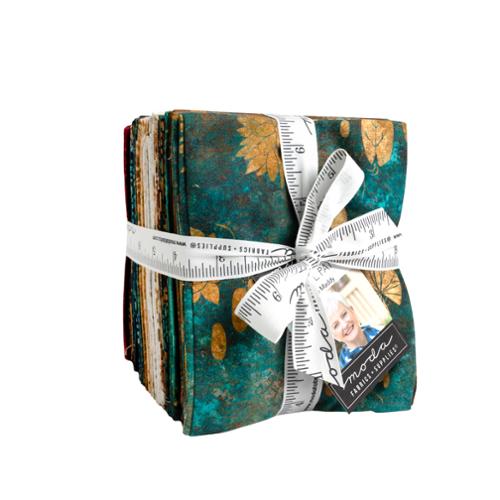
Hey everyone. Today we're cutting into a fat quarter bundle to make a patchwork apron with a divided pocket. It finishes at 22 by 27½ inches, pieced from twenty 6-inch squares, and suits a confident beginner who can sew a ¼-inch seam.
What is the finished size, and what are the key numbers?
Finished size: 22 inches wide by 27½ inches long, lined, with one pocket split into three sections. The pieced front measures 22½ by 28 inches before lining. Each 6-inch square finishes at 5½ inches, seams are ¼ inch, and the apron uses four fat quarters.
Why make this version from fat quarters?
Fat quarters give squares big enough to show a print, with enough left in the piece for pocket and ties. One bundle dresses the apron in one palette.
What do you need?
| Material or tool | What you need | Required or optional |
|---|---|---|
| Fat quarter bundle | 4 fat quarters used; cutting below | Required |
| Lining yardage, 44-in. nominal width | ⅞ yd; one rectangle, cutting below | Required |
| Thread | 50-weight cotton | Required |
| Quarter-inch foot, pins, marking pencil, seam ripper | Seams, placement marks, fixes | Required |
| Rotary cutter, mat, ruler, iron | Cutting and pressing | Required |
My pick is the Tranquil Patina AB 30 Fat Quarter — 30 cotton fat quarters, each 18 by 21 inches, by Debbie Maddy for Moda. Mixing in a textured blender? Mustard 282 Grunge Fat Quarter.
What gets cut, and from where?
Fat quarters one and two: cut each into three bands 6 by 21 inches, then three 6-inch squares per band — nine per fat quarter, plus three 3-by-6-inch offcuts. Fat quarter three: cut a 12-by-21-inch lower piece and a 6-by-21-inch top band. From the lower piece, cut the pocket, 17 by 10 inches. From the top band, cut two more squares — twenty in all. Fat quarter four: six strips, each 3 by 21 inches. Lining: one rectangle, 22½ by 28 inches.
How do you sew the apron?
- Sort the squares by value. Lay out four columns by five rows, repeated prints spread apart.
- Test your seam: sew two squares together, press, measure — 11½ by 6 inches. Adjust the guide until it reads right.
- Sew each row of four, chain piecing to keep the order. Press row one right, row two left, alternating.
- Join the five rows, pinning at every crossing so the seams nest. A crossing a hair off is okay.
- Pocket: fold the top edge of the 17-by-10-inch rectangle under ¼ inch twice, press, stitch the hem. Fold the sides and bottom under ¼ inch; press.
- Center the pocket, its bottom fold about 5 inches above the front's bottom edge. Stitch the sides and bottom close to the folds. Backstitch at the top corners — they take the strain.
- Stitch two lines through pocket and front, 5½ and 11 inches from the left fold — three pockets, each about 5½ inches wide. Backstitch at the top of each line.
- Ties: join two strips end to end for each waist tie — 41½ inches joined. Join the last two for the neck strap, trimmed to a length checked against an apron you like. Fold each lengthwise, right sides together. For the waist ties, sew the long edge and one short end; turn through the open end — that open end is pinned into the side seam in step nine. For the strap, sew the long edge only; both ends are caught at the top corners. Press — about 1¼ inches wide.
- Pin a waist tie at each side edge, its open end at the edge, level with the seam between rows three and four, pointing inward. Pin the strap ends at the top corners the same way.
- Lay the lining over the front, right sides together, ties tucked inside. Sew around all sides, ¼-inch seam, leaving a 6-inch opening at the bottom. Go slow at the corners; keep loose tie lengths clear of the seam.
- Turn right side out, press, topstitch around all four sides, closing the opening.
How does the fat quarter math work?
Each fat quarter here measures 18 by 21 inches. Three 6-inch bands across the 18-inch side, three squares along each band: nine squares per fat quarter. Two give eighteen squares; the third gives the last two plus the pocket; the fourth gives every tie. Twenty squares at 5½ finished inches: four across make 22 inches, five down make 27½.
Before cutting, check that each fat quarter you pick measures a usable 18 by 21 inches — this layout uses the whole 18-inch side, with no spare for trimming. Swap a short piece for another from the bundle. The test pair proves your seam, not the fabric's size. Chain piecing keeps rows in order, and pressing alternate rows in opposite directions lets crossings nest flat. On fat quarter three, cut the pocket before the squares, so the big piece is never shorted.
What can go wrong, and how do you fix it?
| Symptom | Likely cause | Fix |
|---|---|---|
| Rows do not line up at the crossings | Seams drifted from ¼ in. | Re-check with a test pair: two sewn squares should read 11½ by 6 in. |
| Pocket top corners pull loose | No backstitching at the stress points | Restitch the top ½ in. of each side, backstitching at the top |
| A tie comes out twisted after turning | Tie sewn into its side seam twisted | Open that side seam where the tie is caught, untwist it, and restitch the seam and topstitching |
Questions folks ask
How many aprons can I get from one bundle?
Four per apron, from the bundle's 30 — the arithmetic allows seven aprons, with two fat quarters left over. That counts bundle fabric only; each apron still needs lining and thread.
My fat quarters measure 18 by 22 inches. Does the cutting still work?
Yes. Every piece is cut to a stated size, so a wider fat quarter just leaves wider offcuts.
Can I leave the pocket in one wide section?
Yes. Skip the two dividing lines in step seven and the pocket stays one wide pocket, about 16½ inches across. Completely up to you.
How do you care for it, and change it up?
Care follows the components: follow the gentlest guidance on your fabric and thread makers' labels. For a change, swap the palette — dark squares with a pale pocket read bold. It doesn't have to be perfect, folks. Take your time — it's not a race.
Shop the Tranquil Patina AB 30 Fat Quarter at Linda's Electric Quilters.
Thanks for sewing along. We'll see you next time. Bye.


