Hey everyone! Today we're talking about a question I hear all the time: what exactly is QISS, and why are quilters so excited about it? Short answer — it's a way to quilt a big quilt on a regular home sewing machine, one block at a time. No longarm. No wrestling match. Here we go.
The problem QISS solves
If you've ever tried to quilt a queen-size quilt on a domestic machine, you know the fight. All that bulk has to squeeze through a few inches of throat space, and by the middle of the quilt you're pushing, pulling, and sweating. Pauline Rogers, a quilter in Queensland, Australia, spent decades working on that exact frustration, and the system she built at Pauline's Quilters World is called QISS — Quilting Is Sew Simple.
The idea is beautifully simple. Instead of layering a whole quilt and quilting it at the end, you build each block as its own little sandwich — top, batting, backing — quilt that one block completely, and only then join your finished blocks together into a quilt. A block fits under any machine. A whole quilt top doesn't have to.
Controlled Quilting: the part that surprises people
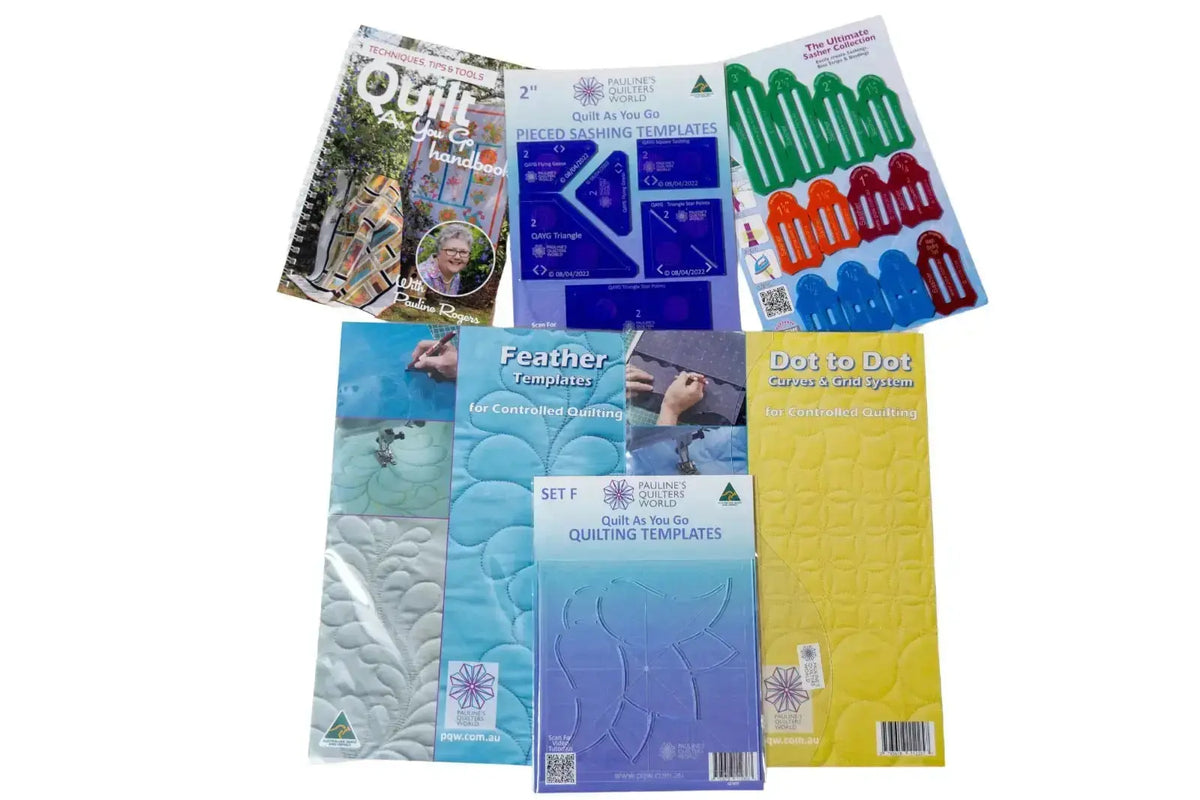
Here's the part that really gets folks. In the QISS system you don't need free-motion quilting. Pauline calls her approach Controlled Quilting. Your feed dogs stay up. You use a regular open-toe appliqué foot — not a free-motion foot — and you guide acrylic quilting templates on the block so the design stitches out evenly, block after block.
That means feathers, curves, and grids are on the table from day one, even if free-motion has never been your friend. The template does the steering. You just keep a steady pace and let the machine do what it already does well. If I can do this, y'all can do it.
The batting is not optional — and here's why
One thing Pauline is firm about: the method is built around Hobbs double-sided fusible batting. You press your block layers together — backing wrong side up, batting in the middle, top right side up — with a hot, dry iron, and the fusing medium on both sides of the batting holds the sandwich together while you quilt it. No pins. No spray baste. No shifting layers halfway through a feather.
That fused sandwich is what makes one-block-at-a-time quilting behave. Cut your layers a little generous, press them flat, keep the blocks flat while you work, and each block stays the size you cut it. That matters later, when it's time to join them.
Joining the blocks: sashers and sashing
Quilted blocks join together with sashing, and this is where Pauline's other invention comes in — the Sasher tools. A Sasher folds a fabric strip to an exact finished width as you press, with the batting tucked inside the sashing, so your joins come out flat, even, and surprisingly fast. The Quilt As You Go Handbook walks through her two joining methods, Between the Blocks and Back to Back, and we'll dig into both of those in this series.
When it's done right, a QISS quilt looks like a traditionally quilted quilt. Your friends will never guess it went through your home machine one block at a time. That's kind of the point.
Who is QISS for?
Honestly? Just about everybody. Beginners get a first big quilt that doesn't intimidate them. Experienced quilters get speed and precision without sending tops out to a longarmer. And if your machine has presser-foot pressure adjustment — most mid-range and up machines do — you're set up for this. Check that one dial before you start; it's the setup step Pauline insists on.
It doesn't have to be perfect, especially your first block. This isn't a race. Make one block. Quilt one block. Then decide. Completely up to you.
In the posts ahead in this series, we'll set up your machine step by step, meet every tool in the system one at a time, and sew along with Pauline's ExQISSite quilt. Thanks for being here, y'all. We'll see you next time. Bye.
Shop the QISS Core 6 Bundle Kit at Linda's Electric Quilters.
The batting the method is built on: Hobbs Heirloom 80/20 Fusible Batting Package. Browse the whole line in our QISS — Quilting Is Sew Simple collection.