Quick answer: A crib quilt usually finishes at 36″×45″ to 40″×60″ (a standard crib mattress is 28″×52″), and everyday baby quilts run 30″×40″ to 36″×52″. Pair yours with a crib-size batting package — shop quilt batting — and see the quilt size guide for every bed size.
Most baby quilt dimensions fall between 30 x 40 inches and 36 x 52 inches. If you want one practical default, I usually point quilters to 36 x 45 inches for an everyday baby quilt or 36 x 52 inches for crib-sized coverage, since a standard crib mattress is about 28 x 52 inches according to the Consumer Product Safety Commission. One important note up front: for infant sleep, safe-sleep guidance recommends keeping loose blankets out of the crib, as explained by the NICHD Safe to Sleep guidance.
Your Quick Guide to Standard Baby Quilt Sizes
The short answer is this: the standard size of a baby quilt is not one single number, but most finished quilts land between 30 x 40 inches and 36 x 52 inches. In practical quilting terms, 36 x 45 inches is a very useful all-purpose choice for supervised cuddling, stroller use, and floor time, while 36 x 52 inches is the classic crib-quilt size because it closely matches standard crib proportions. Quilting references commonly cite 30 x 40 inches for a newborn or travel quilt and 36 x 52 inches for a crib quilt, as noted in this Craftsy baby quilt size guide.
There is no universal standard because the intended use changes the ideal dimensions. A quilt meant for a stroller, car seat cover during supervised outings, or quick cuddle on the couch does not need the same length as one sized to visually suit a crib. In my experience, that is where many sizing mistakes start: people ask for one "right" measurement when they really need the right measurement for a specific job.
For crib-related planning, the mattress matters more than tradition. A full-size crib mattress is roughly 28 x 52 inches, so a quilt around 36 x 52 inches gives coverage without becoming dramatically oversized, which is why it remains the typical baby quilt size in many charts and patterns. But safe-sleep guidance is separate from quilt-making guidance: the American Academy of Pediatrics recommendations advise a bare sleep space for infants, so crib-sized quilts are best understood as nursery quilts, supervised-use quilts, or keepsakes unless caregivers choose to use them later and according to current guidance.
Baby Quilt Size Chart in Inches
If you want the size of baby quilt in inches at a glance, use this chart as your planning reference. I’ve kept it inches-first because that’s how most quilters sketch fabric cuts, count blocks, and buy batting.
| Quilt Type | Dimensions in Inches | Best Use | Why This Size Works |
|---|---|---|---|
| Lovie / Security Blanket | 12 x 12 to 18 x 18 | Small comfort item for supervised soothing or carrying | Easy for little hands to hold and drag around without the bulk of a full quilt. |
| Stroller Quilt | 30 x 30 to 30 x 40 | Stroller rides, car travel, lap coverage | Compact enough to fold into a diaper bag and less likely to puddle on the ground. |
| Receiving / General-Use Baby Quilt | 36 x 45 | Everyday supervised use, cuddling, nursing, floor use | This is one of the most versatile sizes because it feels substantial without being awkward to wash or quilt. |
| Standard Crib Quilt | 36 x 52 | Crib-sized coverage, nursery styling, later toddler use | It aligns closely with a standard crib mattress and gives light overhang rather than excessive drape. |
| Tummy Time / Play Mat | 40 x 40 to 45 x 45 | Supervised floor play | A square format gives usable space in every direction and avoids the narrow feel of a crib-shaped quilt on the floor. |
| Toddler Transition Quilt | 40 x 50 to 45 x 60 | Toddler bed, couch naps, longer-term use | Added length makes it useful beyond infancy, especially once the quilt is no longer tied to crib dimensions. |
A quick interpretation: 30 x 40 is a common small-format answer when people ask about baby size quilt projects, but 36 x 45 is often the better all-around pick if you want one quilt to do more than one job. Also, a 30 x 30 quilt is on the small side for a full-purpose baby quilt; I would treat it as a stroller blanket or lovie-style project rather than the main nursery quilt.
Common Baby Quilt Dimensions at a Glance
The chart above covers the most useful inch-based sizes, but here is the decision shortcut I use at the cutting table:
- Choose 12 x 12 to 18 x 18 for a lovie.
- Choose 30 x 30 to 30 x 40 for stroller or travel use.
- Choose 36 x 45 for a flexible everyday quilt.
- Choose 36 x 52 for a classic crib look.
- Choose 40 x 40 or larger square for tummy time.
- Choose 40 x 50+ if you want the quilt to carry into toddler years.
That range also lines up with common quilting references. Suzy Quilts' size chart identifies 36 x 52 inches as a common crib quilt size, while smaller formats remain popular for newborn and travel use. In my own projects, the quilts that get used most are rarely the tiniest or the largest ones; they tend to be right in that middle band where the quilt is easy to fold, easy to launder, and big enough to spread on the floor.
Feeling inspired to get started? Linda's has a wonderful selection of soft fabrics and cozy batting to bring your beautiful creation to life. Our premium materials ensure your project will be cherished for years to come.
| Quilt Type | Typical Dimensions (Inches) | Primary Use |
|---|---|---|
| Lovie / Security Blanket | Around 12 x 12 | A small, portable comfort item for tiny hands. |
| Stroller / Lap Quilt | 30 x 40 | Perfect for tucking around a baby in a stroller or car seat. |
| Standard Crib Quilt | 36 x 52 | Designed to fit a standard crib mattress perfectly. |
| Tummy Time Mat | Around 40 x 40 | A larger, often square quilt with plenty of space for play. |
How We Chose These Baby Quilt Dimensions
These recommendations are based on four practical criteria: intended use, standard crib proportions, ease of handling, and whether the quilt is meant for supervised play or a sleep environment. We prioritized dimensions that repeatedly show up in quilting references, fit real nursery furniture, and are realistic to wash, bind, and store.
I also weighed the way quilts behave in actual use. A size can look fine on paper and still feel clumsy once it is folded into a stroller basket or loaded into a washing machine. For that reason, the chart favors dimensions that are common, usable, and easy to finish cleanly.
For crib-sized guidance, mattress measurements were the anchor. For smaller formats, the emphasis was portability and comfort. For larger square quilts, the focus was supervised play space rather than bedding. That is why the article separates "crib-sized" from "safe for infant sleep" instead of treating them as the same thing.
How to Choose the Right Dimensions for Your Project
The best baby quilt size depends on four things: intended use, baby age and stage, sleep versus supervised use, and pattern constraints. If you decide those four points first, the finished size usually becomes obvious.
1. Intended Use
Start with the quilt's main job. A stroller quilt needs to stay compact, tuck neatly, and avoid excess fabric. A play quilt needs enough surface area for rolling and toys. A nursery quilt may be chosen partly for how it looks draped over a crib rail or folded on a chair. When someone asks me for the size of baby quilt I recommend most often, my answer is almost always another question: where will it be used?
2. Baby Age and Stage
Newborn quilts are often smaller because they are used for swaddling alternatives during supervised cuddling, travel, or lap coverage. As babies grow, more floor space and body length matter. That is why a typical baby quilt size for a newborn may be around 30 x 40, while a toddler-friendly quilt may move up to 40 x 50 or more.
3. Sleep vs. Supervised Use
This is the sizing question many articles blur together. A quilt for stroller use or tummy time can be selected purely for function and convenience. A quilt associated with a crib needs extra thought, because safe-sleep recommendations for infants generally call for no loose blankets in the sleep space. Excess fabric is harder to manage, yes, but the bigger point is that current guidance from the NICHD Safe to Sleep campaign advises keeping soft bedding out of the crib for sleeping infants.
4. Pattern, Block, and Pre-Cut Constraints
Quilt math can push your finished project larger or smaller than planned. Borders, sashings, and binding all add size. So do block counts. I have learned to calculate the finished top before buying backing, because a "quick" extra border can change the whole project.
For example, a layout of 5-inch finished squares set 6 across by 8 down finishes at about 30 x 40 inches before borders. Add a 3-inch border all around and you are suddenly at roughly 36 x 46 inches. A panel quilt can shift just as fast: a 24 x 36 panel with two borders may end as a stroller quilt, while wider side borders and a pieced top-and-bottom treatment can push it into receiving or crib territory. That is why I prefer choosing the target use first and then letting the block math support it, rather than the other way around.
Matching Size to Function
A stroller quilt and a floor-play quilt may sound similar, but they behave very differently. The stroller version should be narrow enough to fold, tuck, and carry easily. For supervised floor play, a narrow rectangle can feel limiting fast, so a square around 40 x 40 or larger usually works better because the usable space extends in every direction.
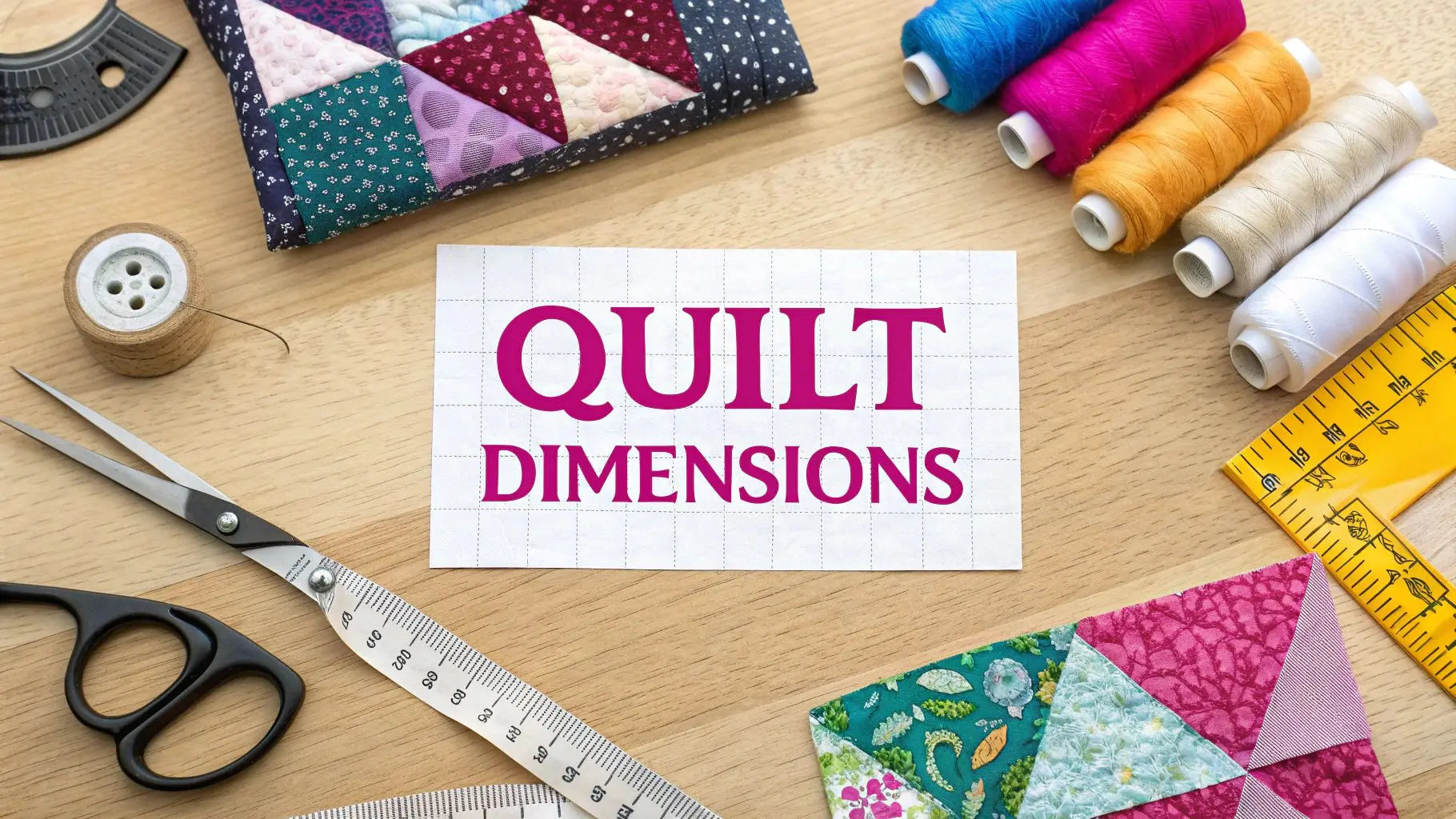
Visual examples show how these standard sizes appear in everyday settings.
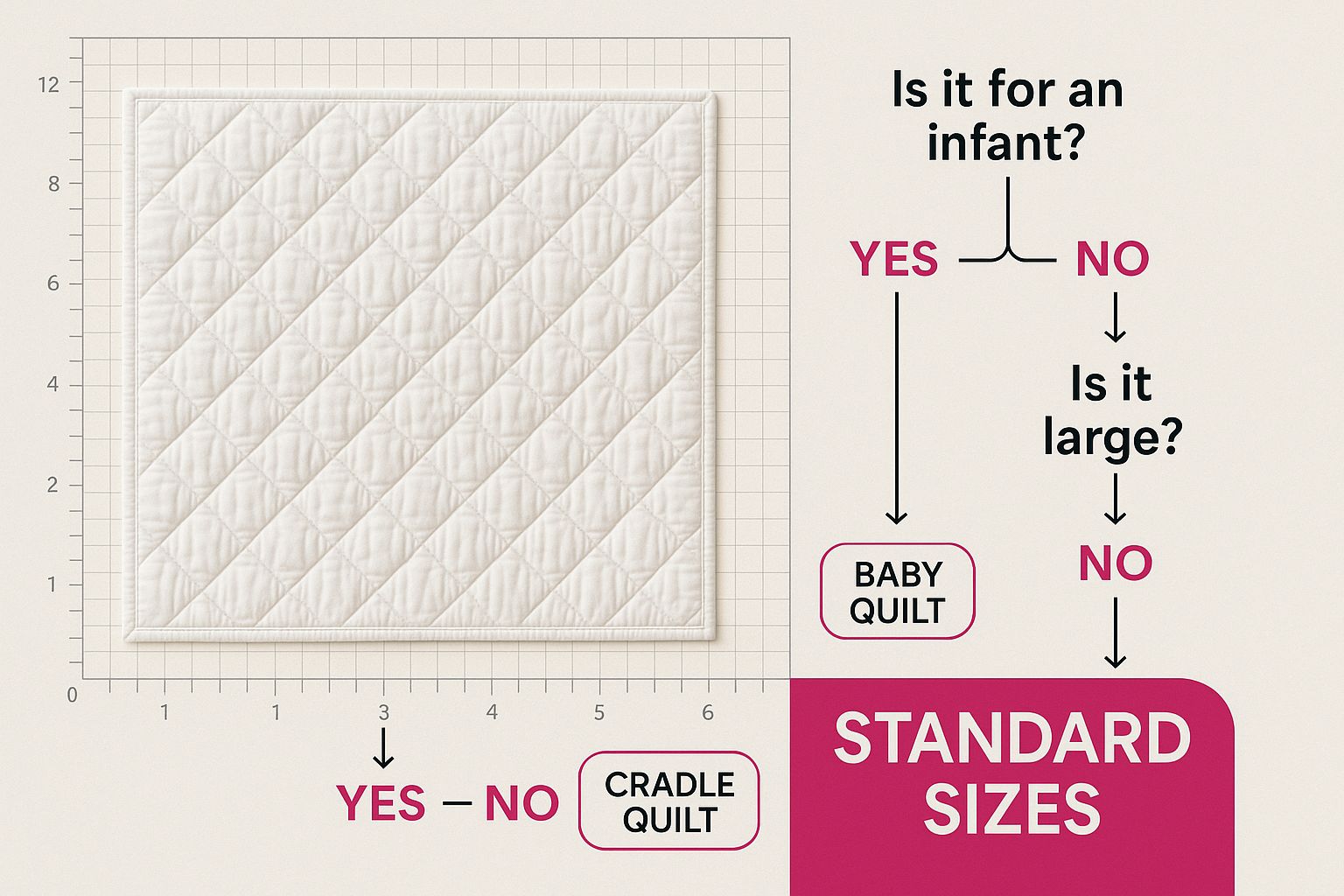
Seeing the dimensions laid out helps connect the numbers to how they'll be used. It's a lot like understanding space planning for a room, knowing the sizes ensures your quilt fits perfectly into its role in the baby's life.
Putting a little thought into these details will help you create a quilt that's not just beautiful, but useful. As you build your confidence, explore more ideas in essential quilt projects for every skill level. Once you’ve settled on the perfect dimensions, you can find all the high-quality fabrics and notions you need right here at Linda's to bring your project to life.
Calculating Your Fabric and Batting Needs
Once you’ve settled on the perfect size for your baby quilt, it’s time to figure out exactly how much fabric and batting you'll need to buy. Don't let the math scare you off! It’s just a little bit of simple arithmetic that ensures you won't run out of material mid-project for your quilt top, backing, or binding.

Think of it like baking a cake; you need the right amount of every ingredient. And just like with baking, it’s always wise to have a little extra on hand. The golden rule here is to add at least 4 inches to both the length and width for your backing and batting. This gives you a crucial buffer for the quilting process, trimming the edges square, and allows for any little bits of shrinkage in the wash.
A Practical Calculation Example
Let's break it down with a real-world example. Say we're making a standard 36" x 52" crib quilt.
- Quilt Top: The amount of fabric you need for the top is completely dictated by your chosen pattern. A simple patchwork of 5-inch squares will use a different amount of fabric than a design featuring large, illustrative panels. Your pattern is always your best guide for this part.
- Quilt Backing: For a finished quilt of 36" x 52", your backing fabric needs to be at least 40" x 56". This gives you that comfortable 2-inch margin on every side.
- Batting: Same goes for the batting! It should also be cut to a minimum of 40" x 56" so it lines up perfectly with your backing.
Choosing the Right Batting
Picking the right batting is just as important as the fabrics you’ve so carefully chosen. For a baby quilt, you’ll want something that’s soft, breathable, and easy to wash. Cotton, bamboo, or a quality cotton-poly blend are all fantastic choices.
The loft, or thickness, of the batting makes a huge difference in the finished quilt. A low-loft batting gives you a flatter, more traditional look and feel. A higher loft will create a puffier, cozier blanket. For babies, we almost always recommend a low-to-medium loft for both safety and comfort.
If you want to really get into the nitty-gritty of the different types out there, you can explore our complete guide to batting choices for the passionate quilter.
With your measurements in hand and materials decided, you're all set for the fun part. Find the perfect high-quality cotton fabrics and cozy battings for your project right here at Linda's. Our selection will help you create a quilt that’s not just beautiful, but soft and durable enough to be loved for years.
Creating Custom Baby Quilt Dimensions
While the standard sizes are a fantastic starting point, the truest magic comes when you create something from the heart, completely from scratch. Going off-script with your baby quilt dimensions is where you can really tailor a gift for a specific need, whether it's for a funky-shaped bassinet or a keepsake meant to be passed down through generations.

Don’t feel boxed in by the crib! A custom project can be anything you dream up. Think about a larger "toddler transition" quilt that can be a comforting friend when a little one moves into their first big-kid bed. Or, you could go the other way and make a tiny, precious 12" x 12" 'lovie' blanket, just the right size for small hands to grab onto. It's all about matching your quilt to its purpose, which makes the final piece that much more special.
How to Adjust a Pattern
Changing a quilt's size sounds a lot scarier than it is. The secret is keeping the pattern's original look and feel balanced. You have two main tricks up your sleeve to make a quilt bigger or smaller without messing up the design:
- Add or Widen Borders: This is easily the simplest method. Just by adding a few extra inches with a beautiful border fabric, you can transform a standard crib quilt into the perfect size for a toddler bed.
- Adjust Block Sizes: For a change that feels a bit more integrated, you can scale the individual blocks themselves. For instance, if your pattern uses 6-inch finished squares, bumping them up to 7-inch squares will make the whole quilt bigger while keeping the design's proportions perfect.
A classic mistake is to stretch a design in just one direction. This can make your beautiful pattern look squished or weirdly long. Always try to scale your changes proportionally to keep the design looking just right.
Making these little tweaks is what turns a standard project into a custom treasure. If you want to see a great example of how individual blocks create a stunning overall design, check out our guide to the Card Trick quilt pattern.
With the right high-quality fabrics and notions from Linda's in hand, you’ve got everything you need to confidently create a custom quilt that will be cherished for years to come.
Why Quilt Size Matters for Safety
Quilt size matters for safety, but not in the oversimplified sense that a perfectly measured quilt automatically creates a safe sleep setup. A key distinction is supervised use versus infant sleep. During supervised cuddling, stroller use, or floor play, the dimensions affect how manageable the quilt is and whether excess fabric gets in the way. For sleeping infants, current safe-sleep guidance is stricter: the AAP recommends a bare crib without loose blankets, quilts, pillows, or soft bedding.
That means the standard size of baby quilt still matters, especially when you are making a nursery quilt, a supervised-use quilt, or a keepsake that may be used later. A quilt that is dramatically oversized is harder to fold, harder to secure out of the way during supervised use, and more likely to bunch up. In my experience, smaller, intentional dimensions are easier for parents to handle than bulky quilts made "extra big" just in case.
Excess fabric is only part of the issue. The bigger safety point is that quilted blankets are considered loose bedding, so the safest sleep environment for infants does not include them. The NICHD safe sleep environment guidance makes that clear. So when you choose dimensions, think of crib-sized quilts as a sizing reference for the project itself, not as permission to place a quilt in the crib for an unsupervised sleeping infant.
Of course, the quilt itself is only one piece of the puzzle. It's so important to be familiar with all the essential safe sleep practices for newborns. Understanding these guidelines ensures that your handmade quilt, which is one of the best gifts you can prepare for the holiday season, will be used in the safest way possible. Here at Linda's, we're committed to helping you craft a quilt that is beautiful, secure, and cherished by providing high-quality, breathable cottons and low-loft battings perfect for the job.
Finishing Your Quilt Cleanly
You've planned, cut, and pieced your quilt top, now for the final, rewarding steps that bring it all together. The finishing touches of squaring, quilting, and binding are what turn your project from a pretty top into a durable, polished heirloom.
Before you can even think about binding, you need to square up your quilt. This just means trimming away the extra backing and batting so all your edges are perfectly straight and your corners are true 90-degree angles. Taking the time to do this right is the secret to a binding that lies flat and looks crisp, not wavy.
Once it's all squared up, a quick bit of math will tell you how much binding you need. Just add up the lengths of all four sides and toss in an extra 10-12 inches to be safe.
A sharp rotary cutter and a quality self-healing mat aren't just nice to have; they are absolutely essential for getting that flawless finish. A dull blade will snag and pull your fabric, leaving you with wonky edges that are a nightmare to bind neatly.
One finishing point I never skip on baby quilts is checking the batting label before quilting densely or sparsely. Some battings specify the maximum spacing between quilting lines, and that affects both durability and wash performance. Leah Day's baby quilt size and materials overview notes that batting instructions can include spacing guidance such as quilting up to 8 inches apart. For shrinkage and puckering, it also helps to remember that cotton fabrics can tighten up after washing; the National Quilters Circle fabric prep tips are a useful reference if you are deciding whether to prewash.
To give your beautiful baby quilt the perfect finishing touch it deserves, having the right equipment makes all the difference. At Linda's, we have everything you need, from sharp rotary cutters and self-healing mats to high-quality threads and binding clips that make the final steps easy and enjoyable. Shop our collection today to find the tools that will make your project a success.
Frequently Asked Questions About Baby Quilt Sizes
Even the most detailed plan can leave you with a few head-scratchers once the fabric is on the cutting mat. Let's tackle some of the most common questions quilters ask about baby quilt sizes so you can stitch with total confidence.
What Is the Best Size for a Multi-Purpose Quilt?
If you're aiming for a quilt that can do it all, a great go-to size is around 36 inches by 45 inches. It's the sweet spot—big enough for tummy time on the floor and perfect for tucking into a stroller, but not so large that it becomes cumbersome or unsafe for a standard crib. New parents really appreciate a do-it-all quilt like this.
How Much Will My Quilt Shrink?
Ah, the dreaded shrinkage! After that first wash, you can typically expect your quilt to shrink anywhere from 3% to 5%. This is especially true for cotton fabrics and batting, which love to crinkle up and get cozy.
If you don't pre-wash your materials (and many of us don't!), it’s a smart move to add an extra inch or two to your starting measurements just to be safe.
Can I Use a Quilt as a Crib Bumper?
This one is a hard no. Safety experts strongly recommend never using quilts or any kind of soft, fluffy bedding as crib bumpers. The safest crib is a bare crib. A baby quilt should fit the mattress well without a lot of extra fabric hanging around and always be used according to safe sleep guidelines.
If you're looking to brush up on your skills, check out these tips to elevate your quilting craft with advanced techniques.
Every heirloom project begins with beautiful materials. At Linda's Electric Quilters, we've curated a gorgeous selection of high-quality fabrics, dreamy soft battings, and all the notions you need to create something truly special. Come explore our collection and find the perfect supplies to bring your vision to life. Shop now at Lindas.com.
When your quilts grow up, so do the numbers - see our king size quilt dimensions guide for the largest standard quilt sizes and how much fabric and batting they need.
Planning a different size? See our complete quilt size chart and guide for throw, twin, full, queen, and king dimensions.
Pair your measurements with the right quilt batting, and if you are finishing with a satin edge, here is how to apply blanket binding step by step.