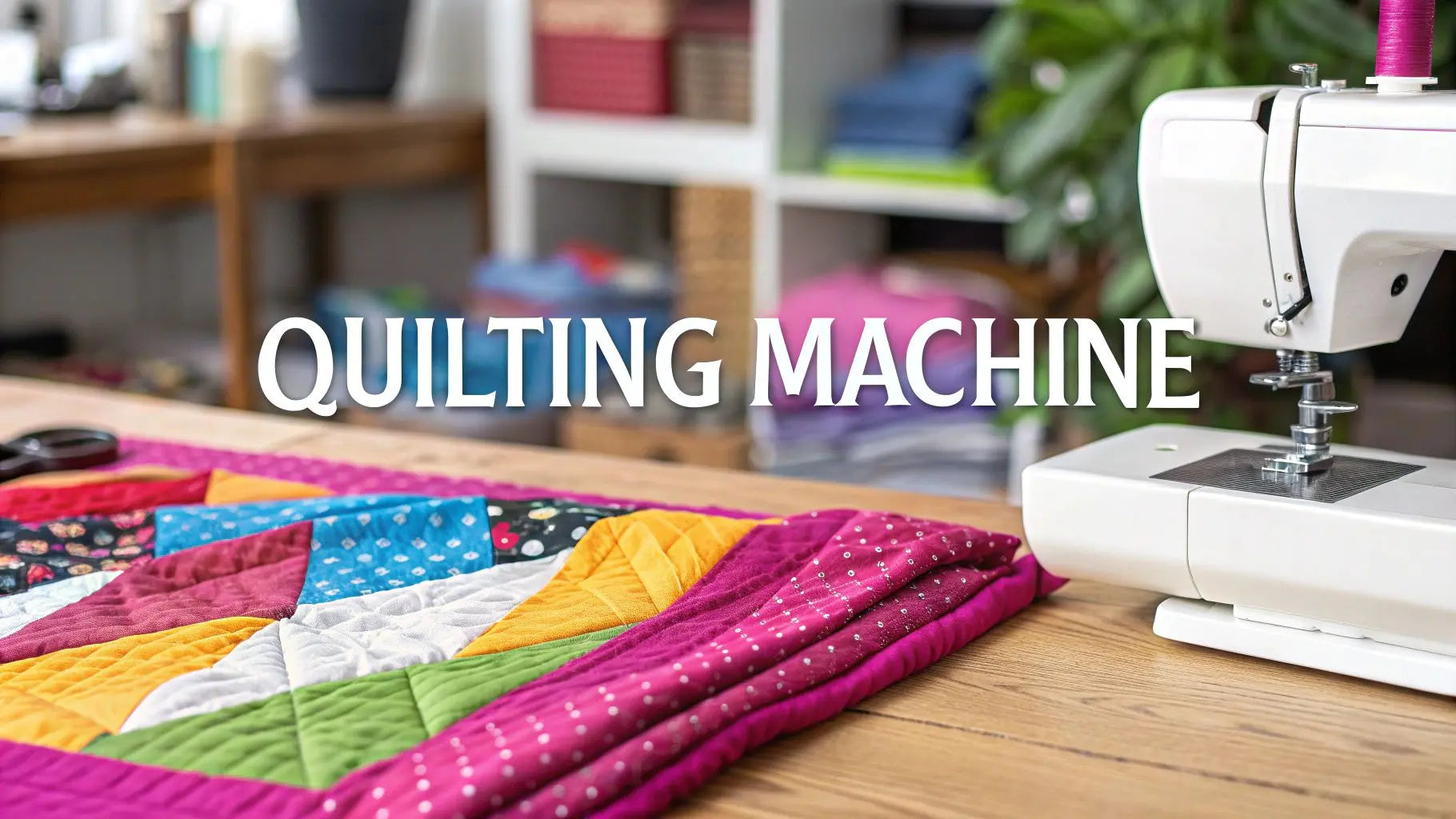
When you're looking for your first quilting machine, what really matters? You need a reliable workhorse with plenty of room to work, a walking foot, and a killer straight stitch. It’s a lot like learning to cook—you don’t need a six-burner Viking range, just a dependable stove and a couple of good pans to make magic happen.
A simple, sturdy machine is all you need to start stitching up your first beautiful quilts. At Linda's, we can help you find the perfect one to begin your creative journey.
Starting Your Quilting Journey with the Right Machine
So, you’re ready to dive into the wonderful world of quilting! It’s such an exciting time, dreaming of all the cozy, creative projects ahead. But let’s be honest, walking into a store and seeing a wall of sewing machines can be completely overwhelming.
The good news? You absolutely do not need the fanciest, most expensive machine on the floor. Not even close.
The secret is to focus on a few key features that will make your life easier and your quilting journey a joy right from the start. A machine with these core functions will be your trusted partner as you grow from simple nine-patch blocks to more ambitious designs. You're looking for a dependable friend, not a gadget with a thousand stitches you’ll never touch.
It seems a lot of people are discovering this joy right now. Quilting is having a major moment! We’ve seen search interest for beginner machines jump by a whopping 61.82% in just one month. It’s all part of a bigger picture—the U.S. quilting industry is now valued at $4.5 billion. To keep up, many brands are bundling their machines with beginner-friendly patterns to help new quilters get going.
Must-Haves vs. Nice-to-Haves
To help you cut through the noise, I’ve broken down the features into two camps: the absolute essentials and the really nice extras. Think of this as your cheat sheet for spotting a true beginner sewing machine for quilting versus a general-purpose machine that might just lead to headaches.
I've put together a quick table to make it even clearer.
Beginner Quilting Machine Features At-a-Glance
| Feature | Importance for a Beginner | Why It Matters |
|---|---|---|
| Generous Throat Space | Must-Have | This is the physical space you have to roll up your quilt. More room means less wrestling with your fabric. |
| Walking Foot Compatible | Must-Have | It's a special foot that grips the top fabric layer, feeding it through at the same rate as the bottom layer to prevent puckers. |
| High-Quality Straight Stitch | Must-Have | You’ll use this stitch for 99% of your quilting. It needs to be strong, consistent, and clean. |
| Needle Up/Down Function | Nice-to-Have | This lets you stop with the needle buried in the fabric, which is perfect for pivoting at sharp corners without losing your spot. |
| Speed Control Slider | Nice-to-Have | A lifesaver for beginners! It puts a speed limit on your machine, helping you build confidence with steady, even stitching. |
| Automatic Thread Cutter | Nice-to-Have | A button that snips your threads for you. It's a fantastic time-saver, but you can definitely live without it at first. |
This table should help you focus on what really counts when you're comparing models.
A reliable machine is your most important tool. It doesn't need to be fancy, but it does need to be strong enough to handle multiple layers of fabric without skipping stitches. Think of it as the foundation of your quilting practice.
As you start out, don’t forget that quilting has always been about community. Learning and creating with others makes the whole process so much richer. If you're looking for pals to share your progress with, check out our tips on finding your local crafting community.
Here at Linda's, we’ve hand-picked a collection of machines that we know are perfect for new quilters. We focus on reliability and the features that will truly help you succeed. Come take a look and find the perfect machine to kick off your amazing quilting adventure.
Choosing Your Machine: Mechanical vs. Computerized
When you first start looking for a quilting machine, you'll quickly see they fall into two main categories: mechanical and computerized. There's no "better" option here; it really just comes down to what feels right for you.
Think of it like choosing between a manual or an automatic car. One gives you a very direct, hands-on feel for the road, while the other handles a lot of the work for you so you can focus on cruising. Neither is wrong, it’s all about your personal style.
The Classic Workhorse: Mechanical Machines
A mechanical machine is the manual transmission of the sewing world. You are completely in charge. Every stitch, every tension adjustment, every setting is controlled by you turning a physical knob or dial. There’s a beautiful, tactile connection to what the machine is doing.
This hands-on approach is fantastic for truly understanding the mechanics of sewing from the ground up. Because they have fewer electronic components, they’re also known for being incredibly durable. These are the workhorses that can be passed down through generations with just a little bit of care.
- Direct Control: You turn a dial, you see the result. This immediate feedback helps you build a real, intuitive feel for sewing.
- Durability: Fewer electronic parts often means a longer lifespan and simpler maintenance. They just keep going.
- Budget-Friendly: Mechanical machines usually have a lower price tag, which leaves more of your budget for the fun stuff—fabric, thread, and essential accessories like a good walking foot.
If you love the idea of getting your hands dirty and mastering the fundamentals, a solid mechanical machine is a phenomenal starting point.
The Smart Assistant: Computerized Machines
On the other side of the aisle are computerized machines. These are your modern, automatic-drive cars packed with helpful features. They’re designed to be smart assistants, taking care of the tedious adjustments so you can focus more on your creativity and less on the setup.
The most obvious feature is usually an LCD screen that shows you exactly what stitch you've selected, along with the length and width. Instead of a dial, you just push a button to cycle through dozens—or even hundreds—of stitches.
For quilters, the absolute game-changers on a computerized machine are the needle up/down button and the speed control slider. The needle up/down function lets you stop with the needle buried in your quilt sandwich, which is essential for pivoting perfectly at corners. And the speed control is like cruise control for your sewing, giving you smooth, consistent stitches even when you're just starting out. It’s a huge confidence booster!
These machines are often loaded with other goodies:
- Push-Button Stitch Selection: Effortlessly pick the perfect stitch for the job.
- Automatic Thread Cutting: A tap of a button snips your top and bobbin threads. It saves a surprising amount of time and thread!
- Programmable Stitch Sequences: You can combine decorative stitches to create unique patterns for quilting or appliqué.
Ultimately, this choice is all about what motivates you. Do you want the raw, tactile experience of a mechanical machine, or does the thought of a smart, convenient assistant get your creative juices flowing? For a deeper look at specific models we love, our team at Linda's put together a guide on deciding on a sewing machine with our top recommendations.
Whether you’re drawn to the classic power of a mechanical model or the slick features of a computerized one, we have an amazing machine waiting for you here at Linda’s. The best way to know for sure is to come in and give them a test drive.
Unpacking the Essential Machine Features for Quilting
Alright, now that we've covered the basics of mechanical versus computerized machines, let's get into the good stuff—the specific features that will make or break your quilting experience. It’s so easy to get mesmerized by a machine with hundreds of fancy stitches and a screen that looks like a spaceship cockpit.
But let me tell you, when it comes to quilting, most of that is just noise.
Think of it like buying a knife for your kitchen. A world-class chef's knife is simple, perfectly balanced, and does its one job flawlessly. It’s far more useful than a cheap multi-tool with a flimsy blade and a dozen gadgets you'll never touch. The same logic applies here. We’re hunting for quality and function, not just a long list of bells and whistles.
Why Throat Space Is Your Best Friend
The first thing I tell every new quilter to look at is the throat space (sometimes called the harp space). This is simply the distance between the needle and the body of the machine. It determines how much quilt you can actually fit in there without wanting to pull your hair out.
Imagine trying to wrestle a king-size quilt through a tiny opening. It's a nightmare. The fabric gets bunched up, you can't see what you're doing, and your stitches end up wonky. A generous throat space gives you room to breathe and maneuver.
Most standard sewing machines have around 5-6 inches of throat space. For quilting, you really want to look for something with at least 8 inches or more. That extra room is a total game-changer, especially when you’re quilting the center of a larger project.
The Power of a Superior Feed System
Next up: how the machine actually moves your fabric. A quilt isn’t just a single piece of cloth; it's a "sandwich" with the quilt top, the fluffy batting in the middle, and the backing fabric. All three layers need to glide through the machine together, perfectly in sync.
This is where the feed system comes into play. The feed dogs are those little metal teeth under your presser foot that grip and pull the fabric. Many modern quilting machines use a box feed system, which moves the feed dogs in a rectangular motion. Think of it like a smooth conveyor belt that keeps constant, even contact with your fabric, preventing the dreaded puckering and shifting that can ruin a quilt top.
Now, the ultimate upgrade for any feed system is a walking foot. This amazing attachment adds a set of feed dogs to the top of your fabric, so it pulls the top and bottom layers through at the exact same time. It's like giving your sewing machine all-wheel drive—no more slipping and sliding! You'll need this essential tool to finish your first quilting project successfully.
The Only Two Stitches You Really Need
I see people get so excited about a machine that boasts 250 different stitches. But here’s a little secret from someone who's been at this for a long, long time: you'll use maybe two of them for 99% of your quilting.
- A Perfect Straight Stitch: This is your bread and butter. It's what you use to piece your quilt blocks and for most of your actual quilting. You need a machine that delivers a consistently straight, strong, and balanced stitch every single time.
- A Simple Zigzag Stitch: This one is a workhorse for finishing raw edges to stop them from fraying. It's also great for appliqué and other decorative touches.
Don’t get caught up in the numbers game. A machine that does one or two things perfectly is infinitely better than one that does a hundred things poorly. Focus on the quality of the stitch, not the quantity.
This little chart helps break down the choice between a mechanical workhorse and a feature-packed computerized model.
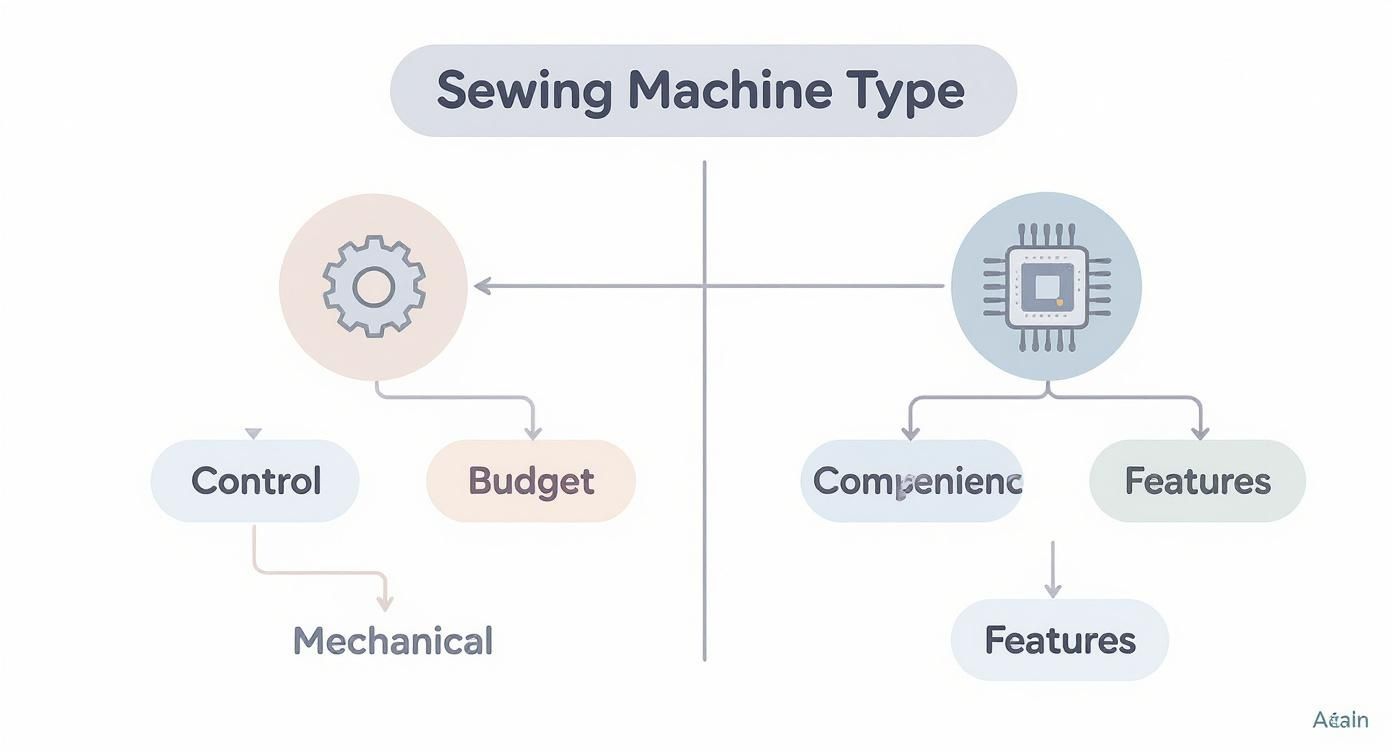
As you can see, it really boils down to whether you prefer hands-on control and simplicity or the automated convenience that comes with a more modern machine.
A Motor That Can Handle the Job
Last but certainly not least, let's talk about power. Pushing a needle through three layers of fabric, batting, and thread over and over again takes some serious muscle. A weak motor will protest, giving you skipped stitches, tension problems, and maybe even burning out completely.
I like to think of the motor as the engine in your car. A little four-cylinder is fine for zipping around town, but if you're going to tow a heavy trailer up a mountain, you need something with more horsepower. Quilting is your machine's version of going uphill. A strong, sturdy motor will deliver consistent power, stitch after stitch, without ever slowing down. This is where you can really feel the difference between a cheap machine and a well-built one.
At Linda’s, we’ve hand-picked every machine we carry with these core quilting features in mind. We want to make sure you start your journey with a reliable partner that’s truly built for the job. Come on in and let our experts help you find the perfect machine for your projects.
Building Your Essential Quilting Toolkit
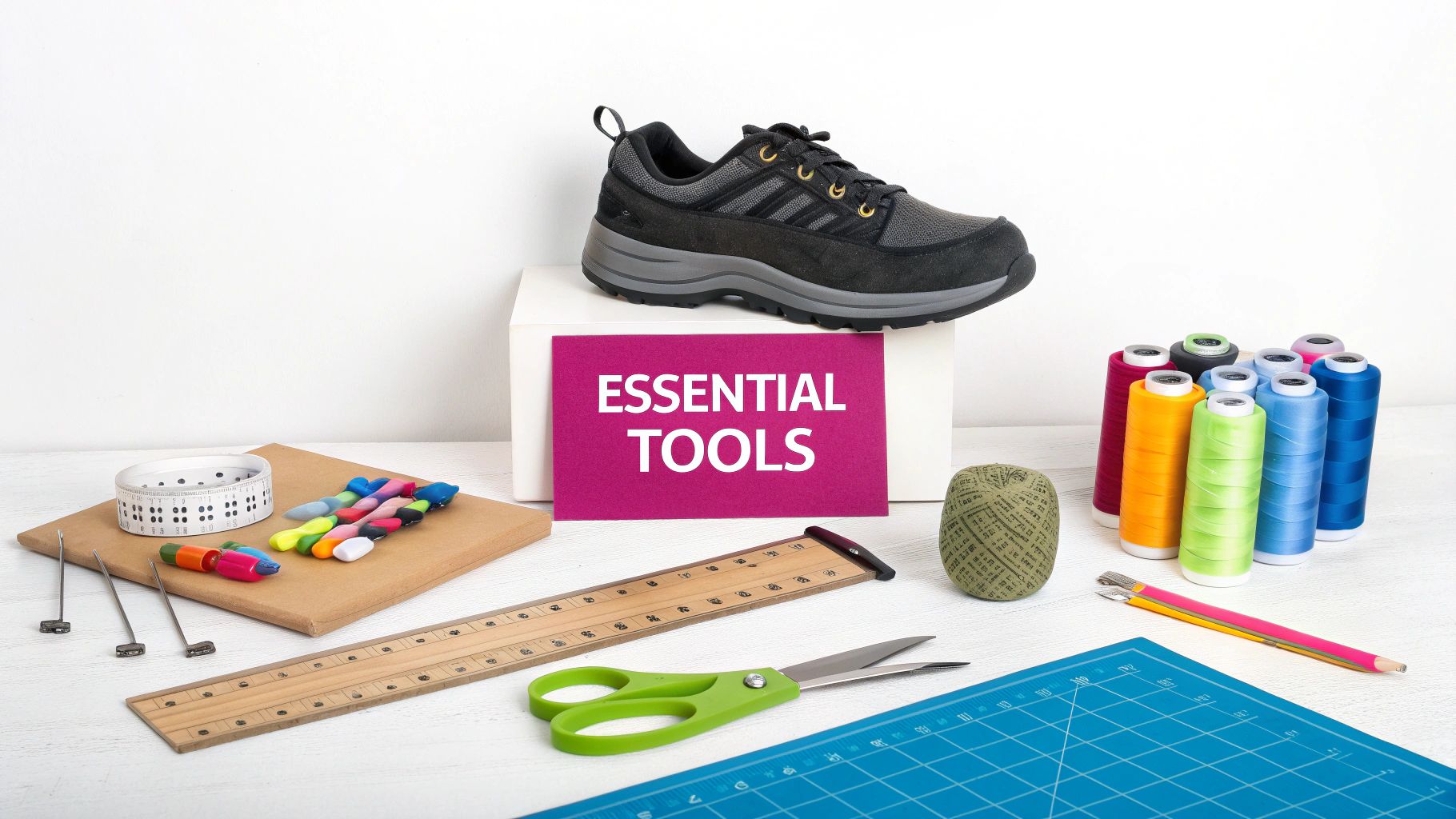
Alright, you've picked out a fantastic beginner sewing machine for quilting. That's a huge first step, but the machine is just the start of your adventure. To really bring your quilts to life, you’ll need a few key accessories. These aren’t just nice-to-haves; they are the tools that will make quilting a smooth, joyful process instead of a frustrating chore.
Think of your sewing machine as a powerful engine. Your accessories are the specialized tires, the comfy seats, and the GPS that make the journey a pleasure. Without them, you're just making the trip harder than it needs to be.
So, let's put together your shopping list with the absolute must-haves that will set you up for success from your very first stitch.
The Most Valuable Player: The Walking Foot
If you only buy one accessory for your quilting journey, make it a walking foot. I can't stress this enough—this incredible tool is the single most important add-on you can get. For straight-line quilting, it's an absolute game-changer.
Here's why: A standard presser foot just glides over your top fabric, while the little feed dogs underneath pull the bottom layer. This mismatch in movement is what causes layers to shift, resulting in puckers and tucks. Not fun.
A walking foot, on the other hand, is like an all-terrain vehicle for your machine. It has its own set of feed dogs on top, gripping the quilt top and moving it in perfect sync with the bottom layer.
This synchronized movement ensures all three layers of your quilt sandwich—the top, batting, and backing—feed through the machine evenly. This prevents fabric shifting and guarantees beautifully flat, pucker-free quilt blocks every time. It’s the secret weapon for professional-looking results.
Find the perfect walking foot for your new machine in our curated collection at Linda's and make your first project a success.
Specialty Feet for Creative Stitching
While the walking foot is the undisputed king of straight lines, you'll eventually want to get more creative. That's where a free-motion quilting foot (sometimes called a darning foot) comes into play. This foot hovers just above the fabric, letting you move your quilt in any direction to essentially "draw" with your thread.
There are two main types you'll see:
- Open-Toe Foot: This version has a little opening at the front, giving you a crystal-clear view of where your needle is going. It's fantastic for detailed work where precision is everything.
- Closed-Toe Foot: This foot is a complete circle, which helps prevent your quilt from snagging on its edges. It's a great, stable option for beginners just learning the ropes of free-motion quilting.
Having one of these on hand opens up a whole new world of swirls, feathers, and artistic designs once you get comfortable with the basics.
Needles and Threads: The Unsung Heroes
Finally, let's talk about the two items that do all the heavy lifting: your needles and thread. Using the wrong ones is a fast track to skipped stitches, shredded thread, and a whole lot of frustration.
Quilting Needles: These are designed specifically for this job. They have a stronger, tapered point made to pierce through multiple layers of fabric and batting without shredding the fibers. Make sure you grab the right size—a 90/14 is a great all-purpose choice for most quilting cottons. Pro tip: change your needle after every 8-10 hours of sewing for the cleanest stitches.
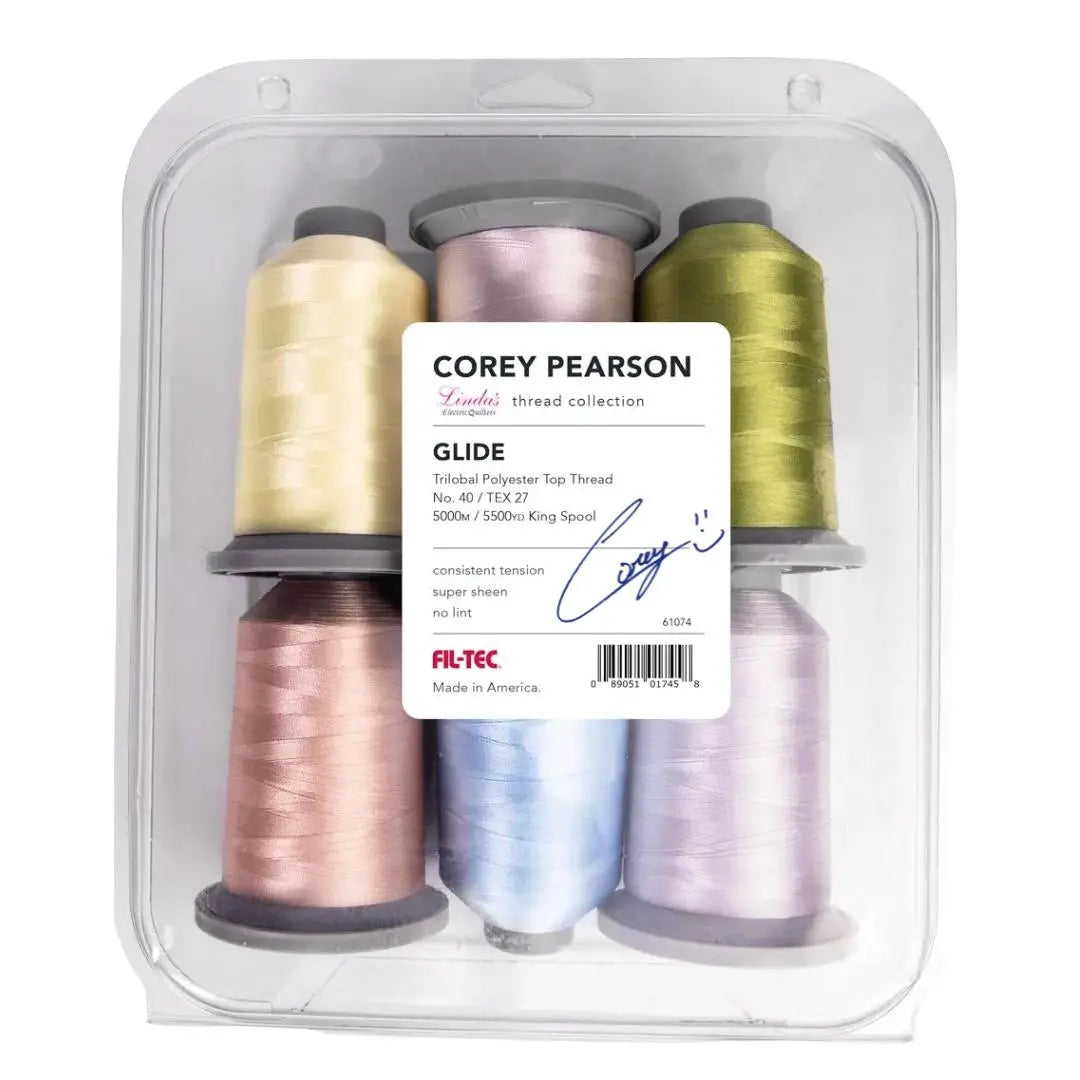
Cotton vs. Polyester Thread: For quilting, 100% cotton thread is the gold standard. It has a beautiful, soft finish that melts into the fabric and wears at the same rate as your cotton quilt top. Polyester thread is stronger and has a bit of stretch, but many quilters prefer to match materials. A good quality 50-weight cotton thread is the perfect place to start.
Your First Quilting Project Shopping List
Feeling a little overwhelmed? Don't be! Here's a simple checklist of everything you'll need to get started on that first quilt. We've got all these essentials waiting for you here at Linda's.
| Item | Primary Function | Beginner Tip |
|---|---|---|
| Walking Foot | Evenly feeds all quilt layers to prevent puckering. | The single most important accessory for straight-line quilting. |
| Quilting Needles (90/14) | Pierces thick layers without damaging fabric. | Change your needle for every new project or after 8 hours of sewing. |
| 50-Weight Cotton Thread | The classic choice for piecing and quilting. | Choose a neutral color like cream, gray, or white to start. |
| Rotary Cutter & Mat | Makes cutting fabric fast, easy, and precise. | A 45mm rotary cutter is a great, versatile size for beginners. |
| Quilting Rulers | Ensures accurate cuts and square blocks. | Start with a 6" x 24" ruler for cutting strips and a smaller square ruler. |
| Fabric Shears | A good pair of scissors dedicated only to fabric. | Hide these from the rest of the family! Paper dulls them quickly. |
| Quality Batting | The fluffy middle layer that gives your quilt warmth. | An 80/20 cotton/poly blend is a forgiving and popular choice. |
With these essential tools from Linda's in your sewing basket, you'll be fully equipped to tackle your first quilting project with total confidence. Stop by today to get everything you need in one place!
Setting Up for Your First Quilting Project
Alright, you’ve picked out the perfect machine and gathered your supplies. Now for the exciting part! This is where you bring everything together to turn a pile of fabric into the start of a beautiful quilt.
Don't let the setup process intimidate you; you'll get the hang of it faster than you think. Think of it like getting all your ingredients measured and your oven preheated before you start baking. A little prep work makes the whole process smoother and way more fun.
Your Pre-Quilting Checklist
First things first, let's get your machine ready for action. The first skills every quilter learns are winding a bobbin and threading the machine. Grab that user manual—it’s your best friend right now, as every machine has its own little quirks.
Once you're all threaded up, it's time to attach your walking foot. This is a non-negotiable step for quilting! A walking foot is what makes sure all three layers of your quilt sandwich glide through the machine together, preventing those frustrating puckers and shifted fabric.
My biggest piece of advice: Always test your stitches on a practice "quilt sandwich" before you touch your real project. Just grab a couple of fabric scraps and a small piece of batting. Stitching on this first lets you dial in your thread tension and stitch length without putting your actual quilt top at risk. It’s a five-minute habit that will save you hours of seam-ripping.
Mastering Your First Stitches
With your machine purring along and your test sandwich looking great, you are officially ready to quilt. For a first project, I can't recommend "stitch in the ditch" enough. It's a fantastic and incredibly satisfying technique that’s exactly what it sounds like—you quilt directly in the "ditches" created by your seam lines.
It’s a brilliant starting point for a few reasons:
- It’s super forgiving. Your stitches practically disappear into the seams, hiding any little wobbles.
- It gives you a roadmap. The seam lines provide a clear path to follow, which is amazing practice for sewing straight.
- It makes your quilt stable. It anchors all your pieced blocks and secures the entire quilt beautifully.
Always start quilting in the middle of your project and work your way out toward the edges. This little trick pushes any extra fullness to the outside, giving you a wonderfully flat and smooth finish. Take it slow, gently guide the fabric, and just let the machine do its job. You’ll be amazed at how quickly you find your rhythm.
You're not alone on this creative journey! The global sewing machine market is set to hit $7.26 billion because so many people are discovering the joy of hobbies just like this one. In fact, quilters and hobbyists make up about 60% of all home sewing machine sales. You're in great company!
As you start dreaming up fabric combinations, a little knowledge of fundamental color theory can make a huge difference in how polished your final quilt looks.
To get your feet wet, a simple pattern is the way to go. We have a fantastic, free quilt pattern for beginners that’s absolutely perfect for practicing the stitch-in-the-ditch technique.
Want to make it even easier? Our Beginner Quilting Project Kits come with everything you need—pre-cut fabric, batting, backing, and clear instructions. It's a foolproof way to dive in and focus on the pure joy of stitching, knowing you’ll end up with something beautiful.
Answering Your First Quilting Questions
Jumping into quilting is exciting, but let's be honest, it also brings up a ton of questions. It's completely normal! Think of me as your quilting friend who’s been around the block a few times, ready to clear things up so you can get back to the fun part.
We’ve rounded up the questions we hear most often from new quilters. Let’s get them answered.
Can I Use a Regular Sewing Machine for Quilting?
You absolutely can! You don't need a fancy machine with "quilting" plastered all over it to make a beautiful quilt. So many standard sewing machines are more than capable, especially when you're just starting out.
The real secret is making sure it has the key features we talked about earlier. If your machine has a decent amount of throat space and, most importantly, can use a walking foot, you are good to go. A solid, reliable machine with a motor that doesn't whine is the perfect beginner sewing machine for quilting. It'll handle piecing your blocks and quilting straight lines like a champ.
How Much Should I Budget for a Beginner Quilting Machine?
Here's the good news: you don't have to break the bank. You can find a tough, high-quality mechanical machine for around $200-$400, and it will have everything you need to learn the ropes.
If you’ve got your eye on a computerized model with some extra bells and whistles, you can find great entry-level options starting around $400. My best advice? Always invest in a brand known for building sturdy machines, not a cheap one that’s loaded with features that will break. And don't forget to set aside a little extra for essentials like that walking foot and some good quality thread.
Remember, the machine is a one-time purchase, but your creativity is limitless. Investing a little more in a machine that won’t fight you at every step is worth every penny in the long run. It’s the difference between a joyful hobby and a frustrating chore.
What Is the Most Important Feature for a Beginner?
If I had to pick just one thing, it would be the ability to use a walking foot. Hands down. This one accessory is a total game-changer and the best friend a new quilter could ask for.
A walking foot basically adds a set of feed dogs on top of your fabric that move in perfect time with the feed dogs below. This creates an even "pull" on all three layers of your quilt sandwich. It’s the magic trick that stops the fabric from shifting, bunching, and puckering—all the things that drive beginners crazy. It’s your ticket to a smooth process and professional-looking results from day one.
How Do I Maintain My New Sewing Machine?
Keeping your machine happy and humming is pretty simple. It just comes down to two little habits: cleaning out the lint and changing your needle often. After you finish a big project, take a minute to brush out all the fluff that’s collected in the bobbin area.
You’ll also want to pop in a fresh needle after every 8-10 hours of sewing. This keeps your stitches looking crisp and prevents snags. For anything else, like oiling, just follow what your machine’s manual says. And to really keep it running like a dream, think about taking it to a trusted dealer for a professional tune-up every year or two.
Your quilting adventure is just beginning, and Linda's Electric Quilters is here to support you every stitch of the way. From finding the perfect machine to stocking up on fabrics, threads, and expert advice, we have everything you need to bring your creative vision to life.
Explore our amazing collection of quilting supplies at Lindas.com today!