The popular advice is simple: choose rayon for shine, polyester for durability, and the most expensive spool you can afford. That advice misses the point. The best quality embroidery thread is the thread that runs smoothly on your machine, at your working speed, through your actual stitch density, while retaining its color and strength after the project is used and washed.
For most everyday machine embroidery and high-use quilting, a branded 40-weight continuous-filament polyester is the practical starting point. It offers dependable strength and wet performance, but it won't solve every break if the needle, stabilizer, tension, or machine speed is wrong. A well-matched mid-tier thread can outperform a premium spool when the production setup is better controlled.
| Thread type | Strength and wet performance | Finish | Best use case | Washfastness |
|---|---|---|---|---|
| Continuous-filament polyester | High tensile strength and strong wet-strength retention. Comparable 40-weight polyester is reported at approximately 30–50% greater dry tensile strength than rayon, with polyester retaining about 95% of dry strength when wet, compared with 50–60% for rayon. Read the polyester and rayon comparison | Smooth, often slightly lustrous | Dense designs, uniforms, children's garments, quilts, and frequently washed items | High-quality polyester can achieve ISO 105 washing-fastness ratings of 4–5 on a five-point scale. Review the technical thread-size guide |
| Rayon | Lower tensile strength and more vulnerable when wet | Soft, luminous sheen | Decorative embroidery and luxury garment embellishment | Requires more care in projects exposed to repeated laundering |
| Cotton | Varies with staple length, twist, spinning, and dyeing consistency | Traditional matte finish and soft hand | Heirloom quilts, fabric art, and classic quilting | Depends heavily on dye quality and documented testing |
| Metallic | More friction-sensitive and demanding to run | Reflective sparkle | Small accents, holiday designs, and decorative details | Test before committing to a washable project |
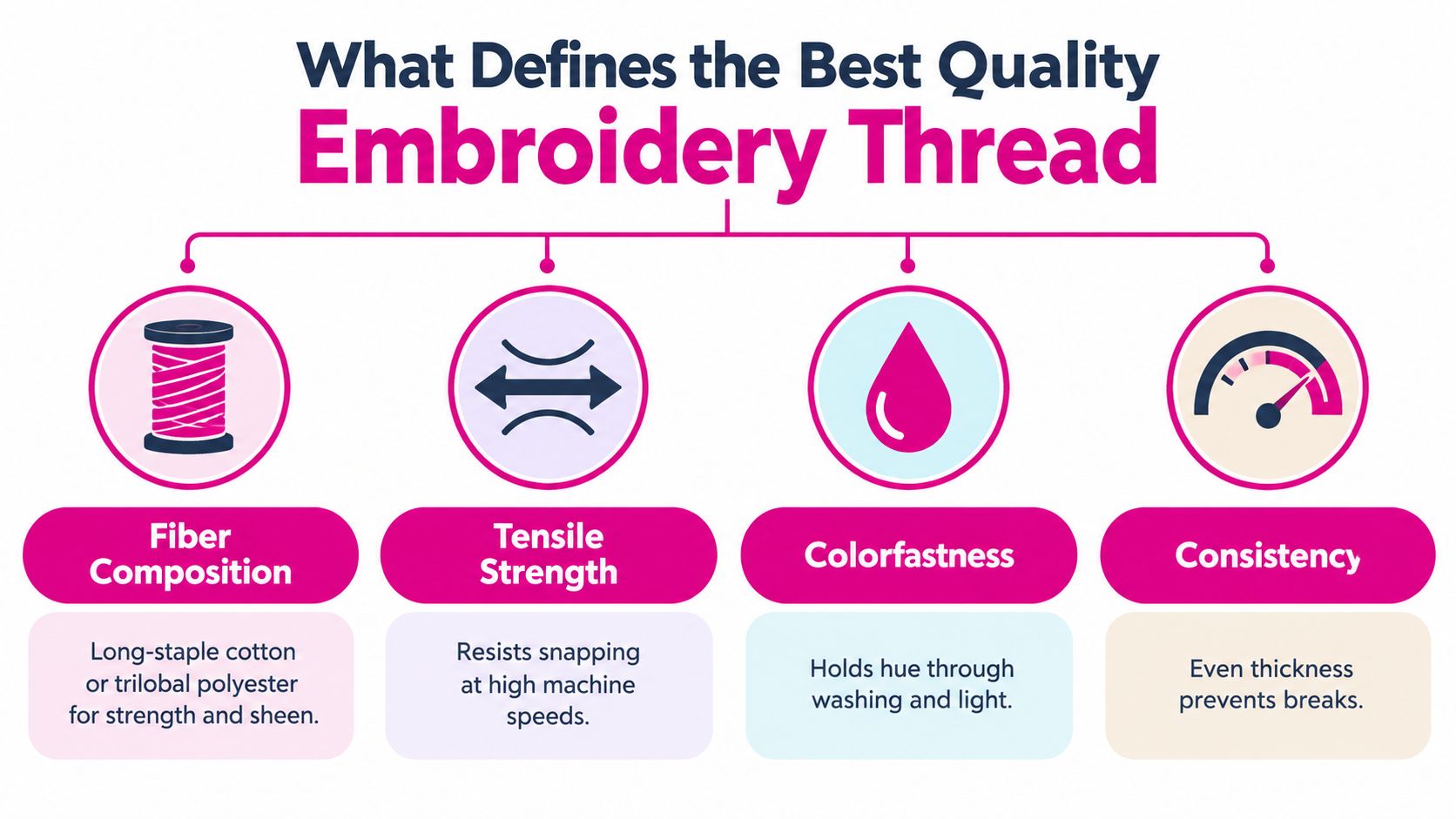
What Defines the Best Quality Embroidery Thread
The best quality embroidery thread is not always the most expensive spool. Machine speed, tension, stitch density, needle size, heat, and fabric determine whether a thread keeps producing clean stitches after high-speed sewing and repeated washing. A mid-tier thread with consistent construction can outperform a premium thread that runs poorly on your machine.
Start with measurable thread behavior
Check consistent thickness, smooth winding, low lint, and a clear intended-use specification before judging fiber type. If the diameter changes as the thread unwinds, the relationship between the tension discs, needle eye, bobbin casing, and fabric also changes. The result can be uneven coverage, loose loops, or repeated breaks.
A dense design increases friction and heat. A small needle eye adds more resistance. High machine speed exposes weak spots quickly. These production conditions explain why a thread that works beautifully on a slow test design may fail during a long commercial run.
Fiber type still affects the result, but it does not define quality by itself. Polyester accounts for much of global fiber production, while cotton remains widely used in traditional textiles. Textile Exchange reports that worldwide fiber production reached 124 million metric tons in 2023, compared with 116 million tons in 2022. Polyester represented approximately 71 million metric tons and 57% of production, while cotton accounted for approximately 20%. Those figures indicate supply and availability, not automatic superiority.
Inspect these characteristics before buying:
- Uniform diameter: Even thread supports predictable tension and stitch coverage.
- Tensile strength: Strong thread resists snapping during dense designs and long runs.
- Surface finish: A smooth surface reduces friction through the needle eye and fabric.
- Low lint: Less lint keeps the tension path and bobbin area cleaner.
- Colorfastness: Documented color retention matters more than a bright spool display.
- Machine compatibility: Match the thread to the needle, speed, stitch density, stabilizer, and fabric.
Use colorfastness as a buying filter
Textile testing commonly checks resistance to washing, light exposure, rubbing, perspiration, and heat. Results are often reported on a 1-to-5 scale, where 1 indicates severe change and 5 indicates little or no visible change. This embroidery quality-testing reference explains why the spool's appearance does not prove lasting performance.
For regularly washed quilts, choose thread with documented strong washfastness and test it on the actual fabric. Strong lightfastness matters more for wall hangings, garments, and décor placed near windows. A thread can pass one test and still behave differently under your machine's heat, tension, and stitch density.
Pro-Tip: Sew and wash a small sample before using any thread on a finished quilt. The label describes the manufacturer's claim. The washed sample shows how your fabric, needle, stabilizer, tension, and thread perform together.
Rayon, Polyester, Cotton, and Metallic Compared
Fiber choice matters, but it does not decide performance by itself. A mid-tier thread matched to the machine, needle, stitch density, tension, and fabric can produce a cleaner, more durable result than a premium thread running outside its workable range. The finished item's use still sets the starting point. A jacket logo, heirloom quilt, and child's sweatshirt face different washing, abrasion, and handling demands.
Polyester for demanding everyday work
Continuous-filament polyester is usually the safest starting point for high-use machine embroidery. Reported polyester tenacity is approximately 4.5–6.0 cN/dtex, compared with roughly 2.0–3.0 cN/dtex for rayon, while polyester's moisture regain is below 0.4%. The rayon and polyester technical comparison links these properties with better strength retention in wet conditions.
Quality polyester suits uniforms, children's clothing, quilt labels, bags, and garments that will be washed often. Its low moisture absorption reduces swelling and dimensional change, helping lettering and dense fills keep their shape. It also gives operators more tolerance when production conditions are less forgiving.
Rayon earns its place when surface appearance leads the decision. Its soft sheen and smooth decorative finish can make lettering and floral motifs look richer. The trade-off is lower wet strength, so rayon needs a stitched sample before it goes onto a quilt or garment that will see repeated laundering.
Cotton produces a different hand and visual character. Premium long-staple cotton offers a soft feel and classic matte surface, but performance depends on fiber length, twist, spinning consistency, and dyeing. It fits heirloom work and fabric art where that traditional finish matters, even though polyester usually handles hard wear with less risk.
Metallic thread belongs in the accent category. Its reflective surface adds detail to borders, lettering, and small motifs, while its construction is less forgiving of friction and poor tension. Use an appropriate needle, reduce production demands when needed, and test the actual design rather than judging the spool alone.
| Thread type | Tensile strength | Sheen / finish | Best use case | Washfastness |
|---|---|---|---|---|
| Polyester | Strong dry and wet performance | Smooth, controlled sheen | Dense machine embroidery and frequently washed goods | Look for documented wash testing for projects that face repeated laundering |
| Rayon | Lower strength, especially when wet | Noticeably luminous | Decorative garments and display pieces | More vulnerable to wet processing and abrasion |
| Cotton | Variable, depending on construction | Matte and traditional | Heirloom quilts and fabric art | Evaluate the actual test claim, not the fiber name alone |
| Metallic | More sensitive to friction and handling | Reflective and bright | Small decorative details | Test a stitched and washed sample first |
The useful comparison is hand, sheen, durability, and care requirements, not a universal fiber ranking. Keep polyester in the everyday inventory for dependable general work. Choose rayon, cotton, or metallic when its visual contribution justifies the narrower operating window, then confirm the choice on the target fabric at the planned density and tension.
Machine Speed, Heat, and Thread Failure Explained
A thread break doesn't prove that the spool is defective. At high speed, the needle and thread pass repeatedly through the same small path, and friction can generate heat before the operator sees an obvious problem. Excessive density, a dull needle, tight hooping, or a stabilizer that fights the fabric can make a good thread fail.
Friction changes the result
A peer-reviewed study found that thread type and machine technology parameters influence embroidered geometry and the tension characteristics of the fabric system. In one comparison, metallic thread reduced embroidery breaking force by 23.9%. Read the study on embroidery parameters and thread behavior.
High-speed thread failure can also come from heat rather than poor manufacturing. One polyester test reported stable operation at 750 rpm, breaks after 10–15 minutes at 900 rpm, and frequent breaks at 1,000 rpm. Those figures are test-specific, so they aren't a universal speed limit. They do show why a machine that runs perfectly during a short sample can begin breaking during a long production run.
Before changing brands, check the setup:
- Reduce speed temporarily. If breaks stop, friction heat or machine timing may be involved.
- Inspect the needle. A damaged or worn needle can shred the surface.
- Review stitch density. Dense satin columns create more needle penetrations and thread contact.
- Check the stabilizer. Excess resistance can increase deflection and tension changes.
- Examine the hooping. Fabric should be supported without being distorted.
- Clean the thread path. Lint and residue can interrupt smooth payout.
Needle size and tension still decide the outcome
A New Mexico State University machine-embroidery publication recommends a size 75/11 needle for free-motion machine embroidery and emphasizes that thread should pass easily through the needle eye to reduce fraying. It also notes that upper-thread tension generally needs to be looser than bobbin tension. Use the NMSU free-motion embroidery guide when checking your needle and tension relationship.
A premium thread won't compensate for a needle that is too small for the thread diameter. Nor will a stronger polyester fix a design digitized with excessive density. The most useful test records the thread type, needle size, stabilizer, stitch speed, upper tension, and break frequency. That gives you a repeatable baseline instead of a vague impression that one spool is better.
The expensive fix is often the wrong fix. If heat, abrasion, or density causes the break, buying a more expensive spool can leave the real problem untouched.
Choosing the Right Thread for Your Project Type
Project type should determine the thread choice before color does. A thread that is perfect for a decorative wall hanging may be a poor fit for a work shirt, and a matte cotton that gives an heirloom quilt its character may not tolerate the same treatment as polyester.
Match the thread to use and care
For dense uniform work, branded 40-weight polyester is the dependable default. It balances coverage, needle compatibility, and manageable upper-thread tension. It also suits children's garments, bags, quilt labels, and other projects that may encounter moisture, abrasion, and repeated washing.
For an heirloom quilt or fabric art, premium cotton can be the better aesthetic choice. Its matte finish and softer hand work with traditional piecing and quilting fabrics. Check the thread's winding, lint level, and colorfastness, because cotton quality varies substantially between products.
Rayon belongs in projects where sheen is part of the design. It can make a monogram, floral motif, or elegant garment embellishment look polished and luminous. I'd use it more confidently on display pieces or garments with a gentler care routine than on a frequently washed child's item.
Metallic thread can transform a small detail. Use it for stars, holiday motifs, borders, or selected lettering rather than filling an entire dense design unless your machine is set up for it. Slow the machine as needed, use a compatible needle, and test the exact combination of fabric, stabilizer, and metallic thread.
A practical project filter looks like this:
- Daily-wear garments: Choose polyester for strength and wet performance.
- Dense machine embroidery: Choose smooth continuous-filament polyester and verify tension.
- Heirloom quilts: Consider premium cotton when matte appearance and hand matter most.
- Luxury embellishment: Consider rayon when sheen outweighs maximum wash durability.
- Festive accents: Use metallic thread selectively and test for breakage.
- Longarm quilting: Prioritize predictable diameter, low lint, and a surface finish that keeps tension stable.
A test panel should include the actual fabric and stabilizer, not just a spare piece of plain cotton. Sew a dense satin column, a fill area, lettering, and any specialty accent you plan to use. Wash the sample if the finished project will be washed.
For a visual demonstration of thread handling and machine setup, watch the tutorial below before committing to a full run.
The goal isn't to find one spool that wins every category. It is to build a small, tested thread lineup that covers durable everyday work, traditional quilting, decorative sheen, and specialty accents.
Practical Buying Rules for Machine Embroidery
A good buying decision starts with the machine and project constraints, then narrows down the fiber and size. Don't begin with a color chart or a premium label. Begin with the question, “What must this stitch survive?”
Build your baseline around construction
For dense designs and long production runs, choose continuous-filament polyester over spun polyester when possible. Independent technical testing summarized by AMANN reported abrasion resistance of approximately 24,000 cycles for continuous-filament polyester compared with 7,600 cycles for spun polyester under the cited test setup. The same technical reference cautions that embroidery-thread abrasion testing doesn't follow one universal DIN or ISO standard, so treat the comparison as test-condition evidence rather than a guarantee for every spool.
A 40-weight thread is a practical benchmark for many home and commercial embroidery machines. Denier measures the mass of 9,000 meters of thread, while Tex measures the mass in grams of 1,000 meters. A technical industry reference places common 40-weight machine-embroidery thread in approximately the Tex 27–35 range. Review how thread size is measured.
Use these rules at the shelf:
- Choose even winding: A clean, uniform package should unwind without sudden drag.
- Prefer low lint: Cleaner thread paths reduce maintenance and contamination around the bobbin casing.
- Check the needle path: The thread should pass easily through the needle eye without visible abrasion.
- Match the thread to the stitch: Fine detail may benefit from a lighter thread, while heavier thread provides stronger visual coverage.
- Confirm documented testing: Look for colorfastness, intended machine use, and care information.
- Buy a test quantity first: A small spool is cheaper than discovering incompatibility halfway through a quilt.
Don't confuse size with quality
A heavier thread can cover more effectively, but it also changes friction, needle compatibility, and tension. A finer thread can produce delicate detail, yet it may require different digitizing or additional passes for coverage. Thread size is part of the machine system, not an isolated quality score.
A sample sew should include the actual production speed. If a thread runs at reduced speed but breaks during your normal run, the test hasn't answered the practical question. Record the settings that work, then reproduce them on the full project.
Buying rule: Keep one dependable polyester as your baseline, then add cotton, rayon, or metallic only when the project has a clear reason for needing a different hand or finish.
Optimizing Tension and Reducing Thread Waste
Tension problems usually announce themselves through loops, bobbin thread showing on top, thread breaks, puckering, or inconsistent stitch coverage. The fix starts with setup, not with blindly turning a dial.
Calibrate the whole thread path
Thread the upper path with the presser foot raised when your machine design requires it. This opens the tension discs and helps the thread seat correctly. Confirm that the bobbin is inserted in the correct direction and that the bobbin casing is clean, secure, and free of lint.
The NMSU guidance recommends a size 75/11 needle for free-motion machine embroidery and emphasizes that the thread should pass easily through the eye. Start with a fresh, correctly sized needle, then test the upper tension on scrap fabric. The upper thread generally needs to be looser than the bobbin tension, but the correct setting depends on the machine, fabric, stabilizer, thread, and stitch pattern.
Use this troubleshooting sequence:
- Check upper tension: Adjust until the top thread locks inside the fabric instead of forming loops.
- Seat the bobbin correctly: Look for smooth payout without snagging or sudden resistance.
- Use a matching needle size: An overly small eye creates friction and fraying.
- Test on scrap fabric: Confirm stitch balance before hooping the finished piece.
- Re-thread after a jam: Clear lint and residue before restarting the machine.
Plan thread and control waste
Coats reports average embroidery consumption of approximately 6.0 meters per 1,000 stitches, with actual use affected by stitch length, needle tension, bobbin tension, and fabric thickness. Use Coats' embroidery thread-planning guidance. A 10,000-stitch design may require roughly 60 meters before start and end tails, trims, color changes, and bobbin use are added.
That estimate is useful for planning, but it isn't a promise of exact consumption. Poor tension can create waste through breaks, repeated sections, and unnecessary rethreading. Keep a test log with the design name, stitch count, thread, needle, stabilizer, speed, tension, and actual spool usage.
Clean the needle plate, bobbin area, and thread path regularly. Replace a needle when it becomes damaged or produces unexplained fraying. If breaks begin after a period of stable stitching, check heat, lint, needle condition, and tension before blaming the spool.
FAQ questions below can be added to your page's FAQ schema in your content management system.
Frequently Asked Questions
What is the best quality embroidery thread for machine embroidery?
For most everyday machine embroidery, 40-weight continuous-filament polyester is the strongest starting point. It combines high tensile strength, low moisture absorption, smooth running, and reliable performance on projects that may be washed often. The best quality embroidery thread still needs to match the machine's needle, stabilizer, tension, speed, and stitch density.
Is rayon or polyester better for frequently washed items?
Polyester is generally the safer choice for frequently washed garments, quilts, children's items, and uniforms because it retains strength more effectively when wet. Rayon remains useful when a soft, luminous sheen matters more than maximum wet durability.
Does a more expensive thread prevent thread breaks?
Not necessarily. Breakage can come from friction heat, excessive stitch density, a damaged needle, incorrect tension, poor hooping, or stabilizer resistance. Test speed and density before replacing a thread that may be performing correctly under unsuitable machine conditions.
What thread weight works for most embroidery machines?
40-weight thread is a practical benchmark for many home and commercial embroidery machines. Confirm the appropriate needle size and test the thread on the actual fabric, since thread weight affects coverage, friction, tension, and stitch definition.
How can I reduce embroidery thread waste?
Start with correct upper tension, a properly seated bobbin, a compatible needle, and a scrap test. Plan thread using the average consumption guidance from Coats, then allow extra material for tails, trims, color changes, bobbin usage, and any rework caused by thread breaks.
Linda's Electric Quilters offers embroidery thread, quilting materials, batting, notions, and educational resources for projects that need dependable machine performance. Visit Linda's Electric Quilters to compare thread options and choose the supplies that fit your next quilt, garment, or embroidery run.