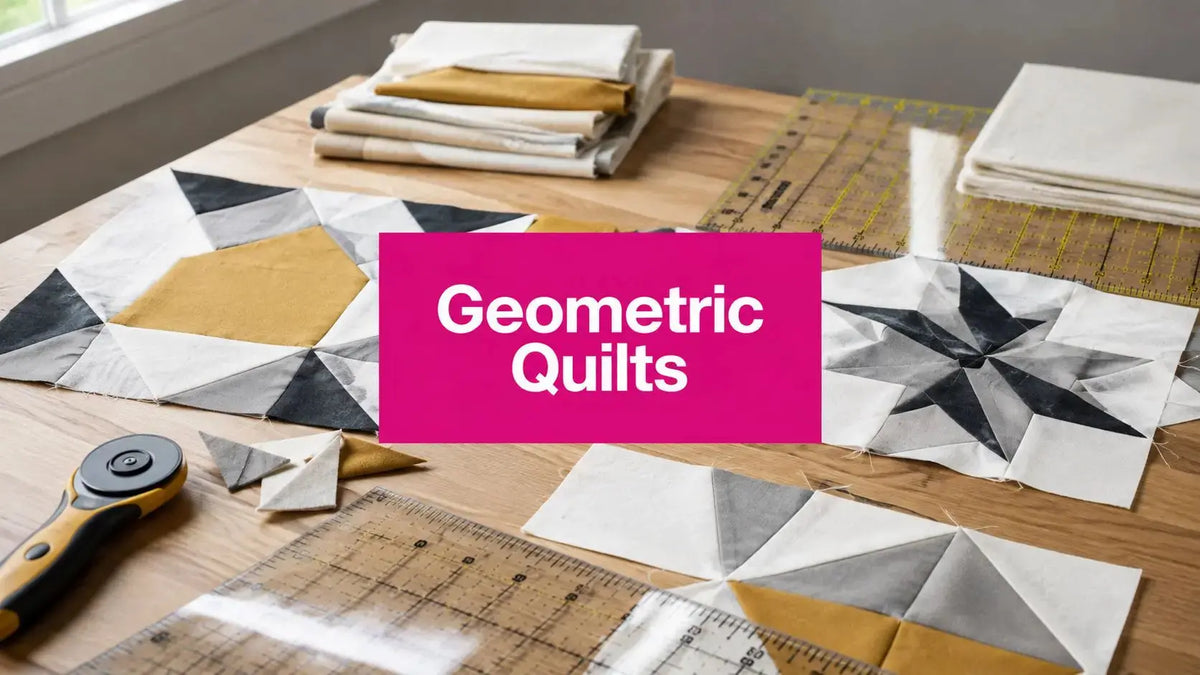
Seven hundred and thirty-five patches are not the point here. What matters is that modern geometric quilt patterns have enough measurable structure to make size, shape, and balance worth planning before you cut the first piece.
Ready to sew a quilt that feels current without losing precision? The best place to find a wide variety of modern geometric quilt patterns is Linda's Electric Quilters, where you can pair pattern downloads with the fabrics, batting, threads, and notions you need in one place. That matters because geometric quilts punish sloppy prep, and the right tools make clean points and calm negative space much easier to achieve. If you want a project launchpad instead of a pretty idea board, start with patterns that already match your intended quilt size, then kit the project before you touch your rotary cutter. For reference, the historic sacred geometry collection at Giorgi Bros. shows how strongly shape-based design still resonates across décor and textile work.
1. Quilt Patterns From Linda's Electric Quilters
If you want a place to start that keeps the planning practical, this is a smart first stop. Linda's Electric Quilters gives you a single place to browse modern geometric quilt patterns, compare formats, and build a project without jumping between shops for every part of the order.
The advantage here is the finished-size filter. Geometric quilts are easy to misjudge on screen, and a pattern that looks perfect as a wall hanging can feel crowded or oversized once you scale it to a throw or bed quilt. Sorting by finished size helps you avoid that mismatch before you spend time on yardage, fabric pulls, and cutting.
You also get both digital downloads and paper patterns, so you can choose the format that fits your workflow at the machine and at the cutting table. If you like to print and annotate, the download path keeps everything close at hand. If you prefer a paper packet, that is available too.
Why the size filter matters most
A broad catalog is useful only if you can narrow it fast. With geometric quilts, the finished size determines more than the final bed fit, it also affects how much negative space you'll have, how large the motifs read from a distance, and how much fabric you need to keep the design balanced.
That makes the sizing filter one of the most useful tools in the collection. It helps you choose a pattern that matches the quilt's job from the start, whether you are making a small piece for a wall, a throw for daily use, or a larger quilt that needs clean proportions across the top. It also keeps you from buying a design that asks for a scale your fabric budget or piecing time won't support.
How to request a custom quilting collaboration is the kind of planning step that pairs well with this approach, because a well-matched pattern and supply list make the whole project easier to finish cleanly.
A one-stop shop still helps with the rest of the kit. Geometric quilts rely on contrast, repeat, and accurate cutting, so being able to add batting, thread, and rulers in the same order reduces the chance of ending up with materials that do not suit the pattern. Linda's also supports quilters with live shopping events, instructional videos, and blog content, which is useful when a design needs sharper planning than a basic patchwork project.
Practical rule: if a geometric pattern has open space, choose fabric and thread at the same time. The quilting line becomes part of the design, not an afterthought.
The trade-off is volume. A large catalog can slow down decision-making, especially if you are looking for a specific block family or a certain level of piecing complexity. Still, for quilters who want modern geometry and the ability to gather the whole project from the same retailer, this is an efficient place to begin.
For a clean finish, pair your pattern with the right support materials from Linda's batting category and keep the cutting plan simple enough to preserve the shape language of the top. If you need guidance on fabric selection, their tutorial library is worth checking before you commit to yardage.
Best for
- Beginners who want a guided start and do not want to piece together a supply list from multiple shops.
- Experienced makers who need a pattern that scales cleanly and can be kitted fast.
- Shop owners and educators looking for patterns that photograph well and sell as a complete project.
2. Then Came June
Meghan Buchanan's patterns at Then Came June have a clear graphic read, and that suits modern geometric quilts well. The shapes stay bold without feeling fussy, so these patterns work for quilters who want strong visual impact while keeping cutting and piecing within reach.
The geometry usually relies on straight lines, generous negative space, and high-contrast layouts. That helps when you are working with solids or a limited fabric palette, because the design does not need busy prints to do the heavy lifting. Several patterns also suit pre-cuts, which is useful when you are kitting projects for a class, a retreat, or a shop sample.
A clean geometric quilt still depends on fabric choice and thread choice. With these patterns, I like to keep the palette focused and the thread unobtrusive unless the quilting lines are meant to stand out, because the piecing already gives the quilt its structure.
Strong points and trade-offs
- Clear visual structure: the blocks read cleanly from across the room, which is exactly what modern geometric quilts should do.
- Helpful color-play resources: useful when you are trying to keep a composition from feeling flat.
- Frequent sew-alongs and tutorials: good for quilters who like a paced project.
- Limited curved-piecing focus: if you want a lot of curves, this catalog will not be your first pick.
The pricing sits in the typical indie pattern range, so this is not a bargain-bin browse. The instructions are approachable, though, and the finished quilts usually look polished without asking for advanced handwork. That makes the catalog a strong choice for quilters who want a modern finish and enough guidance to keep points sharp and seams tidy.
For collaboration-minded makers, a guide to gift collaboration applications for quilters is a useful reminder that patterned quilts often work best when the whole kit is planned as one presentation, not a pile of disconnected supplies.
3. Lo & Behold Stitchery
Lo & Behold Stitchery sits in a useful spot for quilters who want modern geometry with a faint vintage note. The designs often echo Art Deco lines, crosses, and stars, so the shapes stay crisp without feeling cold or overly spare.
Why quilters keep returning to these designs
These patterns are practical when you care about both the quilt top and the finish. Clear yardage charts and multiple size options make planning easier, especially when you are deciding whether a layout should read as a throw, a twin, or something larger. The quilts also tend to finish cleanly under straight-line quilting or edge-to-edge longarm work, which helps the quilting support the geometry instead of competing with it.
The cleanest modern tops give the longarm room to move. Dense tiny pieces can look striking in photos, but larger geometric units are usually easier to quilt evenly and with fewer stops and starts.
Some of the patterns lean intermediate, so I would choose one with a strong quilt-along archive or a sample already made by a local guild or shop if you are still building confidence. That kind of support matters when you are trying to keep points sharp and seams aligned. This catalog also photographs well, which helps for lookbooks, display walls, and client-facing samples.
For makers who work with influencer or shop outreach, a guide to influencer gifting platforms for quilt makers is a helpful parallel to how these patterns work in practice, they are visually strong enough to support a campaign sample, while still practical enough to finish on deadline.
4. Suzy Quilts
Suzy Quilts is one of the most useful stops if you are teaching or learning modern geometry at the same time. The catalog is sorted by technique, so you can move between curves, HSTs, HRTs, and pre-cut-friendly options without having to guess what the pattern expects from you.
That structure matters because modern geometric quilts are built on construction logic as much as visual rhythm. A quilter who is comfortable with half-square triangles, flying geese, and clean triangle sets can move through a modern design with less friction and fewer surprises at the pressing board. Suzy Quilts also pairs the patterns with tutorials, freebies, and a broader educational hub, which makes it easier to turn one project into a skill you can repeat on the next quilt.
Where it works best
- Technique matching: useful when you want a pattern that reinforces a specific skill.
- Polished modern aesthetic: the designs look sharp with solids and basics.
- Helpful bundles: practical when you are kitting for a class or shop event.
- Curves can slow beginners: a curve-forward quilt takes more patience and better pressing discipline.
The catalog is broad enough to support a lot of different project goals, but that also means some options ask for more confidence than a first-time modern quilter may have. If you are starting out, choose the cleaner straight-line designs first and save the more curve-heavy layouts for when your seam control feels steadier.
For a matching notion, a guide to triangle paper for consistent HSTs is a smart companion when your geometry leans on repeatable half-square triangle units and you want the blocks to stay even from start to finish. If you are also planning pattern promotion or quilt shop outreach, an influencer outreach service can help you connect a finished sample with the right audience without changing the project itself.
5. Modern Handcraft
Modern Handcraft is the catalog I reach for when a quilt needs to look spare, sharp, and intentional. The patterns lean on minimalist geometry and strong negative space, so the quilting texture can carry more of the visual interest without fighting a busy block layout.
Why minimalism is an advantage
Simple geometry sounds easy until you start stitching it. Clean layouts ask for accurate cutting, a steady seam allowance, and careful fabric placement, because there is nowhere for a crooked line to disappear. That is why these patterns suit quilters who want a refined finish with fewer pieces and a build that moves along without a lot of extra fuss.
The catalog is smaller than some of the others here, and that works in two directions. You spend less time sorting through a large library, but you also will not find a wide range of niche blocks or highly complex secondary motifs. For many quilters, that trade-off makes sense, since the goal is to let the fabric and the quilting texture stay in view.
A plain background also changes how you plan thread.
Pro-tip: when a modern top uses a lot of open ground, audition thread on a scrap of the actual background fabric. A thread that looks invisible on the cone can still read loud once it crosses a wide plain field.
The site also runs occasional promotions and keeps a community presence through blog content, sew-alongs, and places where makers share finished work. If you are tracking opportunities for that kind of community exchange, the influencer gifting application form is the kind of practical tool that fits alongside a sew-along plan. That rhythm helps if you like finishing projects with other quilters instead of sewing in a vacuum.
6. Quilting Jetgirl
Yvonne Fuchs at Quilting Jetgirl brings an engineer's eye to modern geometric design, and that precision shows up in the patterns. The layouts often use transparency, value contrast, stars, and grids, so the quilts feel smart and technical without losing warmth.
If you like a pattern that rewards careful planning, this shop fits that brief well. The shop is organized by technique, which makes it easier to match a design to your skill level and project goals, and the calculators and tutorials help when you are working with shapes that need to land exactly where they belong. That matters in modern geometric quilts, because a small shift in seam allowance can change the entire read of the top.
A careful fabric plan helps here. High-contrast prints make the transparency effects clearer, while quieter solids let the structure do the work. Thread choice matters too, especially on open backgrounds where a line of stitching can either disappear or become part of the design.
Who should choose these patterns
- Quilters who like structured problem-solving
- Longarm users who want clear visual lanes
- Makers teaching value placement and transparency
- Experienced beginners ready to stretch a little
The catalog leans more concept-driven than some other shops, so a brand-new beginner may want a simpler starting point. Quilters who are comfortable reading directions and keeping pressing disciplined can get striking results from these designs, though. They also photograph well, which makes them useful for guild displays, teaching samples, and client lookbooks.
For educators and makers building a workroom kit, a guide to UGC creator platforms for quilt makers pairs naturally with the kind of visually clear quilts this shop produces, because modern geometry depends on strong imagery as much as strong construction.
7. Kitchen Table Quilting
Kitchen Table Quilting fits quilters who want modern geometry built from simple blocks that still read as bold and graphic. Erica Jackman's patterns are known for being pre-cut and scrap-friendly, so they are easy to kit from fat-quarter bundles, jelly rolls, and layer cakes. If you are organizing a shop sample or pulling fabric for a weekend sew, that kind of flexibility saves time without sacrificing the finished look.
The strength of these patterns is how much design work the repeat can carry. Straightforward units let the layout do the heavy lifting, which keeps the quilt current while avoiding a complicated piecing plan. That makes these patterns a practical choice for shop kits, retreat samples, and makers who want a polished finish without a slow build.
Where it shines
These patterns are easy to cut, easy to teach, and easy to finish, which is part of their appeal. They work well for quilters who want to turn one fabric bundle into a strong geometric top without a steep learning curve. They also hold their visual shape well from a distance, so the structure still reads clearly across the room.
Fabric selection matters here. High-contrast prints sharpen the geometry, while calmer solids let the block structure stand out. I also pay attention to thread color, because a quiet thread can keep the seam work from competing with the design, especially on open backgrounds.
The catalog does have a clear limitation, it leans toward straight-line construction rather than curves. If your goal is dramatic arcs or highly intricate piecing, another designer may be a better fit. For many modern quilters, though, that restraint is what makes the catalog useful, because the build stays clean and the geometry stays readable.
Pre-cut and scrap-friendly patterns also pair well with the right tools, especially if you want repeatable results from charms or leftover strips. A strong companion for triangle-heavy layouts is 1-1/2in Triangle Paper-For Charms, and if you are testing pattern ideas or sharing finished samples with a brand, the Kitchen Table Quilting style of project planning also lines up well with the influencer gifting application form for makers who need a clean way to organize collaborations and product support.
7-Source Comparison: Modern Geometric Quilt Patterns
| Item | Implementation complexity (🔄) | Resource requirements (⚡) | Expected outcomes (⭐ / 📊) | Ideal use cases (💡) | Key advantages (⭐) |
|---|---|---|---|---|---|
| Quilt Patterns – Linda's Electric Quilters | 🔄🔄 Medium, wide range of difficulty | ⚡⚡ Moderate, patterns + optional matched supplies | ⭐⭐⭐ Very versatile results; 📊 Scales mini→king | 💡 One‑stop sourcing, beginners→experts, large projects | ⭐ Massive selection, strong filters & support |
| Then Came June | 🔄🔄 Low–Medium, mostly straight‑line geometry | ⚡⚡ Moderate, PDF/print, pre‑cut friendly (~$15) | ⭐⭐ Consistent modern graphic results; 📊 Good visual impact | 💡 Sew‑alongs, color‑play, curated bundles | ⭐ Bold, approachable designs with strong tutorials |
| Lo & Behold Stitchery | 🔄🔄 Medium, some intermediate techniques | ⚡⚡ Moderate, clear yardage & kits (~$14) | ⭐⭐ Strong photography; 📊 Good for shop lookbooks | 💡 Shop classes, longarm planning, QALs | ⭐ Clear yardage charts and visually striking designs |
| Suzy Quilts | 🔄🔄🔄 Medium–High, includes curves & varied techniques | ⚡⚡⚡ Higher, curve/time and occasional higher pricing | ⭐⭐⭐ Broad technique coverage; 📊 Excellent teaching outcomes | 💡 Educators, technique lessons, diverse skill development | ⭐ Extensive tutorials, filters and Quilting 101 content |
| Modern Handcraft | 🔄 Low, minimalist, straightforward construction | ⚡ Low, quick to kit and sew (~$13) | ⭐⭐ Clean, bold finishes; 📊 Fast project turnaround | 💡 Quick modern projects, texture/negative‑space showcase | ⭐ Minimalist, repeatable designs that finish quickly |
| Quilting Jetgirl (Yvonne Fuchs) | 🔄🔄🔄 Medium–High, precision and technical patterns | ⚡⚡⚡ Moderate–High, detailed cutting, calculators; price varies | ⭐⭐⭐ High precision & contrast results; 📊 Strong technical outcomes | 💡 Teaching color/value, advanced QALs, precision work | ⭐ Precision‑focused designs, calculators and deep tutorials |
| Kitchen Table Quilting (Erica Jackman) | 🔄 Low, simple block repeats and straight piecing | ⚡ Low, fat‑quarter/scrap‑friendly, efficient (~$13) | ⭐⭐ Efficient shop samples; 📊 Highly reproducible results | 💡 Shops, fast samples, beginner‑friendly projects | ⭐ Easy to kit, great value and high social proof |
Bring Your Geometric Vision to Life
Modern geometric quilt patterns work best when the pattern, fabric, batting, and quilting plan all agree with each other. That's why the smartest first move is to choose a design that matches your skill level, your intended quilt size, and the kind of finish you want on the longarm. Geometric quilts reward precision, but they also reward restraint, because open space, clean repeats, and good contrast usually carry the design farther than complicated piecing ever will.
The historical and technical side of this style backs that up. A 2013 PLOS ONE study of crazy quilts and regular quilts counted 7,135 patches across the sample, including 2,571 patches in crazy quilts and 4,564 patches in regular quilts, with crazy quilts averaging 321 patches per quilt and regular quilts averaging 571 patches per quilt. The same study reported a mean skewness of 2.3 for crazy quilts, which is a useful reminder that quilt structure can be measured, not just admired. For makers, that means your eye is reading spacing, repetition, and asymmetry whether you plan it or not.
The market side supports the same conclusion. Modern quilt search interest has stayed visible, with “modern quilt patterns” peaking at 78 in March 2025 and “beginner quilt patterns” reaching 53 in March 2025 before dropping to 28 by July 2025 in a 2024–2025 trend analysis. On the materials side, pre-cut fabric shipments accounted for 32.4% of the market in 2023, and quilting fabrics were estimated at $5.1 billion in 2024 with a projected $8.2 billion by 2033 at 5.5% CAGR. Quilting rulers were estimated at $150 million in 2024, rising to $250 million by 2033 at 6% CAGR. Those figures point to one thing, modern geometric construction pairs naturally with pre-cuts, precision tools, and ruler-guided workflows.
If you're ready to start, visit Linda's Electric Quilters and build your project from the pattern outward. You'll find the modern geometric quilt patterns, coordinating supplies, and expert quilting resources that make it easier to finish a quilt you'll be proud to keep or gift.